
Why Is My AC Blowing Hot Air?
An AC blowing hot air is one of the most frustrating problems a homeowner can face, especially during a sweltering New England summer. When you expect refreshing cold air and get warm air instead, you’re likely wondering what went wrong.
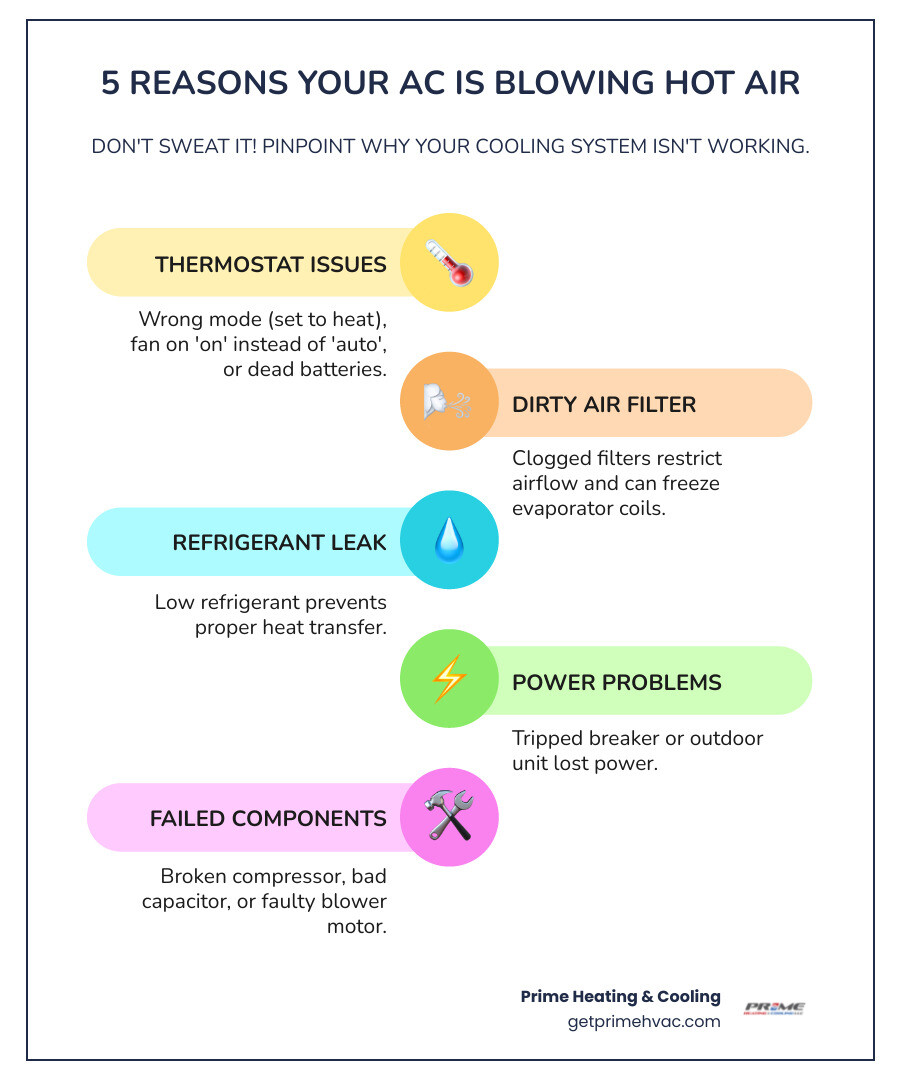
Quick Answer: Top Reasons Your AC Blows Hot Air
- Thermostat Issues – Wrong mode (set to heat), fan on “on” instead of “auto”, or dead batteries
- Dirty Air Filter – Clogged filters restrict airflow and can freeze evaporator coils
- Refrigerant Leak – Low refrigerant prevents proper heat transfer
- Power Problems – Tripped breaker or outdoor unit lost power
- Failed Components – Broken compressor, bad capacitor, or faulty blower motor
Should you turn off your AC? Yes. Running an AC that’s blowing hot air can damage the compressor, leading to more expensive repairs.
Some causes are simple DIY fixes, like adjusting your thermostat or replacing a filter. Others, like refrigerant leaks or electrical problems, require professional help.
I’m Tyler Steiner, founder of Prime Heating & Cooling. With advanced HVAC training from the New England Institute of Technology, I’ve helped hundreds of homeowners diagnose this exact problem. Let’s walk through how to identify the cause and when to call the experts.
How Your Air Conditioning System Creates Cool Air
To understand why your AC is misbehaving, let’s review how it works. An AC doesn’t create cool air; it removes heat from your indoor air and transfers it outside.
Here’s the basic heat transfer process:
- Indoor Unit (Evaporator): The indoor unit pulls warm air over a cold evaporator coil filled with refrigerant. The refrigerant absorbs the heat, and the now-cooled air is circulated back into your home.
- Outdoor Unit (Condenser): The refrigerant, now carrying heat, travels to the outdoor unit. Here, it releases the absorbed heat into the outside air with the help of a fan before cycling back indoors.
This continuous cycle keeps your Rhode Island or Massachusetts home cool. You can learn more about the process of air conditioning on Wikipedia.
The Role of Refrigerant in Cooling
Refrigerant is the lifeblood of your AC. This chemical compound changes from a liquid to a gas at low temperatures, allowing it to absorb heat indoors and release it outdoors.
- Heat Absorption: In the indoor evaporator coil, refrigerant absorbs heat and turns from a liquid into a gas.
- Heat Release: In the outdoor condenser coil, the compressor pressurizes the refrigerant gas, turning it back into a liquid and releasing its heat.
This continuous cycle is crucial for cooling. If your system is low on refrigerant, it can’t absorb enough heat, leading to your AC blowing hot air. A refrigerant leak is a serious issue that needs prompt professional attention. We’ve put together a detailed guide on Refrigerant Leak Repair: Why It’s Critical for Your AC System.
Key Components of Your AC
Each part of your AC system plays a vital role. When one falters, it can lead to your AC blowing hot air:
- Compressor: The “heart” of your AC, located outdoors. It circulates and pressurizes the refrigerant. A failing compressor is a critical cause of hot air.
- Condenser: Also in the outdoor unit, these coils release heat from the refrigerant to the outside air.
- Expansion Valve: Regulates refrigerant flow into the evaporator coil to ensure it’s at the right pressure to absorb heat.
- Blower Motor: Found in the indoor unit, this motor pushes cooled air through your home’s ductwork. A faulty motor means no refreshing breeze.
- Thermostat: Your command center. It tells your AC when to turn on and off. Incorrect settings or a malfunction can cause your AC blowing hot air.
Understanding these components helps you pinpoint potential problems. For more on a crucial component, check out our guide on Understanding AC Compressor Repair: Causes, Costs, and Solutions.
Simple Troubleshooting Steps You Can Do Yourself
When your AC starts blowing hot air, it’s easy to panic. But take a deep breath! Many issues can be resolved with a few simple troubleshooting steps you can perform yourself. This can save you time, money, and the hassle of an unnecessary service call. However, always remember to prioritize safety. If you’re unsure about any step, it’s always best to call a professional. For more advice on what not to do, read our guide on Common Mistakes to Avoid with DIY AC Repair: Expert Advice.

1. Check Your Thermostat Settings
This might seem obvious, but it’s often the simplest culprit when your AC blowing hot air.
- Incorrect Mode: Is your thermostat accidentally set to “Heat” instead of “Cool”? It happens more often than you’d think, especially during seasonal transitions. Double-check that it’s firmly in “Cool” mode.
- Fan Setting: Is your fan set to “On” instead of “Auto”? If the fan runs continuously even when the cooling cycle isn’t active, it will just circulate uncooled air, making it feel like your AC blowing hot air. Switch it to “Auto” so the fan only runs when the compressor is actively cooling.
- Dead Batteries: If your thermostat display is blank or unresponsive, it might just need new batteries. A dead thermostat can’t communicate with your AC system.
- Temperature Setting: Is the desired temperature set lower than the current room temperature? Your AC won’t kick into cooling mode if the room is already at or below your set point.
A malfunctioning thermostat can cause an AC to blow hot air if it’s not accurately sensing temperature or is set incorrectly. Learn more about how to handle this in How a Faulty Thermostat Affects Your AC System: Repair and Solutions.
2. Inspect for a Dirty Air Filter
A dirty air filter is one of the most frequent culprits for an AC blowing hot air. Your air filter is designed to trap dust, pollen, and other airborne particles, keeping your indoor air clean and protecting your AC system. However, a clogged filter becomes a barrier to airflow.
When airflow is restricted:
- The evaporator coil can’t absorb heat efficiently.
- The system has to work harder, increasing energy consumption and potentially leading to higher utility bills.
- In severe cases, restricted airflow can cause the evaporator coils to freeze, as warm air isn’t passing over them to melt any condensation. When coils freeze, they can no longer absorb heat, and you’ll get warm air from your vents.
Signs your air filter is clogged:
- Visible dirt and dust buildup on the filter.
- Reduced airflow from your vents.
- Your AC running for longer cycles than usual.
- Higher energy bills.
- Ice forming on the outdoor unit or refrigerant lines.
- Musty odors from your vents.
How to replace your filter: Most manufacturers recommend changing your air filter every 1-3 months, depending on usage, pets, and indoor air quality. It’s a quick, inexpensive fix that can make a huge difference. Check your owner’s manual for the correct filter size and location. We stress the importance of this simple task in AC Filter Replacement: The Key to Clean and Healthy Indoor Air.
3. Examine the Power and Outdoor Unit
Sometimes, the problem isn’t with the AC unit itself, but with its power supply or immediate surroundings.
- Tripped Circuit Breaker: Your AC system draws a lot of power, and an electrical surge or malfunction can cause its dedicated circuit breaker to trip. Head to your home’s electrical panel and look for a breaker that’s in the “off” or middle position. Flip it firmly to the “off” position, then back to “on.” If it trips again immediately or frequently, don’t keep resetting it; this indicates a more serious electrical issue that needs professional attention.
- Outdoor Unit Power Switch: Many outdoor AC units have a separate shut-off switch located on or near the unit. Ensure this switch is in the “on” position.
- Debris Around Condenser: The outdoor condenser unit needs clear space to dissipate heat effectively. If it’s surrounded by leaves, grass clippings, dirt, or other debris, airflow can be restricted. This traps heat, making your system less efficient and potentially causing your AC blowing hot air. Safely turn off the power to the unit at the circuit breaker, then clear away any obstructions. Trim back any vegetation at least two feet from the unit. This simple cleaning can often restore cooling. For more on maintaining this vital part, see Condenser Coil Repair: Restoring Efficiency of Your Air Conditioner.
When to Call a Professional HVAC Technician
While DIY troubleshooting can resolve many minor issues, some problems are complex, dangerous, or require specialized tools and expertise. Knowing when to call a professional HVAC technician is crucial for your safety and the longevity of your AC system. We’re always here to help in Rhode Island and Massachusetts when you need us. Our guide on When to Call an AC Technician: Signs You Need Professional Repair offers more detailed advice.
Signs of a Refrigerant Leak
If your AC blowing hot air is due to a refrigerant leak, this is not a DIY fix. Refrigerant is a sealed system, meaning it should never need to be “topped off” unless there’s a leak. If levels are low, it means there’s a breach that needs to be located and repaired by a certified professional.
Watch out for these signs:
- Hissing or Bubbling Sounds: These noises often indicate refrigerant escaping from a crack or hole in the lines.
- Oily Residue: You might notice an oily film around the refrigerant lines or on the outdoor unit.
- Sweet Chemical Smell: Some refrigerants have a distinct sweet odor.
- Ice on Lines or Coils: Low refrigerant can cause the evaporator coil to get too cold, leading to ice buildup on the coil or the copper lines.
- Reduced Cooling & Higher Bills: Your system will struggle to cool, leading to longer run times and increased energy costs.
Health Risks of Refrigerant: Refrigerants, particularly older ones like Freon (R-22), can be dangerous. According to the Missouri Poison Center, exposure can lead to coughing, vomiting, dizziness, headaches, and nausea. Federal law prohibits handling AC refrigerant without a license, and technicians must be “Section 608 certified” by the EPA. This is why a professional is essential. If you suspect a leak, turn off your AC immediately and call us for Emergency AC Repair: What to Do When Your Cooling System Breaks Down.
Electrical Issues Beyond a Tripped Breaker
While resetting a tripped circuit breaker is a simple DIY fix, other electrical problems are far more complex and dangerous. These often require a professional with specialized tools and knowledge.
- Faulty Capacitor: Capacitors store and release electrical charges, providing the “kickstart” needed for motors (like the compressor and fan motors) to begin operating. If a capacitor fails, your AC unit might hum but not start, or the fan might not spin.
- Worn Contactor: The contactor is an electrical switch that allows high-voltage power to flow to the outdoor unit’s components. If it’s worn or damaged, it won’t properly deliver power, leading to your AC blowing hot air or not turning on at all.
- Wiring Problems: Loose, frayed, or corroded wiring can disrupt electrical flow, cause components to fail, or even pose a fire hazard.
- Repeatedly Tripping Breaker: If your circuit breaker keeps tripping even after you reset it, this is a clear sign of a serious electrical fault or an overloaded circuit. Do not continue to reset it. This needs immediate professional diagnosis to prevent damage to your system or home.
These electrical components carry high voltage and should only be inspected and repaired by a qualified HVAC technician. Attempting DIY repairs can be extremely dangerous. For fan-related electrical issues, our team can help with AC Fan Repair and Replacement: Fixing Cooling System Airflow Problems.
Major Component Failure: Compressor or Blower Motor
When core components like the compressor or blower motor fail, your AC system effectively grinds to a halt, and you’ll definitely experience AC blowing hot air. These are significant repairs that almost always require professional help.
- Signs of a Failing Compressor:
- The outdoor unit makes a loud, grinding, or banging noise.
- The unit hums but doesn’t start.
- Your AC is blowing warm air, even though the thermostat is set to cool.
- The circuit breaker for the AC unit repeatedly trips.
- The outdoor unit vibrates excessively.
- Contaminants like rust and metal particles can block refrigerant flow in an aging compressor.
- Signs of a Bad Blower Motor:
- No air, or very weak airflow, coming from your vents.
- Loud noises (squealing, grinding, rattling) coming from the indoor unit.
- The indoor unit fan runs, but no cool air is produced.
- The indoor unit smells like burning plastic or electrical components.
Repair vs. Replacement: The average lifespan of an AC unit is typically 10 to 15 years. If your unit is nearing the end of its life and experiences a major component failure like a compressor, the cost of repair might be significant. The cost of an AC compressor alone can range between $800 to $2,800, and the total repair can add up. Sometimes, replacing the entire unit is a more cost-effective solution in the long run, especially considering modern units are much more energy-efficient. Our experts can help you weigh the pros and cons. Find out more about when it’s time to consider a new system in Is It Time for AC Replacement? Signs to Watch For.
How Regular Maintenance Prevents an AC Blowing Hot Air
The best defense against your AC blowing hot air is a good offense: regular, proactive maintenance. Just like your car, your AC system needs consistent care to run efficiently and prevent breakdowns. Regular maintenance not only prolongs the life of your system but also ensures it runs at peak energy efficiency, saving you money on utility bills. We can’t stress this enough for homeowners in Smithfield, Warwick, and across Rhode Island and Massachusetts. Read more about the benefits in The Importance of Regular AC Maintenance: Benefits and Tips and find out about our local services at AC Maintenance RI.
Annual Professional Tune-Ups
We recommend scheduling a professional AC tune-up at least once a year, ideally in the spring before the cooling season begins. During a tune-up, our skilled technicians will:
- Clean Coils: Both evaporator and condenser coils collect dirt and debris over time. Clean coils improve heat transfer, allowing your system to cool more effectively.
- Check Refrigerant Levels: We’ll ensure your refrigerant is at the correct level and inspect for any leaks.
- Inspect Electrical Connections: We’ll tighten any loose connections and check for worn wiring or failing capacitors.
- Clear Drain Lines: The condensate drain line can become clogged with algae or debris, leading to water leaks and potential system shutdowns. We’ll ensure it’s clear and flowing freely.
- Lubricate Moving Parts: Proper lubrication reduces friction and wear on motors and bearings.
- Test Thermostat Calibration: We’ll verify that your thermostat is accurately reading temperatures and communicating correctly with your system.
A comprehensive tune-up helps us catch small issues before they become major, expensive problems that leave you with an AC blowing hot air. For a detailed checklist of what’s included, check out What Happens During an AC Tune-Up? Importance and Checklist.
The Importance of Clean Coils and Ducts
Clean coils and well-maintained ductwork are fundamental to an efficient AC system.
- Evaporator Coil Function: As mentioned, this indoor coil absorbs heat. If it’s covered in grime, it can’t absorb heat effectively, leading to reduced cooling and potentially freezing up.
- Condenser Coil Function: The outdoor coil releases heat. If it’s dirty or obstructed, the heat gets trapped, making your system work harder and less efficiently.
- Ductwork Leaks: Your ductwork is the pathway for cool air. If there are leaks, holes, or poor connections in your ducts, that precious cool air can escape into unconditioned spaces (like your attic or basement) before it reaches your living areas. This means your AC runs longer, consuming more energy, and you still end up with uneven cooling or an overall warm house, even if the air coming out of the vents feels cool.
- Uneven Cooling: Duct leaks or blockages can lead to some rooms being perfectly cool while others remain stubbornly warm. This is a common complaint we hear from homeowners in Smithfield and Providence.
Regular cleaning of coils and inspection of ductwork are critical. While you can clear debris from around the outdoor unit, internal coil cleaning and duct inspections are best left to professionals. Our team is skilled in Ductwork Repair and Replacement: Improving Airflow and Energy Efficiency.
Frequently Asked Questions about ACs Blowing Hot Air
We get a lot of questions about why ACs blow hot air, and we’re always happy to provide clear answers. Here are some of the most common ones:
How much does it cost to fix an AC that’s blowing hot air?
The cost to fix an AC blowing hot air varies widely by issue. Based on industry statistics, the typical range for AC repairs is between $150 to $600.
- Simple Fixes (Lower End): DIY fixes like changing a filter cost next to nothing. A basic service call for a technician to check settings is typically $75-$150.
- Mid-Range Repairs: Fixing a clogged condensate drain line, replacing a faulty capacitor, or cleaning dirty coils can fall into the $150 to $400 bracket.
- Complex Repairs (Higher End): A refrigerant leak repair can cost $200 to $600 or more, while a new blower motor might range from $400 to $800.
- Major Component Replacement: Replacing a compressor is one of the most expensive repairs, often costing $800 to $2,800 or more. For older units, a full AC replacement ($3,900 to $8,000) may be more cost-effective.
It’s always best to get a professional diagnosis and a clear quote before proceeding with any significant repairs. For a comprehensive overview of repair costs, consult The Ultimate Guide to Air Conditioning Repair: Everything You Need to Know.
Should I turn off my AC if it is blowing warm air?
Yes, absolutely. If your AC is blowing hot air, you should turn it off immediately. Continuing to run a malfunctioning AC unit can cause more severe damage, especially to the expensive compressor, and lead to frozen coils or safety hazards.
Why is my AC running but the house is still hot?
This is a frustrating scenario. If your AC runs but the house stays hot, especially in areas like Smithfield or Lincoln, several factors could be at play:
- Insufficient Insulation: Poor insulation allows cool air to escape and hot air to seep in, forcing your AC to work constantly without catching up.
- Air Leaks in the Home: Gaps around windows, doors, and electrical outlets can allow cool air to escape and warm air to enter. Sealing these leaks can make a big difference.
- Leaky Ductwork: As discussed, if your ducts have cracks or disconnections, a significant portion of your cooled air might be lost before it ever reaches your living spaces.
- Undersized AC Unit: If your AC unit is too small for your home’s square footage, it will constantly run but never be able to adequately cool the space.
These issues prevent your AC from effectively distributing or retaining cool air, even if the unit itself is functioning. Our team can help you understand and fix Understanding Airflow Issues: Fixing Uneven Cooling in Your Home.
Get Your Cool Air Back with Expert Help
Dealing with an AC blowing hot air can turn a beautiful summer day in Rhode Island or Massachusetts into a sweaty, miserable experience. While some basic troubleshooting steps can often resolve minor issues, recognize when a professional touch is needed. Attempting complex repairs yourself can be dangerous and lead to further damage, costing you more in the long run.
At Prime Heating & Cooling, we understand the urgency of a broken AC, especially during peak heat. With over 20 years of experience serving communities like Smithfield, Warwick, East Greenwich, Providence, and North Providence, we offer reliable, energy-efficient solutions delivered by skilled technicians. Our commitment to a customer-first approach, combined with 24/7 availability for emergencies, means you can trust us to get your cool air back quickly and efficiently.
Don’t sweat through another hot day. If your AC is still blowing hot air after trying the basic troubleshooting steps, or if you suspect a more serious issue like a refrigerant leak or major component failure, it’s time to call in the experts.
Schedule expert HVAC services in RI today, and let us bring comfort back to your home.