Should You Repair or Replace Your Furnace? Here’s How to Decide
Repair vs replace furnace is one of the most stressful decisions a homeowner can face — especially when it happens in the middle of a New England winter.
Here’s a quick answer to help you decide:
| Situation | Recommendation |
|---|---|
| Furnace is under 10 years old, minor issue | Repair |
| Furnace is 10-15 years old, moderate repair needed | Evaluate using the 50% rule |
| Furnace is 15+ years old, major repair needed | Replace |
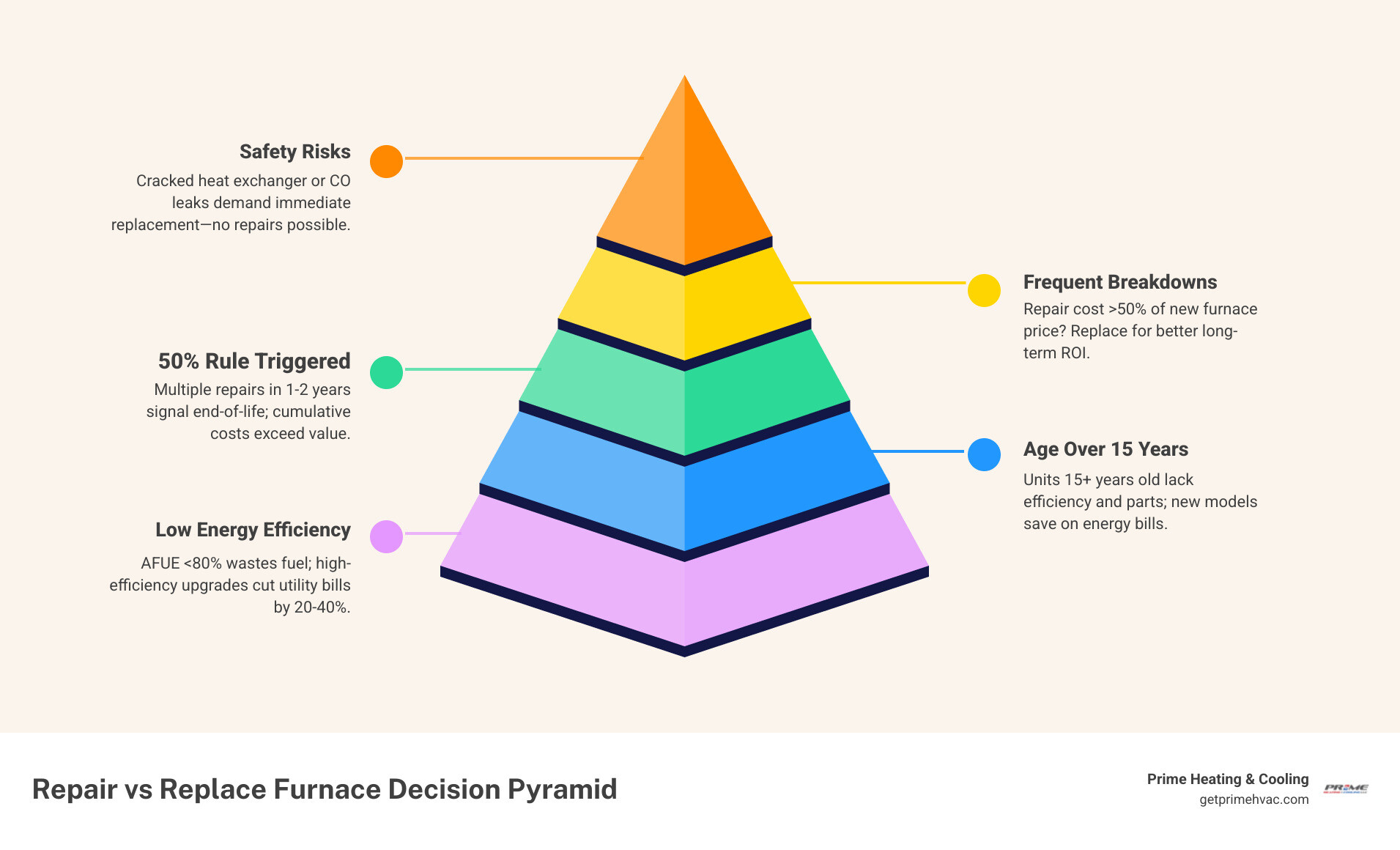
| Repair cost exceeds 50% of a new furnace price | Replace |
| Cracked heat exchanger detected | Replace immediately |
| Frequent repairs in the past 1-2 years | Replace |
The 50% rule is the simplest guideline: if a repair costs more than half the price of a new furnace installation, replacement is almost always the smarter financial move.
But cost isn’t the only factor. Age, energy efficiency, safety, and even your plans to sell your home all play a role.
This guide walks you through every factor — clearly and without guesswork — so you can make a confident decision.
I’m Tyler Steiner, CEO and founder of Prime Heating & Cooling, and after years of helping New England homeowners navigate the repair vs replace furnace decision, I’ve seen how the right choice can mean the difference between years of reliable heat and a cycle of costly, frustrating breakdowns. Let’s break it all down so you know exactly where you stand.
Evaluating the Repair vs Replace Furnace Financial Framework
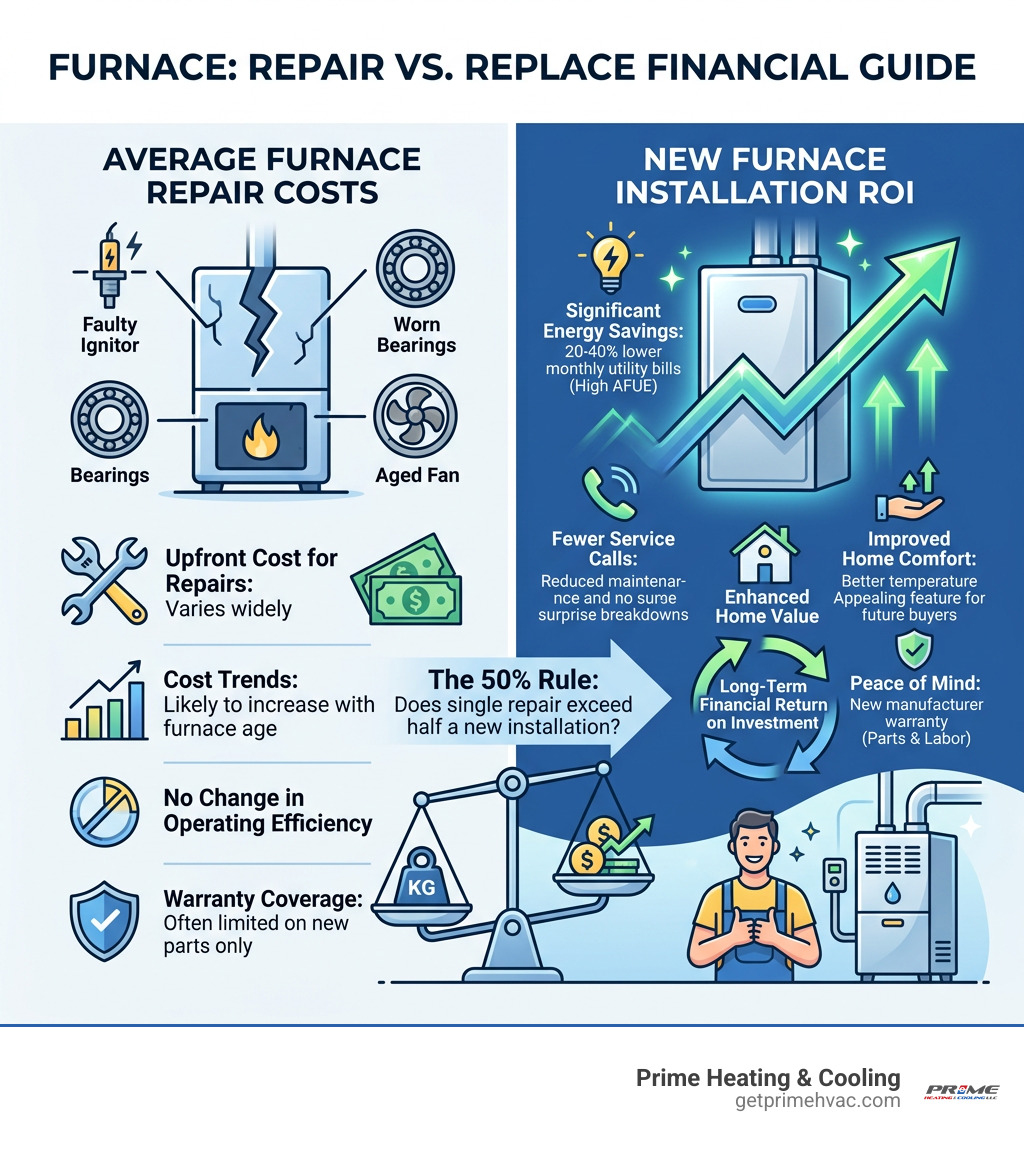
When your furnace stops blowing warm air in the middle of a cold January night in Warwick or Scituate, your first instinct might be to “just fix it.” However, looking at the long-term financial picture is essential. A furnace isn’t just a box in your basement; it’s an investment in your home’s infrastructure.
To determine if you should keep patching up your current unit or invest in a new one, we look at the Return on Investment (ROI). While a repair has a lower upfront cost, a new installation offers lower monthly utility bills, fewer service calls, and the peace of mind that comes with a fresh manufacturer warranty.
Applying the 50% Rule to Your Repair vs Replace Furnace Decision
In the HVAC industry, we swear by the “50% Rule.” It’s a straightforward mathematical approach: if the cost of a single repair is 50% or more of the cost of a brand-new furnace, you should replace it. For example, if you are looking at a $2,800 repair on an older unit and a new, high-efficiency furnace costs $5,500, the repair simply doesn’t make financial sense.
Beyond the 50% rule, consider the “Repair multiplied by Age” formula. Some experts suggest that if the age of the furnace multiplied by the repair cost exceeds $5,000, it’s time to go shopping. For instance, a $500 repair on a 12-year-old furnace equals $6,000—well over the threshold.
You should also keep a close eye on your “repair trail.” furnace repair costs can add up quickly. If you’ve had two or three significant repairs (costing $500 or more each) in the last two years, your furnace is telling you that its internal components are reaching the end of their mechanical life. Sinking more money into short-term fixes on a 15-year-old system is often like throwing good money after bad.
Critical Signs That Signal an Immediate Replacement
While some decisions are based on math, others are based on safety. There are certain “red alert” failures where we almost always recommend replacement over repair, regardless of the 50% rule.
The most serious of these is a cracked heat exchanger. The heat exchanger is the component that separates the combustion process (the fire and fumes) from the air being circulated into your living spaces. If this metal component cracks, it can leak carbon monoxide (CO) into your home. Carbon monoxide is a colorless, odorless, and potentially fatal gas. Because replacing a heat exchanger is equally labor-intensive to installing a whole new furnace, and because a crack often signals that the rest of the unit is soon to follow, we strongly advise a full system replacement for safety and value.
Other “red alert” signs include:
- A Yellow Pilot Light: A healthy furnace flame should be crisp and blue. A flickering yellow flame suggests improper combustion and potential CO leaks.
- Excessive Soot or Rust: If you see soot around the registers or rust flakes on the floor around the unit, the system is corroding from the inside out.
- Strange Noises: Banging, screeching, or rattling often points to a failing blower motor or an inducer motor that is about to seize.
How Energy Efficiency and AFUE Ratings Influence the Choice
If your furnace was installed 15 to 20 years ago, it likely has an AFUE rating (Annual Fuel Utilization Efficiency) of around 60% to 70%. This means that for every dollar you spend on gas or oil, 30 to 40 cents is literally going up the chimney as wasted energy.
Modern high-efficiency furnaces have an AFUE rating of 90% to 98.3%. Upgrading from an old 70% AFUE unit to a 95% AFUE model can save you approximately $40 a month on heating bills. Over the 15-to-20-year lifespan of the unit, those savings can total over $4,000—nearly paying for the furnace itself!
When deciding between repair vs replace furnace, don’t just look at the repair bill; look at your monthly gas or oil statements. If your bills have been steadily climbing despite regular maintenance, your furnace has lost its ability to convert fuel into heat efficiently.
Long-Term Considerations for Rhode Island Homeowners
Living in Rhode Island—from the coastal breezes of East Greenwich to the woods of North Scituate—means our heating systems work harder than those in many other parts of the country. Our winters are damp and cold, putting significant strain on mechanical parts.
The Role of Age and Warranty in Your Repair vs Replace Furnace Strategy
Age is perhaps the most honest indicator of a furnace’s future. Most gas furnaces are designed to last between 15 and 20 years. If your system is in the “bonus round” (over 20 years old), it is a ticking time bomb. Even if it’s running today, the likelihood of a total failure on the coldest night of the year is high.
Warranty status is a major “swing” factor in the repair vs replace furnace debate. Most manufacturers offer a 5-to-10-year warranty on parts. If your furnace is 8 years old and a major component fails, the part might be covered, leaving you only with the labor costs. This makes repair a very attractive option. However, if the warranty has expired, you are responsible for the full cost of expensive parts like the circuit board ($750–$1,300) or the variable-speed blower motor ($1,700–$2,000). At that point, the “financial logic” usually shifts toward replacement.
Impact on Home Value and Future Sale Plans
Are you planning to sell your home in Providence or Lincoln in the next few years? A brand-new, high-efficiency heating system is a massive selling point. Prospective buyers are often wary of “big-ticket” items like an old roof or a 20-year-old furnace. By replacing the unit now, you enjoy the comfort and lower bills for a few years, and you increase the marketability of your home when it’s time to list.
Furthermore, there has never been a better time to upgrade thanks to federal and local incentives. The Inflation Reduction Act provides significant tax credits (up to 30% of project costs) for installing high-efficiency equipment. When you combine these federal credits with local utility rebates, the net cost of a new furnace becomes much more manageable.
Consulting a Professional for a Final Assessment
The best way to resolve the repair vs replace furnace dilemma is to get an expert diagnostic. At Prime Heating & Cooling, we’ve spent 20 years serving homeowners across Rhode Island, from Johnston to Smithfield and beyond. We don’t believe in high-pressure sales; we believe in providing the facts so you can make the best choice for your family.
Our technicians can perform a combustion analysis, check the integrity of your heat exchanger with specialized cameras, and give you an honest assessment of your system’s remaining life. Whether you need a precision repair to get through the season or comprehensive HVAC installation services, we are here 24/7 to ensure your home stays warm and safe.
Don’t wait for a total breakdown in the middle of a blizzard. If your furnace is making noise, smelling strange, or driving up your bills, contact us today for a professional assessment. We’ll help you weigh the costs, evaluate the efficiency gains, and find a solution that fits your budget and your home.