

Why Understanding Ducted Heat Pump Installation Cost Matters for New England Homeowners
Ducted heat pump installation cost is a key factor for homeowners upgrading their HVAC. Here’s what you need to know upfront:
Average Ducted Heat Pump Installation Cost:
| Home Size | System Size | Standard Model Cost | Cold-Climate Model Cost |
|---|---|---|---|
| 1,200–1,800 sq ft | 2–2.5 tons | $8,500–$15,000 | $10,500–$17,500 |
| 1,800–2,500 sq ft | 3–3.5 tons | $11,500–$19,500 | $13,500–$22,500 |
| 2,500–3,500+ sq ft | 4–5 tons | $15,000–$25,000+ | $18,000–$30,000+ |
What’s Included:
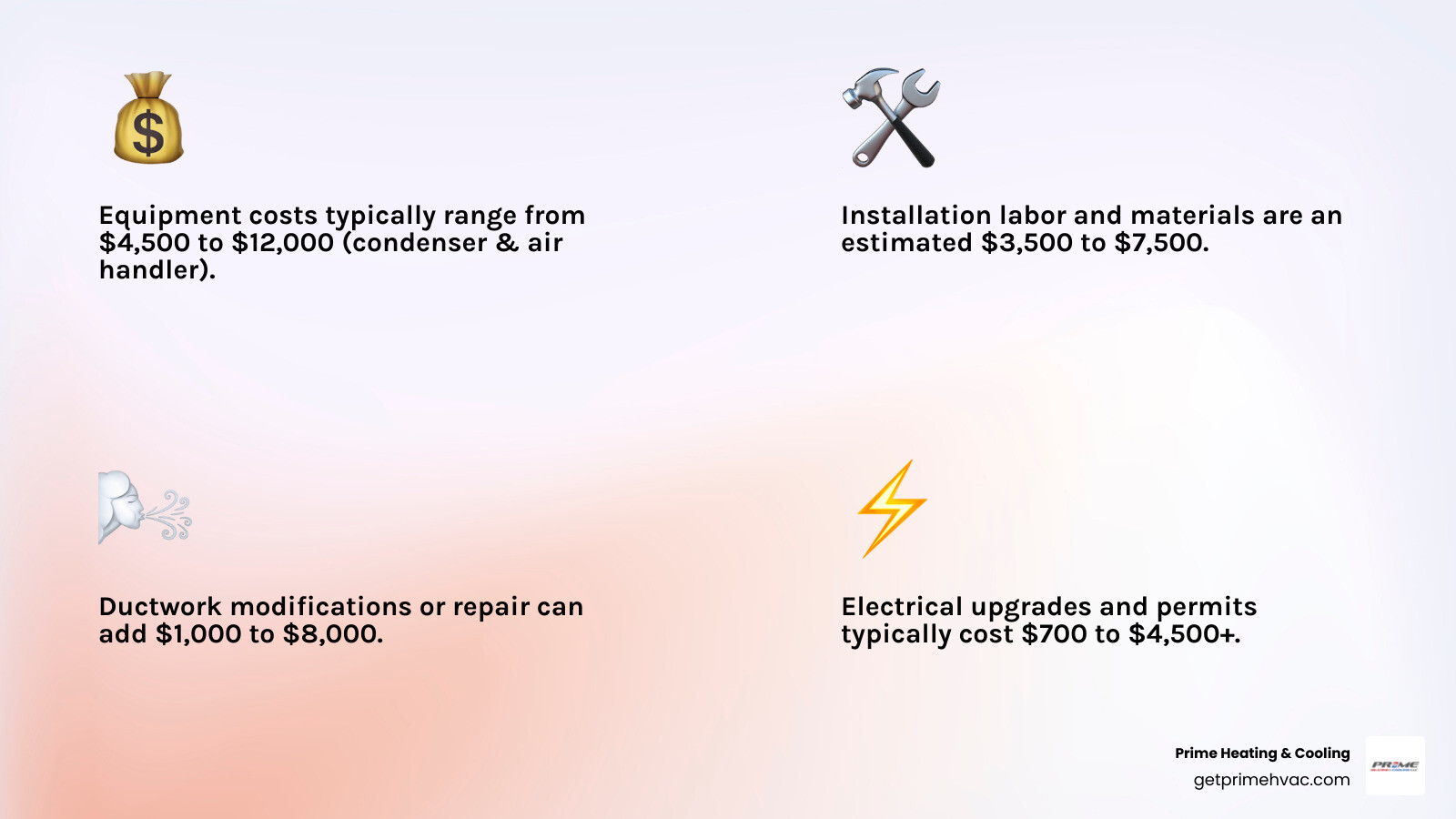
- Equipment (condenser + air handler): $4,500–$12,000
- Installation labor and materials: $3,500–$7,500
- Ductwork modifications: $1,000–$8,000
- Electrical upgrades: $500–$3,500+
- Permits and commissioning: $200–$1,000
Ducted heat pumps provide year-round comfort in one efficient system. Instead of creating heat, they move it, making them highly energy-efficient. In winter, they pull heat from the outdoors inside, and in summer, they reverse the process to cool your home.
For New England homeowners, this investment is particularly smart. It’s a key strategy for cutting residential greenhouse gas emissions. Modern cold-climate models work efficiently even in freezing temperatures, making them ideal for Rhode Island and Massachusetts winters.
The total cost varies by home size, ductwork condition, and system efficiency. Significant duct or electrical work increases the price. However, federal tax credits (up to $2,000) and state rebates (over $10,000 in MA) can dramatically lower your out-of-pocket cost.
I’m Tyler Steiner, founder of Prime Heating & Cooling. Our team helps New England homeowners steer ducted heat pump installation cost with professional assessments and transparent pricing. We specialize in right-sizing systems for our climate, ensuring you get maximum efficiency without overpaying.
Understanding the Full Ducted Heat Pump Installation Cost
When considering a ducted heat pump in Rhode Island or Massachusetts, the true ducted heat pump installation cost goes beyond the equipment price. It reflects the total cost of ownership, including labor, upgrades, and permits. We provide transparent pricing so you understand every component of your investment. Our goal is to avoid surprise costs by providing a clear picture from the start. A comprehensive assessment identifies all expenses and tailors a solution to your home. This investment leads to long-term utility savings. More info about energy efficient systems.
Equipment vs. Labor: A Detailed Cost Breakdown
The overall ducted heat pump installation cost breaks down into two main categories: equipment and labor.
The equipment price (outdoor condenser and indoor air handler) ranges from $4,500 to $12,000. This varies by brand, efficiency (SEER2/HSPF2), and capacity (tonnage). High-efficiency, cold-climate models are at the higher end of this range.
Installation labor and materials add $3,500 to $7,500 to the cost. This covers skilled work like connecting refrigerant lines and electrical components. Professional installation is critical for performance and longevity; improper setup leads to inefficiency and breakdowns. Our technicians in Johnston, Warwick, and Smithfield ensure every installation meets the highest standards.
The Price of Ductwork: Modifications and Replacement
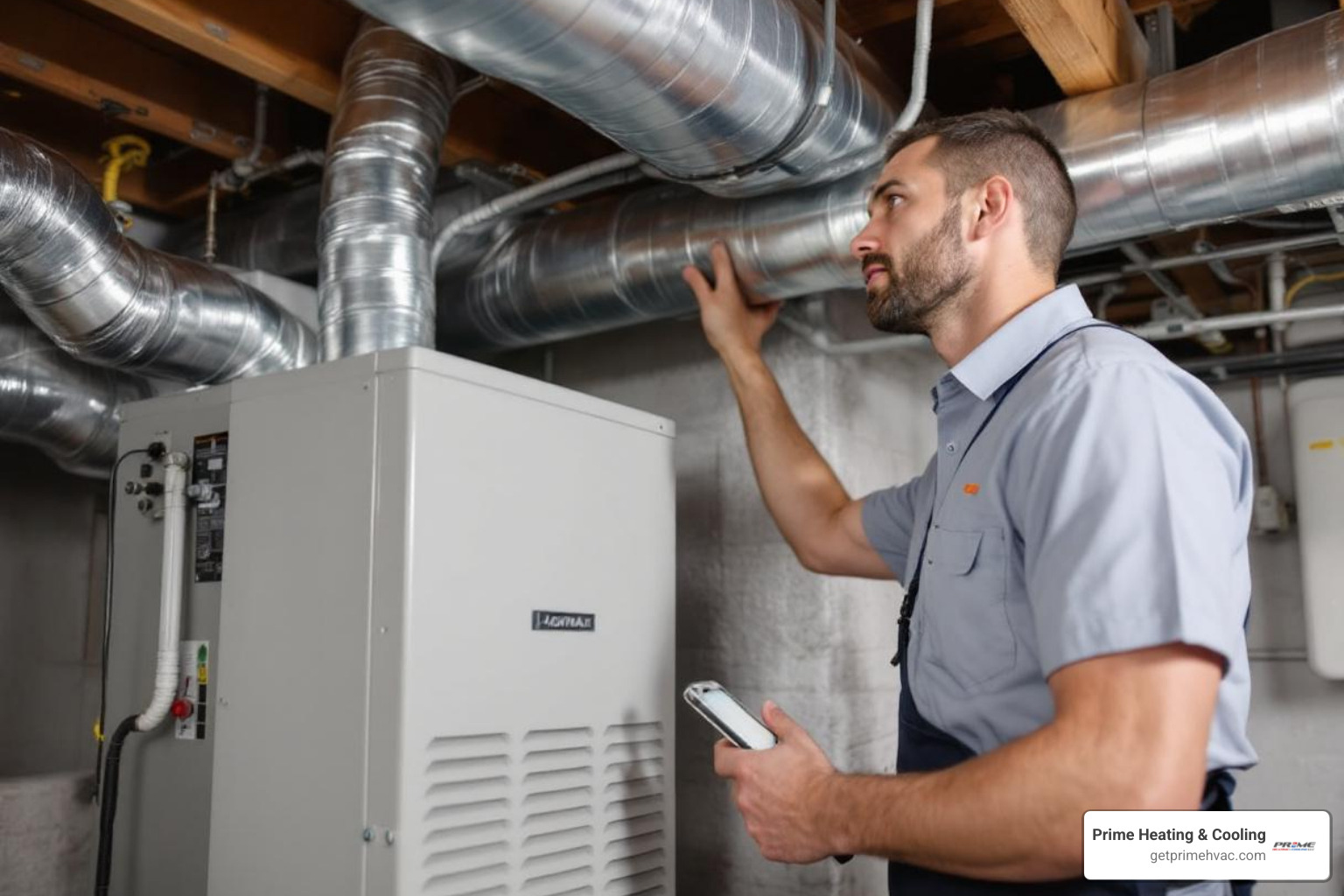
Your existing ductwork’s condition is critical, directly impacting efficiency and the ducted heat pump installation cost. Older homes in our area often have leaky, poorly sized, or insulated ducts.
We perform a thorough ductwork inspection before installation. Leaks can cause up to 30% energy loss, so sealing them is a wise investment. Costs for duct modifications range from $1,000 to $8,000, depending on the work needed, from minor repairs to full replacement.
We also assess return air improvements, as many older homes lack sufficient return ducts, which can reduce a new heat pump’s efficiency. A full replacement vs. modification decision may be necessary. While more expensive, a full replacement can drastically improve efficiency if existing ducts are compromised. Proper ductwork is crucial for comfort and energy savings.
Additional System Upgrade Costs
Other upgrades often contribute to the total ducted heat pump installation cost, ensuring your new system operates safely and efficiently.
Electrical upgrades are common in older homes. A heat pump needs a dedicated 220-volt circuit, and you may need a panel upgrade to a 200 amp service. These upgrades can cost $500 to $3,500+, depending on the work required.
Thermostat upgrades to smart, programmable models optimize performance and energy management, though this can add to the cost.
Finally, permits and commissioning ($200–$1,000) are essential. These fees cover local permits and professional system calibration to ensure your heat pump operates at peak efficiency from day one.
Key Factors That Influence Your Final Price
The average ducted heat pump installation cost is a starting point, but there’s no single price. Every home in North Smithfield, Franklin, or Smithfield is unique. Our detailed assessment accounts for all variables to give you an accurate quote.
We perform a precise ACCA Manual J load calculation to determine your home’s exact heating and cooling needs, considering factors like insulation, windows, and layout. This ensures the system is perfectly sized for your home-specific needs, preventing issues from improper sizing. Getting contractor quotes after this assessment is the best way to determine your true investment.

Home Size and System Capacity (Tons)
Your home’s size is a primary driver of system sizing and the ducted heat pump installation cost. Capacity is measured in “tons” (1 ton = 12,000 BTUs/hour), with larger homes needing higher-tonnage units.
The price per ton is typically $4,000–$7,000 for standard models and $5,000–$8,500 for cold-climate models. A larger system will cost more.
Proper sizing is crucial. Oversizing vs. undersizing issues both cause problems. An oversized unit short-cycles, wasting energy and causing uneven temperatures. An undersized unit runs constantly without reaching the desired temperature. Our team conducts a detailed load calculation to determine the precise BTUs needed for your home, ensuring optimal comfort and efficiency. More info about professional HVAC installation.
Average Ducted Heat Pump Installation Cost by Home Size
Your home’s square footage directly affects the system capacity and the ducted heat pump installation cost. Here’s a general breakdown for homeowners in Rhode Island and Massachusetts, reflecting total installed costs. These are averages; your specific cost will depend on a detailed home assessment.
-
Small homes (1,200–1,800 sq ft): Typically need a 2–2.5 ton system. A standard model costs $8,500–$15,000, while a cold-climate model runs $10,500–$17,500.
-
Mid-size homes (1,800–2,500 sq ft): Usually require a 3–3.5 ton system. A standard unit costs $11,500–$19,500, and a cold-climate model costs $13,500–$22,500.
-
Large homes (2,500–3,500+ sq ft): Often need a 4–5 ton system or larger. A standard model can be $15,000–$25,000+, while a cold-climate model can be $18,000–$30,000+.
Climate and System Type: Standard vs. Cold-Climate
New England’s regional climate differences impact which ducted heat pump is best and the final ducted heat pump installation cost. Our chilly winters make the choice between standard models and cold-climate heat pumps (CCHPs) critical.
Standard heat pumps work well in moderate climates but lose efficiency below freezing, requiring more backup heat in our region and increasing operating costs.
Cold-climate heat pumps (CCHPs) are engineered with advanced technology to maintain heating capacity at very low temperatures, often down to 0°F and even below -15°F. This superior low-temperature performance makes them a far more efficient choice for homes in Lincoln, Coventry, or Franklin. While the upfront ducted heat pump installation cost for CCHPs is higher, their long-term energy savings and consistent comfort often justify the investment.
Many homeowners opt for auxiliary or backup heating systems even with CCHPs. Options include electric resistance heat strips or dual-fuel systems, which pair a heat pump with a gas furnace. The furnace takes over in extreme cold, providing a robust and cost-effective solution for our climate. This pairing balances efficiency with reliability, ensuring your home stays warm all winter.
Efficiency Ratings and Brand Tiers
When evaluating ducted heat pump installation cost, look at two key efficiency ratings: SEER2 for cooling and HSPF2 for heating. Higher numbers mean greater efficiency.
Units with higher SEER2 and HSPF2 ratings consume less electricity, leading to lower utility bills. Many also earn ENERGY STAR certification by meeting strict EPA guidelines.
The trade-off is simple: higher efficiency equals higher upfront cost. A high-efficiency unit has a greater initial ducted heat pump installation cost but offers substantial long-term savings, using 40%–60% less electricity than traditional electric heaters.
The brand tiers also play a role:
- Economy: Affordable with basic features.
- Mid-tier: A good balance of cost, efficiency, and features.
- Premium: Top-of-the-line efficiency, features, and quiet operation. Costs can exceed $20,000 for large homes.
Finally, consider the warranty impact. Reputable brands offer comprehensive warranties (e.g., 10 years on compressor, 5 on parts) that protect your investment. We only work with trusted brands that stand behind their products.
Savings, Benefits, and Long-Term Value
Investing in a ducted heat pump is more than an upfront expense; it’s an investment in your home’s comfort, efficiency, and value. Beyond the initial ducted heat pump installation cost, the benefits in return on investment (ROI), lower utility bills, environmental benefits, and improved home comfort are substantial.
Modern heat pumps move heat instead of generating it, dramatically reducing electricity use. This lowers your bills and your carbon footprint. You’ll also enjoy precise temperature control and quiet operation for superior comfort.
Calculating Operating Costs and Payback
A ducted heat pump’s potential for significant energy savings directly impacts your annual operating costs. They are remarkably efficient, delivering 2–4 units of heat for every unit of electricity consumed.
To understand potential savings, consider annual kWh usage and compare it to other heating sources:
| Fuel Type | Heating Cost per MMBtu (approx.) |
|---|---|
| Ducted Heat Pump | ~$15.6 |
| Natural Gas Furnace | ~$15.8 |
| Propane Furnace | ~$28.8 |
| Fuel Oil Furnace | ~$34.0 |
| Electric Resistance Heat | ~$46.9 |
As the table shows, ducted heat pumps are competitive with natural gas and far cheaper to run than propane, oil, or electric resistance heat. The National Renewable Energy Laboratory (NREL) reports median annual savings of $300–$650, and over $1,000 when replacing inefficient systems. A report from the National Renewable Energy Laboratory details these savings.
The payback period can be surprisingly short. When you factor in rebates and tax credits, your investment could pay for itself in as little as 8 years, making the ducted heat pump installation cost a smart long-term financial decision.
How to Save on Your Ducted Heat Pump Installation Cost
While the initial ducted heat pump installation cost can seem high, numerous incentives can make it more affordable:
-
Federal Tax Credits: The 2022 Inflation Reduction Act offers a federal tax credit for air-source heat pumps of 30% of project costs, up to $2,000, for qualifying ENERGY STAR models. Federal tax credits for heat pumps provides more details.
-
State and Utility Rebates: Massachusetts residents can get up to $10,000 in rebates through programs like Mass Save, and Rhode Island also offers strong incentives. Find local programs on the Database of State Incentives for Renewables & Efficiency. Database of State Incentives for Renewables & Efficiency
-
Financing Options: We offer flexible financing options, including low monthly payments, to make the upfront ducted heat pump installation cost more manageable.
-
Off-Season Installation: Scheduling your installation during the off-season (fall or spring) can sometimes lead to discounts.
By combining these strategies, you can significantly reduce the net cost of your ducted heat pump.
Lifespan, Maintenance, and Home Value
Understanding the long-term value of your ducted heat pump includes its lifespan, maintenance, and impact on home value.
A well-maintained ducted heat pump has an expected lifespan of 12–18 years. Regular maintenance is crucial for longevity and efficiency. Annual maintenance costs are typically $150–$300 for tasks like filter changes and system checks. We offer maintenance plans to keep your system in top shape. More info about HVAC maintenance.
You may face repair vs. replace decisions. If your unit is over 10-15 years old and needs frequent repairs, replacing it is often more cost-effective than continued fixes, especially given the efficiency of new models.
Finally, a ducted heat pump can increase your home value. Energy-efficient upgrades are attractive to buyers, signaling a well-maintained home with lower utility bills and providing a strong return on your ducted heat pump installation cost.
Frequently Asked Questions about Ducted Heat Pump Costs
Here are answers to common questions we get from homeowners in Rhode Island and Massachusetts about ducted heat pumps:
Can a ducted heat pump replace my furnace entirely in a cold climate like Rhode Island or Massachusetts?
Yes, a properly sized cold-climate model (CCHP) can often replace your furnace entirely, even in New England. These advanced units are designed to maintain heating capacity in freezing temperatures.
However, many homeowners opt for backup heat strips or a dual-fuel system (pairing the heat pump with a furnace) as a safety net for the absolute coldest days. The furnace takes over in extreme cold, ensuring comfort. Professional sizing is critical, and our experts will recommend the best configuration for your home.
Will my existing ductwork be compatible with a new heat pump?
Often yes, but an evaluation is required. Existing ductwork must be professionally evaluated to ensure it’s compatible with a new heat pump.
Older ducts often have leaks, which duct leakage testing can identify. Static pressure issues can also arise if ducts are undersized for modern airflow needs. Insufficient return air is another common problem, as return duct sizing is critical for performance.
Sealing and modifications are common and may involve fixing leaks or resizing sections. While this adds to the ducted heat pump installation cost, it’s essential for efficiency and comfort. Our technicians will determine what modifications are needed.
What are the main downsides of a ducted heat pump?
While beneficial, ducted heat pumps have a few potential downsides:
-
Higher Upfront Cost: The initial ducted heat pump installation cost is generally higher than for traditional systems, especially for high-efficiency models or if duct/electrical upgrades are needed. This is often offset by long-term savings and rebates.
-
Performance in Extreme Cold: Even cold-climate models can lose efficiency in sub-zero temperatures (e.g., below -15°F) without a backup source. This is why backup heat is recommended in New England.
-
Need for Electrical Upgrades: A new heat pump may require a dedicated circuit or a panel upgrade, adding to the ducted heat pump installation cost, especially in older homes.
-
Installation Quality is Critical: Performance and longevity depend heavily on proper installation. Poor work leads to inefficiency and breakdowns, making it vital to choose an experienced HVAC contractor like Prime Heating & Cooling.
Despite these points, for most homeowners in our area, the long-term savings, environmental benefits, and superior comfort make a ducted heat pump a smart investment.
Get a Precise Quote for Your Home
As we’ve explored, ducted heat pump installation cost is influenced by a variety of factors, from your home’s size and existing infrastructure to the specific type of system and local climate. While the initial investment might seem significant, a ducted heat pump is a smart investment that delivers long-term savings and unparalleled comfort year-round.
The final cost of your ducted heat pump system will depend on a professional, on-site assessment of your home. We understand that every home in East Greenwich, Johnston, Smithfield, or any of our service areas has unique needs, and a one-size-fits-all approach simply doesn’t work.
For an expert evaluation and accurate quote in Rhode Island or Massachusetts, trust the experienced team at Prime Heating & Cooling. We’ll assess your home’s specific requirements, discuss your comfort goals, and provide a transparent breakdown of your ducted heat pump installation cost, including all potential rebates and financing options. Let us help you open up the benefits of efficient, reliable heating and cooling. Get your heating installation estimate today.


