
Is It Time for an AC System Upgrade? Here’s What You Need to Know
An AC system upgrade means replacing your existing air conditioner with a newer, more efficient unit — and it’s one of the smartest investments a homeowner can make for long-term comfort and lower energy bills.
Quick answer: When should you upgrade your AC?
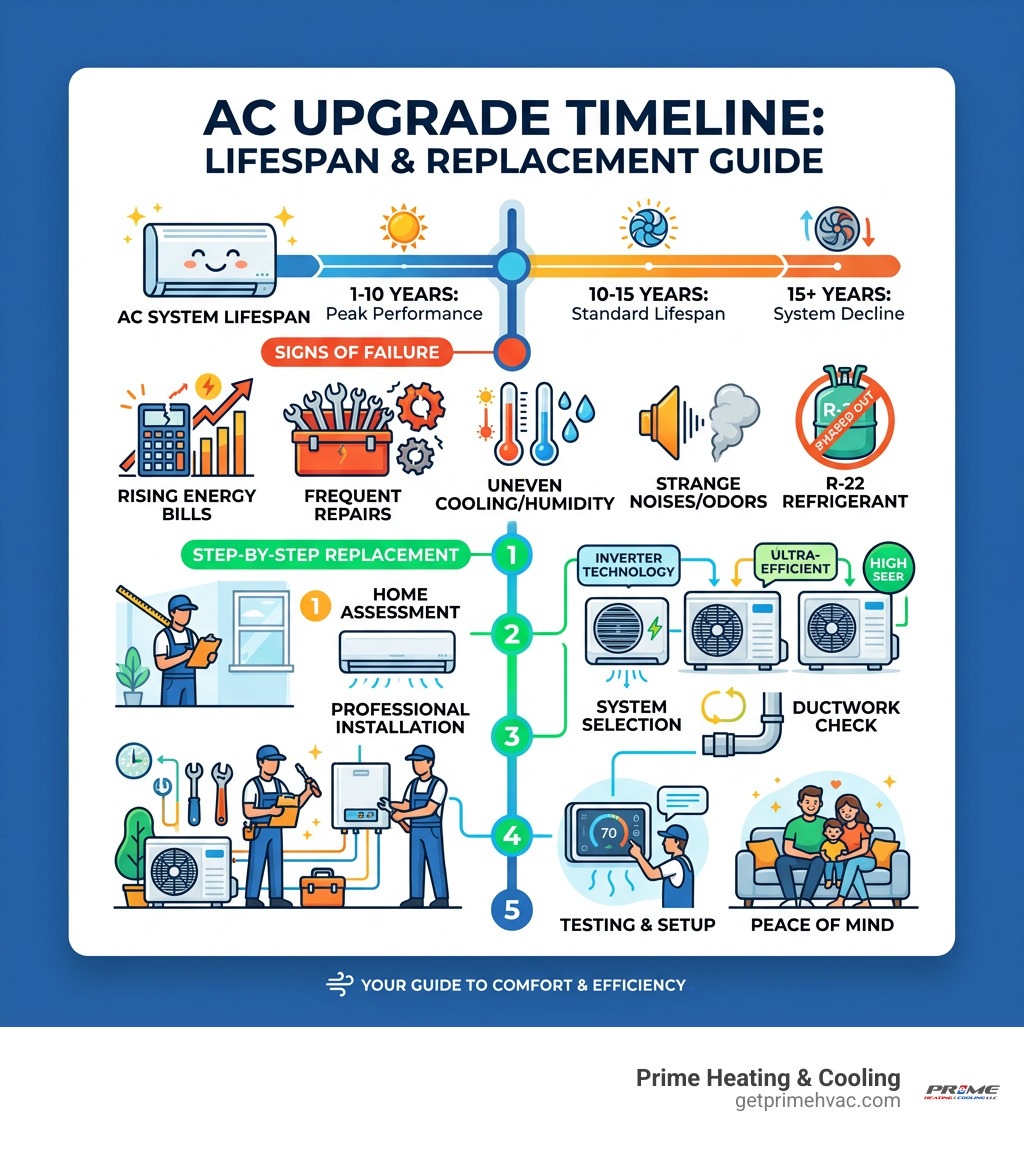
- Your unit is 10–15 years old or older
- You’re seeing rising energy bills without a clear cause
- You’re dealing with frequent repairs or breakdowns
- Your home has uneven cooling or humidity problems
- Your system uses R-22 refrigerant, which is being phased out
- Repair costs are approaching half the price of a new system
If one or more of these apply to you, it’s likely time to replace — not repair.
Most AC systems are built to last between 10 and 15 years. But as they age, they work harder, cost more to run, and break down more often. Meanwhile, modern systems use inverter technology and advanced efficiency ratings that can cut energy use by 30–40% compared to older fixed-speed models.
The decision isn’t always simple, though. Costs, sizing, ductwork, refrigerant type, and contractor quality all affect whether your upgrade goes smoothly — or turns into a headache.
That’s why having the right information (and the right team) makes all the difference.
I’m Tyler Steiner, CEO and founder of Prime Heating & Cooling, and I’ve spent my career designing and installing AC systems across Rhode Island and Massachusetts — helping homeowners navigate exactly this kind of decision. In this guide, I’ll walk you through everything you need to know to make a confident, cost-effective AC system upgrade.
Key Indicators and Benefits of an AC System Upgrade
Recognizing the right moment for an AC system upgrade can save you from a mid-summer meltdown. While it is tempting to squeeze every last drop of life out of an old unit, there comes a point where an aging system becomes a financial drain rather than a comfort provider.
System Age and the 10-15 Year Lifespan
In our experience serving neighbors from Providence to Coventry, we’ve seen that most central air systems have a reliable lifespan of 10 to 15 years. Some high-end models might stretch to 20, but efficiency drops off a cliff long before then. If your unit was installed back when flip phones were the height of fashion, it is likely costing you significantly more to operate than a modern equivalent.
The R-22 Refrigerant Phase-Out
One of the most critical environmental and financial drivers for an upgrade is the type of refrigerant your system uses. Older units typically run on R-22 (often called Freon). Because R-22 is being phased out globally due to its environmental impact, it has become incredibly scarce and expensive. If your aging unit develops a leak, the cost of recharging it with R-22 can be astronomical—often serving as the “final straw” that makes an AC system upgrade the only logical choice.
Rising Energy Bills and Efficiency Gaps
Have you noticed your summer electric bills creeping up even though you haven’t changed your habits? As internal components like the compressor and coils age, they have to work harder to achieve the same cooling effect. This inefficiency shows up directly on your monthly statement.
Furthermore, cooling efficiency isn’t just about the AC unit itself. According to the U.S. Department of Energy, about 30% of a home’s heating and cooling energy is lost through windows. When we perform an upgrade, we look at the whole picture—including your insulation and windows—to ensure your new system isn’t just blowing cold air out of a leaky house.
Uneven Cooling and Poor Air Quality
If your upstairs feels like a sauna while the living room is a refrigerator, your system is struggling with air distribution. An aging system often loses its ability to dehumidify effectively, leading to that “sticky” feeling indoors. This can even lead to secondary issues like mold growth or increased dust and allergens, which impact your family’s health.

Recognizing When to Replace vs. Repair
The “Repair or Replace” dilemma is the most common question we get in Scituate and Smithfield. We generally recommend the 50% rule: if the cost of a single repair is 50% or more of the value of a new system, it’s time to upgrade.
Frequent breakdowns are another red flag. If you are calling a technician every summer for “just one more fix,” those costs add up quickly. You can learn more about these specific warning signs in our guide on Is It Time for AC Replacement? Signs to Watch For. Investing in a new system often provides a better long-term return on investment than patching up a mechanical failure waiting to happen.
Financial and Comfort Advantages of an AC System Upgrade
The primary benefit of a modern AC system upgrade is the massive jump in efficiency. Today’s systems are measured by SEER2 (Seasonal Energy Efficiency Ratio 2) and EER2 (Energy Efficiency Ratio 2) ratings. These updated standards provide a more accurate reflection of how a unit performs in real-world conditions.
While older units might have SEER ratings as low as 8 or 10, modern entry-level units start at 13.4 SEER2, with premium models reaching over 23 SEER2. Upgrading can lead to a 30-40% reduction in energy use, which translates to hundreds of dollars in savings every year.
Modern Features: Inverters and Smart Controls
The “secret sauce” of modern cooling is inverter technology. Traditional air conditioners are either “on” or “off”—they blast at 100% capacity until the thermostat is satisfied, then shut down. This constant cycling is noisy and inefficient.
In contrast, variable-speed compressors (inverters) can adjust their output dynamically. If your home only needs a tiny bit of cooling to maintain the temperature, the inverter runs at a low, quiet speed. This results in:
- Superior Humidity Control: Longer, lower-speed cycles remove more moisture from the air.
- Whisper-Quiet Operation: No more “clunking” sounds when the unit kicks on.
- Stable Temperatures: No more 3-degree swings between cycles.
Pairing these units with smart thermostat integration allows you to control your comfort from your phone and can save an additional 10-15% on cooling costs. For larger homes in areas like East Greenwich or Warwick, we often recommend zoning systems, which allow you to cool different parts of the house independently.
Planning Your Professional Installation Process
A successful AC system upgrade isn’t just about picking a box off a shelf; it’s about engineering a solution for your specific home. If a contractor gives you a quote over the phone without visiting your house, that’s a major red flag.
Selecting the Right Size and Efficiency Rating
Size matters—but bigger isn’t always better. An oversized AC unit will “short cycle,” meaning it turns on and off so quickly that it never has a chance to dehumidify the air, leaving your home cold but clammy. Conversely, an undersized unit will run constantly, wearing itself out prematurely.
We use a Manual J Load Calculation to determine the exact BTU (British Thermal Unit) capacity your home needs. This calculation considers:
- Total square footage and ceiling height.
- The number and orientation of windows.
- The quality of your insulation.
- Local climate data for Rhode Island.
Understanding these SEER ratings and their impact helps us match the right unit to your budget and energy goals. According to Angi, assessing these factors before installation is the best way to avoid “surprise” costs later.
The Step-by-Step AC System Upgrade Experience
When you choose a professional team, the process is streamlined to minimize disruption to your daily life. Here is what a typical AC system upgrade looks like:
- Consultation and Load Calculation: We visit your home in Johnston or Lincoln to assess your needs and current ductwork.
- System Selection: We help you choose between central air, ductless mini-splits, or packaged units based on your home’s structure.
- Removal of Old Equipment: We safely recover the old refrigerant (especially R-22) and haul away the old unit for recycling.
- Ductwork and Insulation Check: We ensure your existing ducts can handle the airflow of a high-efficiency unit.
- Professional Installation: This includes mounting the outdoor condenser, installing the indoor evaporator coil, and running new refrigerant lines.
- Electrical and Control Setup: We handle the high-voltage connections and install your new smart thermostat.
- System Testing and Commissioning: We don’t just “turn it on.” We measure airflow, check refrigerant pressures, and ensure the system is operating at peak efficiency.
You can find a more detailed breakdown of these steps to a successful AC installation on our blog.
Maximizing Your Investment with Prime Heating & Cooling
At Prime Heating & Cooling, we’ve spent 20 years perfecting the art of the AC system upgrade in Rhode Island. We know that every home is unique, which is why we offer 24/7 availability and a customer-first approach. Whether you’re in North Providence or the East Side, our goal is to provide a system that pays for itself through energy savings and reliability.
Comparison: Single-Stage vs. Variable-Speed Systems
| Feature | Single-Stage AC | Variable-Speed (Inverter) AC |
|---|---|---|
| Operational Speed | 100% (On) or 0% (Off) | Adjustable (usually 25% to 100%) |
| Energy Efficiency | Standard | High (up to 40% savings) |
| Humidity Control | Basic | Excellent |
| Noise Level | Noticeable start/stop | Whisper quiet |
| Temperature Consistency | Moderate swings | Very stable |
| Initial Investment | Lower | Higher |
When you are ready to move forward, our expert AC installation services ensure your home stays a sanctuary of cool comfort. We invite you to explore our full range of professional cooling services and consultations to find the perfect fit for your lifestyle and budget.
Upgrading your AC system is a big step, but with the right team, it can be entirely stress-free. From initial sizing to the final test, we are here to ensure your Rhode Island home stays cool for many summers to come. Give us a call today to schedule your consultation and see how much you could save with a modern, high-efficiency upgrade.