
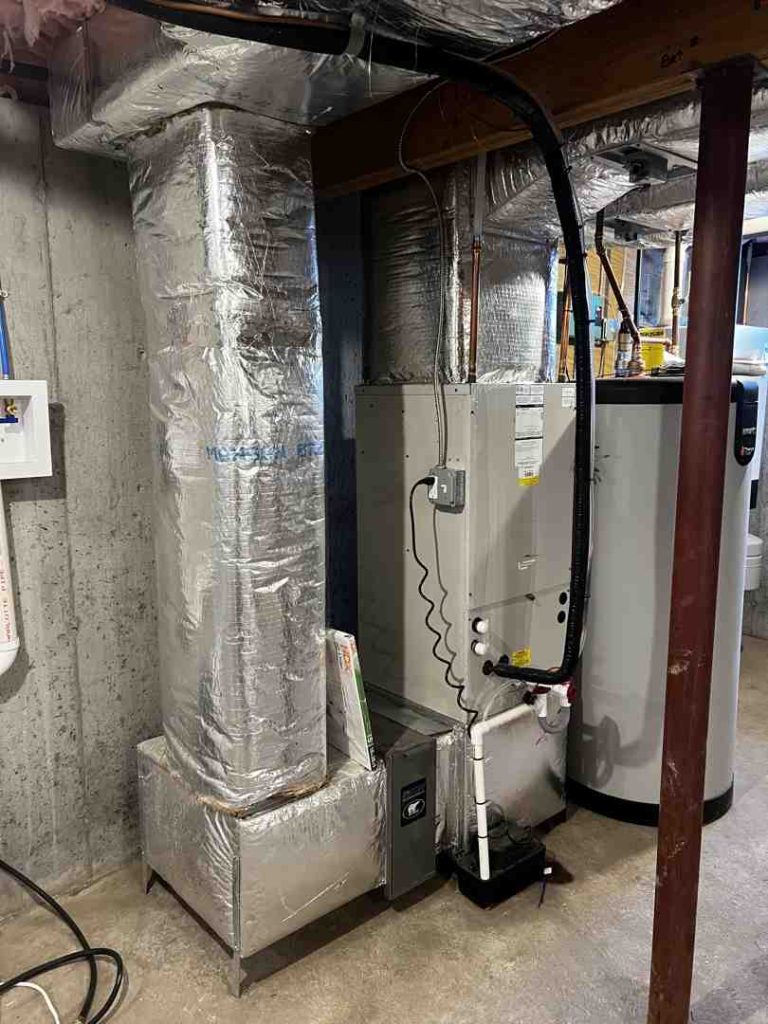
Why Every Modern Homeowner Should Know About Whole Home ERVs
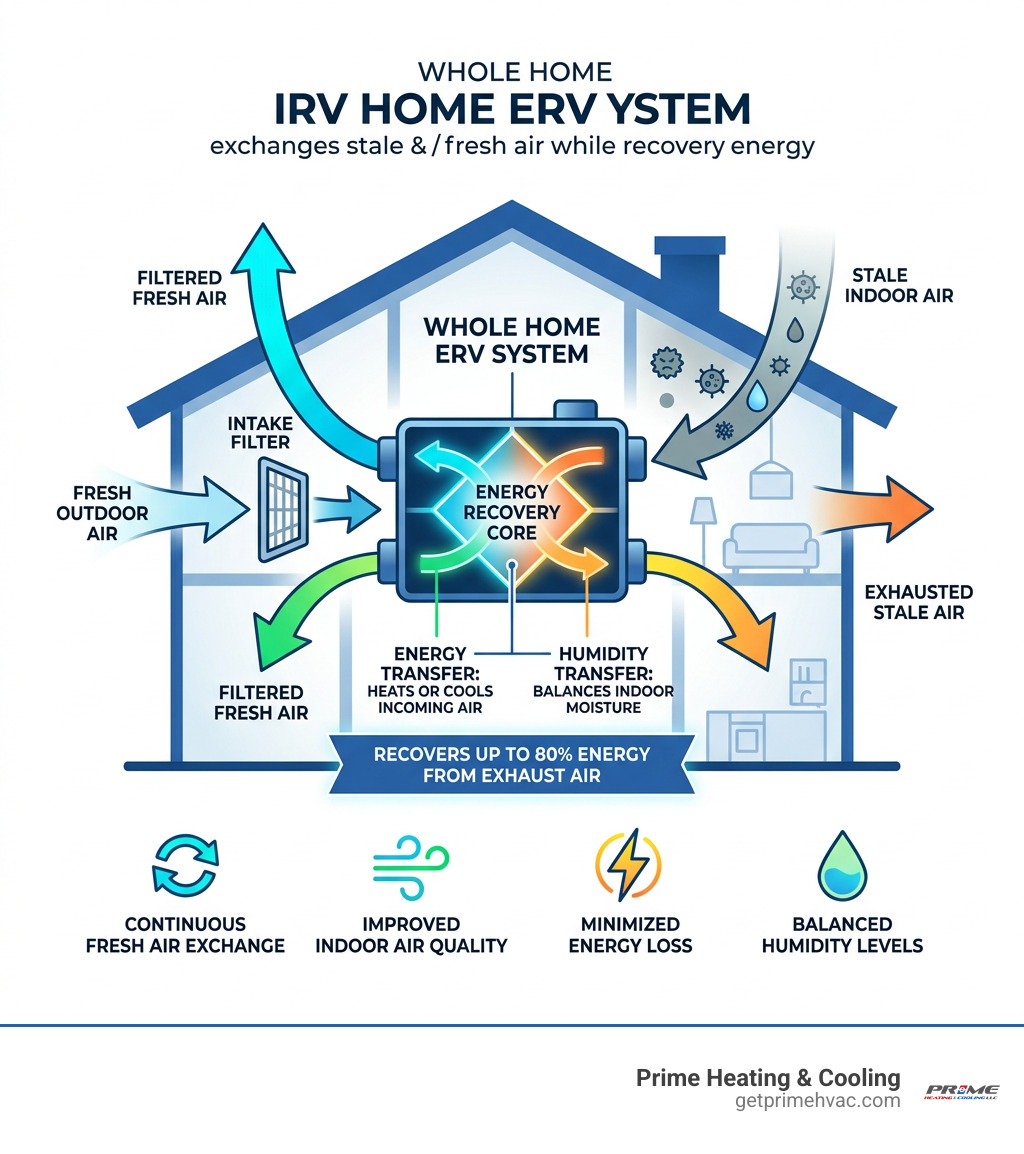
A whole home ERV (Energy Recovery Ventilator) is a mechanical ventilation system that continuously exchanges stale indoor air with fresh outdoor air — while recovering up to 70–80% of the energy from the outgoing air to heat or cool the incoming air.
Here’s what you need to know at a glance:
| Feature | Details |
|---|---|
| What it does | Exchanges stale indoor air for fresh outdoor air |
| Energy recovery | Recovers 70–80% of energy from exhaust air |
| Humidity control | Transfers moisture between airstreams to balance indoor humidity |
| Best for | Tightly sealed, energy-efficient homes |
| Climate fit | Most effective in hot, humid, or extreme climates |
| Key benefit | Better air quality with minimal energy loss |
Today’s homes are built tighter than ever. That’s great for energy bills — but it creates a real problem. Without a way to flush out stale air, pollutants like VOCs, allergens, bacteria, and excess moisture get trapped inside. Opening a window isn’t a reliable fix, especially in New England winters or humid summers.
That’s exactly where a whole home ERV comes in.
Unlike a simple exhaust fan or a cracked window, an ERV delivers balanced, continuous ventilation — bringing in filtered fresh air while recovering the energy you’ve already paid to heat or cool. The result is a home that breathes properly without wasting energy.
I’m Tyler Steiner, CEO and founder of Prime Heating & Cooling, and I’ve spent years designing and installing whole home ERV systems across Rhode Island and Massachusetts — helping homeowners solve stubborn air quality and humidity problems in tight, high-performance homes. In the sections below, I’ll walk you through everything you need to choose, install, and maintain the right ERV for your home.
Understanding the Benefits of a Whole home ERV
When we talk about “tight” homes in places like Providence or Warwick, we’re talking about houses that are so well-insulated and sealed that they barely leak any air. While this is fantastic for your heating bill during a snowy January, it means the air you’re breathing is likely a cocktail of pet dander, cooking odors, and chemicals from your furniture (VOCs).
A whole home ERV acts as the lungs of your house. It provides balanced ventilation, which is the gold standard of air management. Unlike exhaust-only systems (like a bathroom fan) that pull air out and hope fresh air finds its way in through cracks, or supply-only systems that push air in and hope the old air finds an exit, an ERV does both simultaneously. It pulls in fresh, filtered outdoor air and pushes out stale indoor air in equal amounts.
The real “magic” happens in the enthalpic core. As the two streams of air pass each other, they don’t mix, but they do exchange energy. In the winter, the warm air leaving your home pre-heats the freezing air coming in. In the summer, the cool, air-conditioned air leaving your home pre-cools the hot air coming in. According to Scientific research on energy recovery ventilators, most systems can recover about 70% to 80% of the energy in the exiting air.
This process ensures your home meets ASHRAE 62.2 standards, which is the national benchmark for residential ventilation and acceptable indoor air quality. It’s not just about comfort; it’s about making sure your home isn’t making you sick.

How a Whole home ERV Manages Humidity and Air Quality
One of the biggest questions we get at Prime Heating & Cooling is: “How is this different from just running a dehumidifier?”
The answer lies in the moisture transfer. A whole home ERV doesn’t just move heat; it moves water vapor. In our humid Rhode Island summers, the ERV core can remove nearly half of the moisture from the incoming air before it ever enters your living space. This reduces the load on your air conditioner and prevents that “sticky” feeling.
In the winter, it works in reverse. If your indoor air is comfortably humidified, the ERV can transfer some of that moisture to the dry incoming winter air, preventing your skin and throat from drying out. This constant management helps with:
- Mold Prevention: By exhausting humid air from bathrooms and kitchens, you stop mold before it starts.
- Allergen Reduction: High-quality MERV filters in the ERV catch pollen and dust before they enter your home.
- Pollutant Removal: It flushes out VOCs, bacteria, and viruses. Some advanced models, like those mentioned in our Rhode Island HVAC services, provide ozone-free operation, ensuring you aren’t adding any irritants to your lungs.
Comparing ERV vs. HRV for Different Climates
Choosing between an ERV and an HRV (Heat Recovery Ventilator) can be confusing. The main difference is that an HRV only transfers heat (sensible energy), while an ERV transfers both heat and moisture (latent energy).
| Feature | HRV (Heat Recovery) | ERV (Energy Recovery) |
|---|---|---|
| Primary Function | Transfers Heat | Transfers Heat + Moisture |
| Best Climate | Cold, Dry Winters | Humid Summers / Tight Homes |
| Winter Benefit | Pre-heats air, reduces condensation | Pre-heats air, retains humidity |
| Summer Benefit | Minimal humidity control | Pre-cools air, removes humidity |
| Core Type | Crossflow / Counterflow | Enthalpic Core |
In Rhode Island, we often recommend a whole home ERV because of our humid summers. However, if you live in a climate with extremely cold winters and very little summer humidity, an HRV might be the better choice. Brands like HERO offer HRVs that recover up to 82% of energy even at freezing temperatures. But for the modern, airtight home in our service area, the ERV’s ability to manage moisture year-round usually wins out.
Key Features to Look for in a Whole home ERV
When you’re shopping for a system, don’t just look at the brand name. Look at the specs:
- Airflow Capacity (CFM): You need enough “Cubic Feet per Minute” to refresh your home’s air. For example, the AprilAire Model 8100 can ventilate homes up to 7,500 square feet.
- SRE (Sensible Recovery Efficiency): This tells you how good the unit is at transferring heat. Top models like the Bryant Preferred™ ERVXXLHB achieve up to 81% SRE.
- TRE (Total Recovery Efficiency): This measures both heat and moisture transfer.
- Filtration: Look for units that support MERV 13 filters if you have allergies.
- Smart Controls: Modern units now offer app integration and air quality monitoring. The CERV2 system, for instance, monitors CO2 and VOC levels and adjusts its speed automatically.
Choosing the right features is a big part of professional HVAC installation, as an oversized or undersized unit won’t give you the benefits you’re paying for.
Installation, Costs, and Maintenance for Long-Term Efficiency
Installing a whole home ERV is not a weekend DIY project. It requires a deep understanding of your home’s existing ductwork and airflow balance.
The installation process typically involves mounting the unit in a utility room, basement, or attic. From there, we run two sets of ducts: one to the outside (to bring in fresh air and exhaust stale air) and one to the inside. Ideally, the ERV has its own dedicated “return” vents in high-moisture areas like bathrooms and a “supply” vent in the main living area. However, in many retrofits, we can integrate the ERV directly into your existing central HVAC system.
Estimating Costs and Energy Savings
While we won’t give you a specific quote here (every home is different!), it’s helpful to understand the value proposition. A whole home ERV is an investment in your home’s health and efficiency.
By recovering 70–80% of the energy from your exhaust air, you’re significantly reducing the workload on your furnace and AC. This can lead to a better HERS (Home Energy Rating System) score and may even qualify you for utility rebates in Rhode Island. For those interested in the nitty-gritty of performance, you can check out the Technical data on ERV performance for models like the AprilAire 8100. Over time, the energy savings and the extended life of your HVAC equipment help offset the initial installation expenses.
Common Installation Mistakes to Avoid
We’ve seen it all in the field, and most ERV issues stem from poor installation. Here are the big ones to avoid:
- Sizing Errors: An ERV that’s too small won’t move enough air to keep the home fresh. One that’s too large will waste electricity.
- Poor Sealing: If the ducts aren’t sealed with proper mastic, you’ll lose that precious fresh air into your attic or crawlspace. Check out our guide on ductwork efficiency for more on this.
- Long Duct Runs: The further the air has to travel, the harder the fans have to work. We aim for short, straight runs.
- Uninsulated Spaces: If ducts run through an unheated attic, they must be insulated to prevent condensation and energy loss.
- Improper Drainage: While ERVs manage moisture, some condensation can still occur in extreme cold. Without a proper drain line, you could end up with a puddle.
Avoiding these mistakes is key to extending your HVAC life and ensuring your home stays quiet and comfortable.
Maintaining Your System for Peak Performance
The good news is that a whole home ERV is relatively low-maintenance, but “low” doesn’t mean “none.” To keep the air smelling fresh and the energy recovery high, you need to stay on top of a few tasks:
- Filter Replacement: Most units have two filters—one for the incoming air and one for the outgoing air. These should be checked every 3–6 months. For AprilAire users, the EZ KLEEN 5153 filters are a popular choice.
- Core Cleaning: The enthalpic core should be vacuumed or cleaned according to the manufacturer’s instructions every year or two. This ensures the “pores” of the core don’t get clogged with dust.
- Inspecting Vents: Make sure the outdoor intake and exhaust hoods aren’t blocked by leaves, bird nests, or snow.
At Prime Heating & Cooling, we include ERV inspections in our HVAC maintenance plans. We’ll check the airflow balance, clean the core, and make sure the motors are running efficiently so you don’t have to worry about it.
Conclusion: Is a Whole Home ERV Right for You?
If you live in a modern, airtight home in Rhode Island, the answer is almost certainly yes. Whether you’re in Johnston, Smithfield, or the East Side of Providence, the combination of our humid summers and freezing winters makes a whole home ERV one of the smartest upgrades you can make for your indoor air quality.
You’ll breathe easier knowing that VOCs and allergens are being flushed out, and your wallet will thank you for the energy recovery. No more stuffy rooms, no more lingering cooking smells, and no more high energy bills from leaving a window cracked in December.
Ready to transform your home’s air? Schedule your whole-home ventilation service today with the experts at Prime Heating & Cooling. We have over 20 years of experience helping Rhode Island homeowners stay comfortable, healthy, and energy-efficient. Give us a call, and let’s get your home breathing again!