
Why the “Waste of Money” Question Matters for New England Homeowners
Is duct cleaning a waste of money? The short answer: it depends on your specific situation. For most well-maintained homes with clean filters and no visible problems, routine duct cleaning provides little proven benefit. However, it becomes a smart investment when you have visible mold growth, pest infestations, excessive dust buildup after renovations, or unexplained respiratory issues in your household.
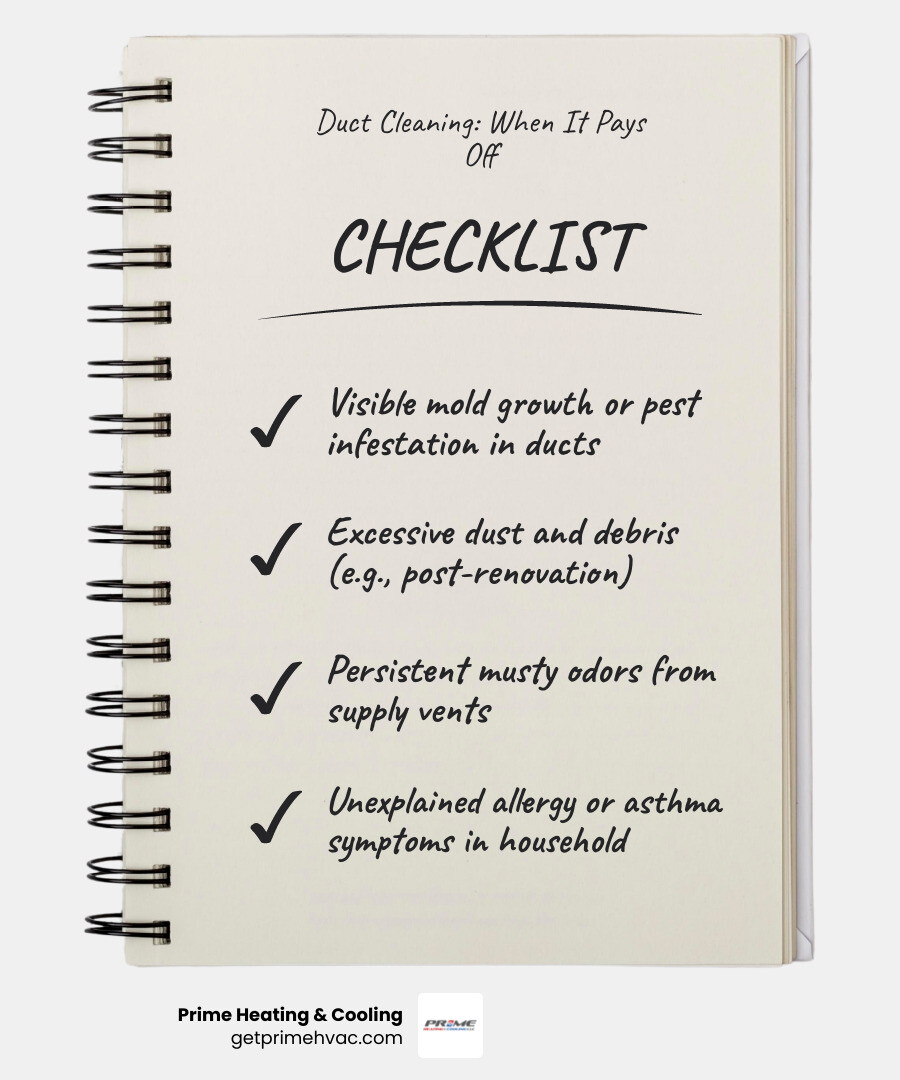
When Duct Cleaning is Worth It:
- Visible mold growth inside ducts or on HVAC components
- Evidence of rodents, insects, or vermin in ductwork
- Substantial dust and debris clogging ducts (especially post-construction)
- Persistent musty odors from supply vents
- Household members experiencing unexplained allergy or asthma symptoms
When It’s Likely Unnecessary:
- Your HVAC system is well-maintained with regular filter changes
- No one in your home has allergies or unexplained respiratory issues
- Ducts appear clean during visual inspection
- You’re hoping for significant energy savings (cleaning ducts alone rarely delivers this)
- A company is pushing it as “routine yearly maintenance”
If you’ve wondered if a $99 duct cleaning special is a scam, you’re asking the right question. The Environmental Protection Agency (EPA) states that duct cleaning has never been conclusively shown to prevent health problems or improve air quality in most homes. While it seems intuitive to clean the ducts that circulate your home’s air, the science tells a more nuanced story.
I’m Tyler Steiner, founder of Prime Heating & Cooling. In my years in the HVAC industry, I’ve seen countless homeowners struggle with this question, often pressured by aggressive sales tactics. My goal is to provide the facts so you can make an informed decision based on your home’s actual needs, not fear-based marketing.
What is Air Duct Cleaning? A Look Inside the Process
Air duct cleaning is the process of removing dust and contaminants from your home’s entire forced-air HVAC system. These ducts act as the circulatory system for your home’s air, delivering conditioned air to rooms and returning stale air to the unit.
A typical HVAC system includes several key components that can accumulate grime:
- Supply Ducts: These deliver heated or cooled air to your living spaces.
- Return Ducts: These pull air back into the HVAC unit to be conditioned.
- Registers and Grilles: These are the visible covers where air enters and leaves your rooms.
- Blower Motor: This powerful fan pushes air through the ductwork.
- Evaporator Coils: Found in your air conditioning unit, these coils cool the air and can accumulate moisture and debris.
- Condensate Drain Pan: Located beneath the evaporator coils, this collects and drains away condensation.
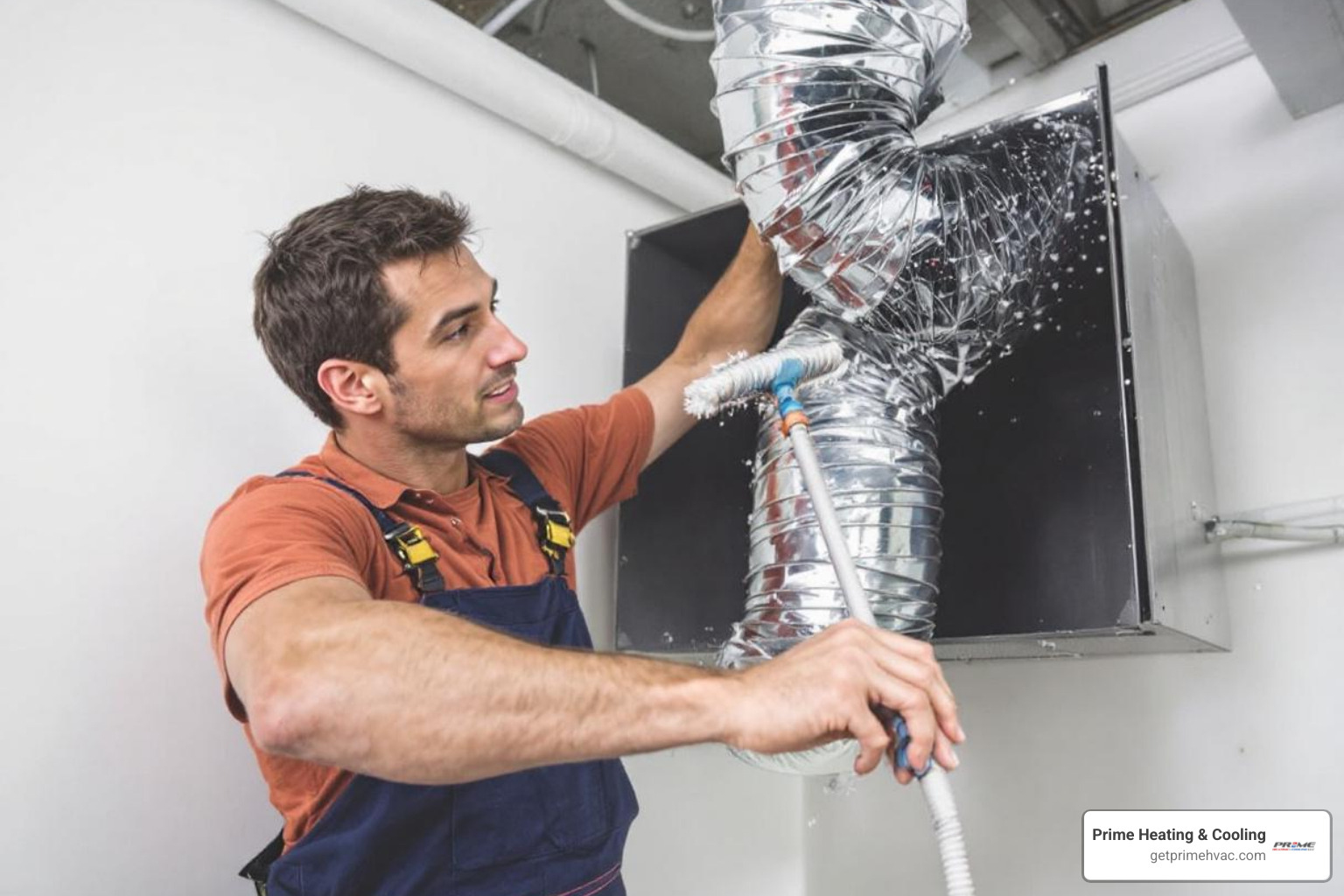
A professional duct cleaning is more than sticking a vacuum hose in a vent. It requires specialized equipment for a methodical, whole-system cleaning. Technicians use high-powered, truck-mounted vacuums to create negative pressure, sucking out debris. Simultaneously, agitation tools like rotary brushes or air whips dislodge contaminants from duct surfaces. This combination ensures particles are captured, not just stirred into your air.
The Difference Between a “Quick Clean” and a Comprehensive Service
This is where the “waste of money” question gets tricky. Low-priced specials (e.g., a “$99 whole house clean”) are often bait-and-switch scams. They typically involve a superficial cleaning of only the main ducts, followed by aggressive upselling for services like cleaning individual vents or applying biocides to treat “mold” they suddenly find.
A comprehensive service, following standards from the National Air Duct Cleaners Association (NADCA), cleans all HVAC components: supply and return ducts, registers, grilles, diffusers, heat exchangers, cooling coils, condensate drain pans, and the blower motor and housing. It’s an involved process requiring specialized equipment and proper sealing of access points.
At Prime Heating & Cooling, we believe in transparent pricing and thorough work. Our goal is to provide exceptional HVAC services that genuinely improve your home’s comfort and air quality, without resorting to misleading tactics.
The Official Verdict: What Experts Like the EPA and NADCA Say
The debate around duct cleaning isn’t just among homeowners; even experts have differing perspectives, though they often agree on the core science.

The EPA’s Cautious Stance
The U.S. Environmental Protection Agency (EPA) maintains a cautious stance on routine air duct cleaning. Their official advisory states that “knowledge about air duct cleaning is in its early stages, so a blanket recommendation cannot be offered.” They emphasize that there is “little evidence to suggest that regular duct cleaning improves air quality or reduces dust levels in homes that maintain clean filters and properly sealed duct systems.”
Here are some key points from the EPA’s position:
- No Proven Health Benefits: The EPA states duct cleaning has not been shown to prevent health problems. Normal household dust in ducts is not a known health risk.
- Particle Levels: Studies don’t show particle levels increase due to dirty ducts or decrease after cleaning. Most dirt adheres to duct surfaces.
- Routine Cleaning Unnecessary: The EPA does not recommend routine duct cleaning, only when specific issues are present.
- Focus on Prevention: The EPA advocates for prevention, like regular AC filter replacement and HVAC maintenance, as the most effective way to improve air quality.
Essentially, the EPA’s advice is simple: don’t clean your ducts for routine maintenance. Do it only if there’s a clear, identifiable problem.
The Industry Perspective from NADCA
The National Air Duct Cleaners Association (NADCA), which represents cleaning companies, promotes the benefits of professional duct cleaning for a healthier indoor environment and a more efficient HVAC system.
NADCA highlights several potential benefits:
- Improved Indoor Air Quality: Removing dust, allergens, and contaminants leads to cleaner air.
- Allergen Removal: Cleaning can reduce triggers for allergy and asthma sufferers.
- Energy Efficiency: A clean system works less hard, improving efficiency and reducing energy use.
- System Longevity: Removing debris reduces strain on components, potentially extending system lifespan.
NADCA recommends annual inspections by a qualified professional and adherence to their stringent cleaning standards. You can learn more on their website about why clean air ducts are important.
So, Is Duct Cleaning a Waste of Money? The Real Answer
After hearing from both sides, it’s clear that the answer to “is duct cleaning a waste of money?” isn’t a simple yes or no. It requires a careful cost-benefit analysis based on your unique home environment and circumstances. We want you to make an informed decision for your home in Rhode Island or Massachusetts.
When Duct Cleaning is Likely a Waste of Money
For many homeowners, especially those diligent with their HVAC maintenance, duct cleaning may indeed be an unnecessary expense. Here’s when it’s probably not worth your hard-earned money:
- Well-Maintained Systems with Regular Filter Changes: If you consistently change your HVAC filters every 1-3 months (or as recommended by the manufacturer and filter type), a significant amount of airborne particles are already being captured. The EPA emphasizes that this is the most effective way to keep particles out of your home’s air.
- No Visible Issues or Symptoms: If you don’t see visible dust plumes from your vents, notice strange odors, or have household members experiencing unexplained respiratory issues, your ducts are likely doing their job without needing a deep clean. As the EPA points out, much of the dust in ducts adheres to surfaces and doesn’t necessarily become airborne.
- Unsubstantiated Health Benefits: If you’re considering cleaning solely for general “health improvement” without specific symptoms or problems, the scientific evidence doesn’t strongly support it. The American Lung Association and other public health groups do not recommend routine duct cleaning for health prevention.
Focusing on regular HVAC maintenance—like filter changes, coil cleaning, and system tune-ups—will often yield more tangible benefits for your indoor air quality and system efficiency than a routine duct cleaning.
3 Clear Signs Duct Cleaning is a Smart Investment
While routine cleaning might be overkill, there are definitive situations where duct cleaning transitions from a debatable expense to a smart, necessary investment for your home and health.
- Visible Mold Growth: This is perhaps the most compelling reason. If you or a professional can see visible mold growing inside your hard-surface ducts or on other HVAC components, cleaning is crucial. However, if the mold is in insulated ducts (like fiberglass duct board or lined ducts), the EPA and NADCA both recommend that these sections be removed and replaced, as cleaning won’t effectively eliminate the mold. The source of the moisture causing the mold must also be identified and corrected, or it will simply return.
- Pest or Rodent Infestation: Finding evidence of rodents (droppings, nesting materials) or insects (dead bugs, insect parts) in your ductwork is a clear signal for cleaning. These can introduce allergens, bacteria, and unpleasant odors into your home’s air.
- Excessive Dust and Debris:
- Post-Renovation: If you’ve recently completed a major home renovation that generated a lot of dust (especially without properly sealing off your HVAC system), your ducts might be clogged with construction debris. This can reduce airflow and strain your system.
- Particles from Vents: If you notice substantial amounts of dust, dirt, or debris consistently blowing out of your supply registers, it indicates a significant buildup in your ducts that warrants professional attention.
- Unexplained Allergy or Asthma Symptoms: While not always solely due to ducts, if household members are experiencing new or increased allergy symptoms, asthma flare-ups, or other respiratory issues, and other common causes (like dirty filters, pet dander, or outdoor allergens) have been ruled out, a thorough inspection of your ductwork may reveal significant contamination that cleaning could alleviate. Persistent musty odors from your vents could also indicate hidden mold or bacterial growth.
In these specific scenarios, the potential benefits of improved air quality and reduced health risks far outweigh the cost of a professional cleaning.
The Cost vs. Benefit Analysis: Efficiency, Lifespan, and Your Wallet
Many homeowners wonder if duct cleaning saves money through improved energy efficiency or a longer HVAC lifespan. While NADCA suggests dirty ducts waste energy, research offers a more nuanced view. The U.S. Department of Energy (DOE) states that 25% to 40% of heating and cooling energy is wasted due to inefficient ducts. However, this is often caused by leaky ducts and poor maintenance, not just a thin layer of dust.
For a comprehensive approach to home comfort and efficiency, consider our services for ductwork repair and replacement in Rhode Island and Massachusetts.
The Impact on Energy Efficiency and HVAC Lifespan
Here’s the relationship between duct cleaning, energy bills, and your HVAC system’s longevity:
- HVAC Components vs. Ducts: Cleaning the entire HVAC system—especially the blower fan, evaporator coils, and heat exchangers—improves efficiency. These parts are critical for airflow and heat transfer. Cleaning only the ducts, if they have just a light layer of dust, shows little evidence of improving efficiency.
- Airflow Restriction: Genuinely clogged ducts restrict airflow, forcing your HVAC system to run longer and use more energy. In these cases, cleaning restores airflow and can lead to energy savings.
- System Strain: Restricted airflow causes wear and tear on components like the blower motor. Cleaning (when necessary) reduces this strain, potentially extending the system’s lifespan and preventing repairs.
- Leaky Ducts: Leaky ductwork is a more significant cause of energy waste. Unsealed ducts can lose up to 30% of conditioned air. Sealing these leaks, a separate service from cleaning, offers a much better return on investment for energy savings and is recommended by the EPA’s Energy Star program.
In short, cleaning the entire system and sealing leaky ducts yield the most significant energy and longevity benefits, more so than just cleaning lightly soiled ducts. For more insights, explore our energy efficient HVAC solutions.
How Much Does a Proper Duct Cleaning Cost?
According to the EPA, a proper duct cleaning for an average-sized home costs between $450 and $1,000. Lower prices often indicate a less comprehensive service or a bait-and-switch scam.
Here’s a comparison to illustrate the difference:
| Feature | Scam/Low-Ball Pricing (e.g., “$99 Special”) | Legitimate, NADCA-Compliant Service |
|---|---|---|
| Initial Quote | Very low (e.g., $99 – $200) | $450 – $1,000+ |
| Scope of Work | “Main ducts only” or vague | Entire HVAC system (all ducts, coils, blower, etc.) |
| Upselling | Aggressive, for “mold treatment,” “sanitizing,” individual vents, etc. | Transparent pricing, recommendations based on actual inspection |
| Equipment | Often inadequate household vacuums or less powerful units | High-powered, truck-mounted vacuums; specialized agitation tools |
| Technician Training | Minimal or none | NADCA-certified Air System Cleaning Specialists (ASCS) |
| Post-Cleaning Inspection | Minimal, often just a “look-see” | Thorough visual inspection, sometimes with remote cameras |
| Chemical Use | Pushing unnecessary biocides/sealants | Avoids routine use; only with explicit homeowner permission and specific need |
| Final Price | Significantly higher than initial quote | Close to initial detailed estimate |
Factors influencing a legitimate price include:
- Home and HVAC System Size: Larger homes or multiple/complex systems cost more.
- Ductwork Accessibility: Hard-to-reach ducts increase labor time.
- Level of Contamination: Heavy contamination requires more intensive work.
- Time Required: A thorough cleaning takes several hours.
Always be wary of prices that seem too good to be true. A reputable company provides a detailed, written estimate after an on-site inspection and explains the scope of work before starting.
How to Hire a Pro and Avoid Scams
If you’ve determined that your home in Rhode Island or Massachusetts truly needs duct cleaning, the next step is to find a qualified professional. This is paramount to ensure the job is done correctly and effectively, without falling victim to common scams.
Finding a Qualified Professional
Choosing the right duct cleaning service can feel like navigating a minefield, but with a few key steps, you can find a reputable company:
- NADCA Certification: Look for companies that are members of the National Air Duct Cleaners Association (NADCA). NADCA members must have certified Air System Cleaning Specialists (ASCS) on staff and adhere to NADCA’s standards for HVAC system assessment, cleaning, and restoration. You can use NADCA’s online directory to find a NADCA professional duct cleaner near you.
- Check References and Reviews: Ask for references and check online reviews (Google, Yelp, BBB) for companies operating in your area (Providence, Warwick, Smithfield, etc.). Look for consistent positive feedback regarding professionalism, thoroughness, and transparent pricing.
- Written Estimates: Always get a detailed written estimate after an on-site inspection. The estimate should clearly outline the scope of work, all costs involved, and any potential additional charges. Be suspicious of companies that give a firm quote over the phone without seeing your system.
- Insurance and Licensing: Ensure the company is properly insured and licensed to perform HVAC work in Rhode Island and Massachusetts. This protects you in case of any accidents or damage during the cleaning process.
- Experience and Procedures: Ask about their experience, the equipment they use, and their specific cleaning procedures. They should be able to explain how they access and clean all parts of your system, including the coils, fan, and drain pan.
Red Flags: How to Spot a Duct Cleaning Scam
The duct cleaning industry is unfortunately ripe with scams. Here are common red flags to watch out for:
- Low-Ball Prices (“$99 Special”): As mentioned, these are almost always bait-and-switch tactics. The initial low price will quickly escalate with hidden fees for “extra vents,” “mold treatment,” or “sanitizing.” A proper cleaning costs significantly more.
- High-Pressure Sales Tactics: Be wary of technicians who try to scare you with exaggerated claims about mold, allergens, or health risks, pressuring you into immediate, expensive services.
- Unverified Health Claims: Reputable companies will not make sweeping claims that duct cleaning will cure allergies or asthma. As the EPA states, there’s no conclusive evidence for this.
- “EPA-Certified” Claims: The EPA does not certify duct cleaning companies. Any company claiming to be “EPA-certified” is being dishonest.
- Bait-and-Switch Tactics: This includes the low-price offer that quickly changes, or a technician who finds “major problems” (often non-existent) that require expensive, unquoted services.
- Chemical Biocides and Sealants: Most organizations, including the EPA, NADCA, and NAIMA, do not routinely recommend the use of chemical biocides or sealants in ductwork. Biocides are pesticides and should only be used in specific, limited circumstances (e.g., bare metal ducts, and strictly according to label instructions), and never in fiberglass-lined ducts for which no EPA-registered products exist. Sealants are not fully proven for effectiveness or safety and can invalidate warranties. Be extremely cautious if a company pushes these as standard practice.
Trust your gut. If an offer seems too good to be true, or a technician makes you uncomfortable, it’s best to politely decline and seek other quotes.
Frequently Asked Questions about Duct Cleaning
How often should air ducts be cleaned?
There’s no universal answer. Recommendations vary:
- NADCA: Recommends an annual inspection, with cleaning performed as needed.
- EPA: Does not recommend routine cleaning; only when specific issues arise (mold, pests, excessive debris).
- General Guideline: Many professionals suggest cleaning every 3 to 5 years for a home without specific issues.
- Factors Increasing Frequency: Homes with pets, smokers, or residents with severe allergies may need more frequent cleaning (e.g., every 2-3 years). Cleaning is also recommended immediately after major renovations or water damage.
It’s about monitoring your home’s situation and relying on professional inspections, not a rigid schedule.
Can I clean my own air ducts?
While you can clean visible registers and change filters, a full DIY duct cleaning is not recommended.
Here’s why:
- Ineffective Equipment: Household vacuums lack the power to remove deeply embedded debris and can worsen air quality by stirring up dust.
- Specialized Tools: Professionals use high-powered vacuums and agitation tools (like brushes and air whips) that homeowners don’t have.
- Risk of Damage: You can easily damage ductwork, especially flexible or fiberglass-lined ducts, leading to costly repairs and reduced efficiency.
- Incomplete Cleaning: Without proper tools and access, you’ll only clean a small, visible portion of the system.
For a thorough and safe cleaning, leave it to the professionals.
Is duct cleaning a waste of money if my goal is energy savings?
If your primary goal is energy savings, duct cleaning alone is often not the most effective investment.
- Leaky Ducts are the Bigger Problem: The biggest energy waster in ductwork is leaks, not dirt. Unsealed ducts can lose 20-30% of conditioned air. Sealing leaks, as recommended by the EPA’s Energy Star program, is a highly effective energy-saving measure.
- Component Cleaning is More Effective: Cleaning HVAC components like the blower fan and evaporator coils has a more direct impact on energy efficiency than cleaning lightly soiled ducts.
- Tune-Ups Offer Better ROI: Regular HVAC tune-ups that include cleaning these critical components are far more effective for saving energy.
A routine cleaning on a relatively clean system is unlikely to provide significant energy savings. Focus on regular maintenance, filter changes, and duct sealing for the best return on your investment.
Conclusion: Making the Right Call for Your Rhode Island Home
The great duct debate boils down to one essential truth: air duct cleaning is not a one-size-fits-all solution. For many homeowners in Rhode Island and Massachusetts, it’s not a routine necessity and can indeed be a waste of money if undertaken without a clear, specific reason.
However, when faced with visible mold, pest infestations, excessive debris from renovations, or persistent health concerns tied to your indoor air quality, duct cleaning becomes a vital step towards a healthier, more comfortable home.
Our advice at Prime Heating & Cooling is to make an informed decision. Don’t be swayed by low-ball offers or scare tactics. Instead, rely on transparent, professional assessments from trusted HVAC providers. Prioritize regular HVAC maintenance, consistent filter changes, and addressing any underlying moisture or airflow issues.
If you suspect your ducts need attention, or if you’re experiencing any of the signs that warrant a cleaning, we encourage you to reach out to us. Our skilled technicians are here to provide honest assessments and expert HVAC services in Rhode Island, ensuring your home’s air quality and comfort are always at their best. We’re committed to helping you make the right call for your home, ensuring your investment truly pays off.