

Why Commercial Water Heater Installation Demands Strategic Planning
Commercial water heater installation is a critical project that directly impacts your business operations, employee comfort, and customer satisfaction. Whether you’re running a restaurant, hotel, office building, or retail facility, getting it right means understanding the substantial differences between commercial and residential systems—and following a proven process from start to finish.
Quick Overview: Commercial Water Heater Installation Essentials
- Assess Your Needs – Calculate peak hot water demand based on fixtures, appliances, and usage patterns
- Choose the Right System – Select tank or tankless, gas or electric, sized for commercial demand (typically 1″+ piping)
- Plan for Codes & Permits – Ensure compliance with local building codes, ANSI standards, and National Fuel Gas Code
- Prepare the Site – Shut off utilities, clear space, ensure structural support, install drain pans
- Install Infrastructure – Size pipes properly, install pressure-reducing valves, set up ventilation (gas units), manage condensate
- Connect Gas/Electric – Use licensed professionals for all connections, install shut-off valves, test for leaks
- Test & Calibrate – Check for leaks, purge air, set thermostat (120-140°F), verify safety controls
- Schedule Maintenance – Annual flushing, anode rod checks, descaling, burner inspections
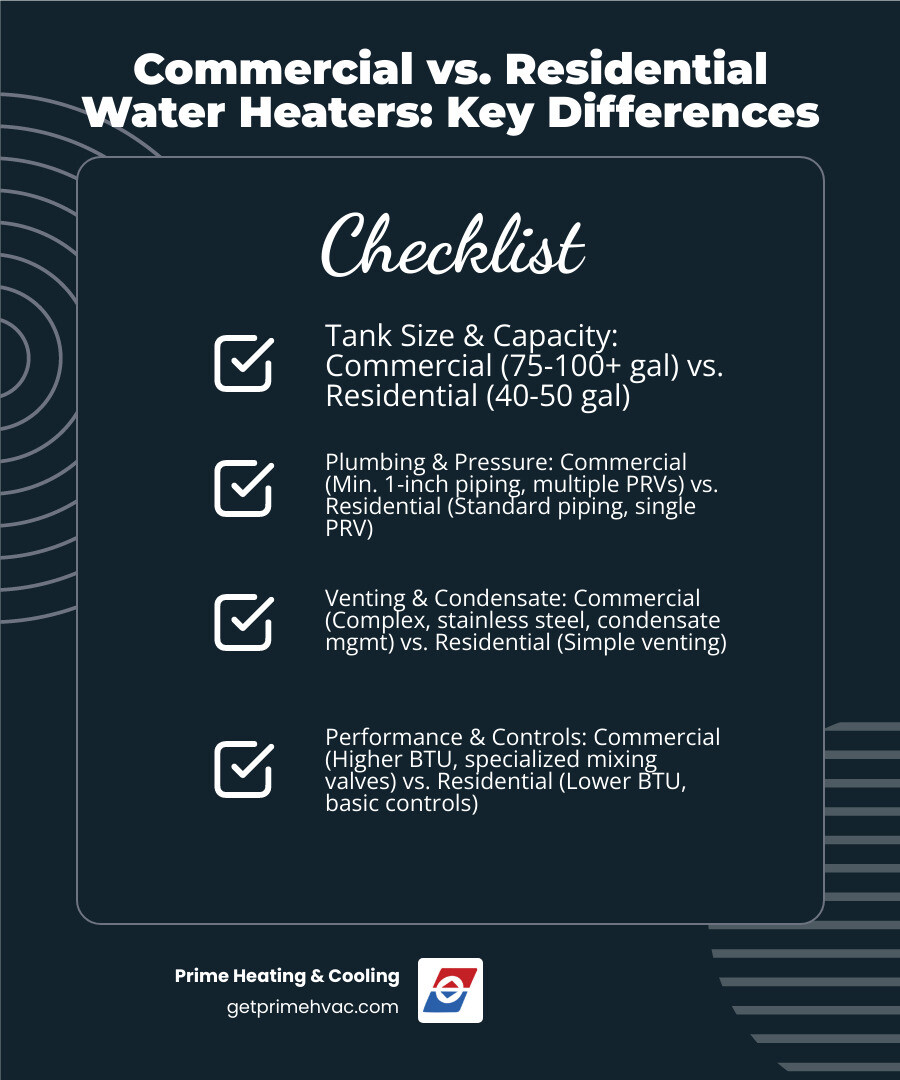
Commercial water heaters are more intricate than residential units. They supply hot water to multiple fixtures spread across larger physical spaces, requiring more complex plumbing infrastructure. Standard pipe sizes that work for homes won’t cut it—commercial buildings need pipes at least one inch in diameter to handle higher demand and maintain consistent pressure. Gas-powered units require carefully planned ventilation systems with proper vent lengths, diameters, and angles, often using stainless steel to prevent deterioration.
As Tyler Steiner, CEO and founder of Prime Heating & Cooling, I’ve overseen countless commercial water heater installation projects across New England, combining technical mastery with a commitment to safety and efficiency. My team and I understand that proper planning, code compliance, and professional execution are non-negotiable for commercial systems.
Planning Your Commercial Water Heater Project
Before we even think about turning a wrench, meticulous planning is the cornerstone of a successful commercial water heater installation. We’re talking about more than just finding a spot for a new tank; we’re integrating a vital system into your business’s operational heartbeat. This phase involves deep dives into sizing calculations, understanding your peak hour demand, choosing the right fuel source, prioritizing energy efficiency, and, crucially, navigating the labyrinth of local codes and permitting.
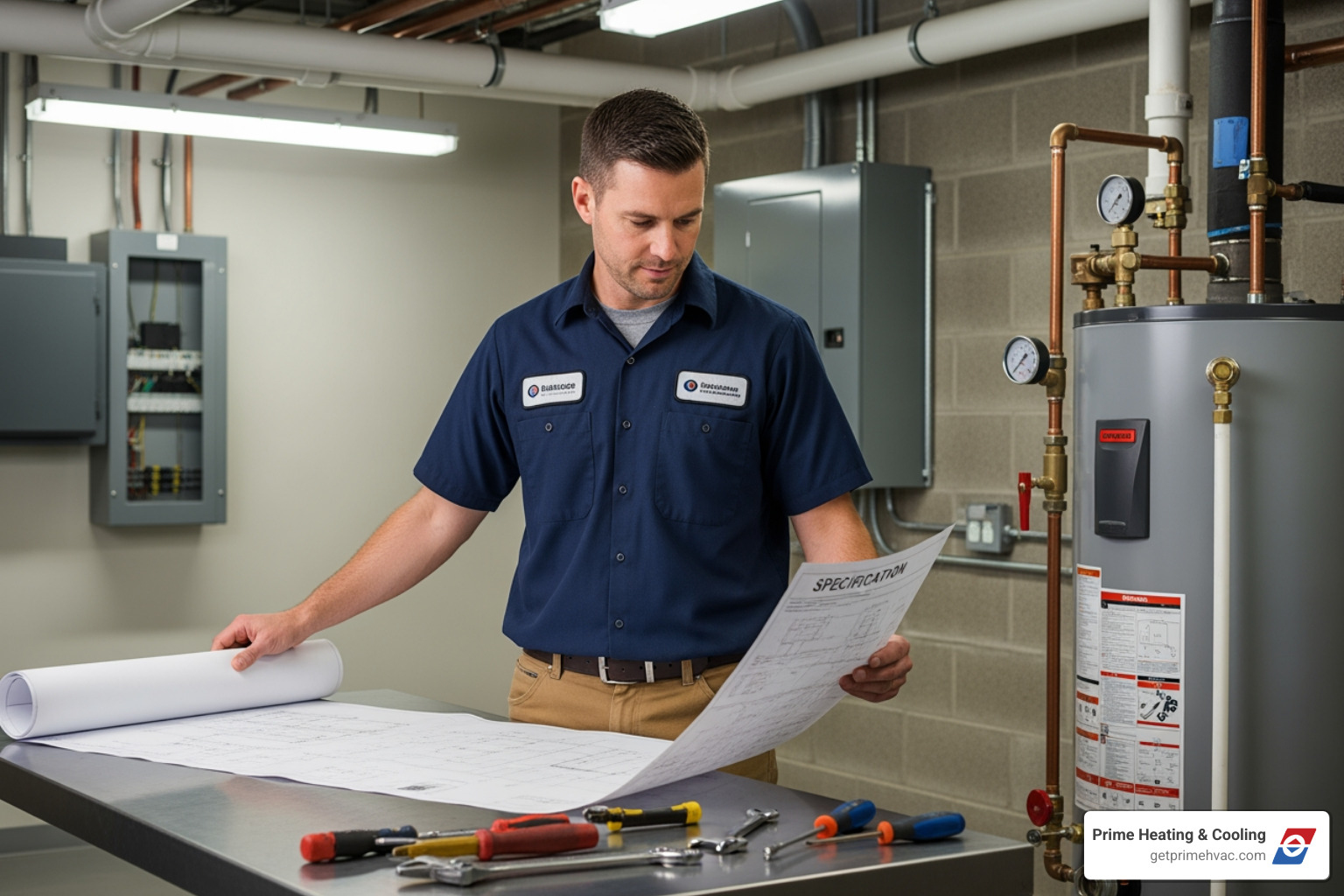
Commercial water heaters are inherently more complex than their residential counterparts. They’re designed to meet the high demand of multiple fixtures and appliances spread across a larger physical space, from the dishwashers in a busy restaurant to the laundry facilities in a hotel or the restrooms in a busy office building. This scale demands a level of strategic thinking and advanced planning that goes far beyond a typical home installation.
Key Considerations for Your Commercial Water Heater Installation
Choosing the right commercial water heater isn’t a one-size-fits-all decision. It requires a thorough assessment of your business’s unique hot water requirements. Think about your business type: a restaurant needs consistent, high-temperature water for sanitation, while an office might have more sporadic, but still significant, demand for handwashing and breakrooms. Mapping out your daily water usage and identifying peak demand times is crucial.
Sizing Your Water Heater for Commercial Needs
Unlike residential units, which are often sized based on the number of bedrooms or bathrooms, commercial sizing is about flow rate (GPM – gallons per minute) and temperature rise. For tankless units, this means adding up the flow rates of all hot water devices that might run simultaneously and determining the temperature increase needed from your incoming cold water to your desired output. The U.S. Department of Energy provides excellent resources on Sizing a New Water Heater, which can be a great starting point, though commercial applications will require more in-depth analysis.
Tank vs. Tankless: Which is Right for Your Business?
The two main categories of commercial water heaters are tank and tankless. Each has distinct advantages:
| Feature | Tank Commercial Water Heater | Tankless Commercial Water Heater |
|---|---|---|
| Storage | Stores a large volume of ready-to-use hot water. | Heats water on demand, no storage tank. |
| Best For | Consistent, high-demand needs (e.g., peak morning showers in a hotel). | Space-saving, energy efficiency, continuous hot water (if sized correctly). |
| Energy Use | Can incur standby heat loss as water is kept hot. | Heats only when needed, reducing energy waste. |
| Space | Requires significant dedicated space. | Compact, can be mounted on walls, saves floor space. |
| Initial Cost | Generally lower upfront. | Often higher upfront. |
| Operating Cost | Can be higher due to standby loss. | Lower due to on-demand heating. |
| Demand | Excellent for simultaneous heavy usage across multiple outlets. | Can struggle with simultaneous heavy usage if not properly sized. |
For a deeper dive into the pros and cons, we recommend checking out our article on More info about Tank vs. Tankless Water Heaters.
Gas vs. Electric Models
Your fuel source is another critical choice. Gas heaters are often quicker to heat water and can be more economical over time, especially where natural gas is readily available. Electric models, while easier to install in areas without gas lines, can have higher operating costs, though advancements are constantly improving their efficiency.
Energy Efficiency and Your Bottom Line
We always advocate for energy-efficient solutions. Water heaters with an ENERGY STAR® rating can significantly reduce energy bills, sometimes by as much as 55% compared to minimum federal standards. Choosing an efficient model not only benefits your wallet but also aligns with sustainable business practices, a win-win in our book!
Understanding Legal and Code Requirements
Navigating legal and code requirements is paramount in any commercial water heater installation project in Rhode Island and Massachusetts. These aren’t just suggestions; they’re mandatory guidelines designed to ensure safety and proper operation. We adhere strictly to local building codes, national standards like the National Fuel Gas Code (ANSI Z223.1-Latest Edition), and specific state regulations. For instance, Massachusetts has its own distinct requirements for water heater installation (248 CMR Section 2.00 and 5.00) that we are intimately familiar with.
Ignoring these codes can lead to failed inspections, costly rework, and, more importantly, significant safety hazards for your employees and customers. That’s why professional consultation is non-negotiable. Our team at Prime Heating & Cooling handles all aspects of the inspection process and ensures every installation meets or exceeds safety regulations. If you’re in Smithfield, you can learn more about our commitment to compliance by visiting Commercial HVAC Contractor Smithfield RI. We believe that peace of mind comes from knowing your system is not only performing efficiently but is also completely up to code.
The Core Steps of Commercial Water Heater Installation
Once the planning is complete, we move into the hands-on phase of commercial water heater installation. This is where our expertise truly shines, changing blueprints and calculations into a fully functional, reliable hot water system. This critical stage encompasses meticulous site preparation, strict adherence to safety protocols, setting up a robust plumbing infrastructure, ensuring proper ventilation, and making secure electrical and gas connections. It’s a complex dance of precision and experience.
Preparing the Installation Site
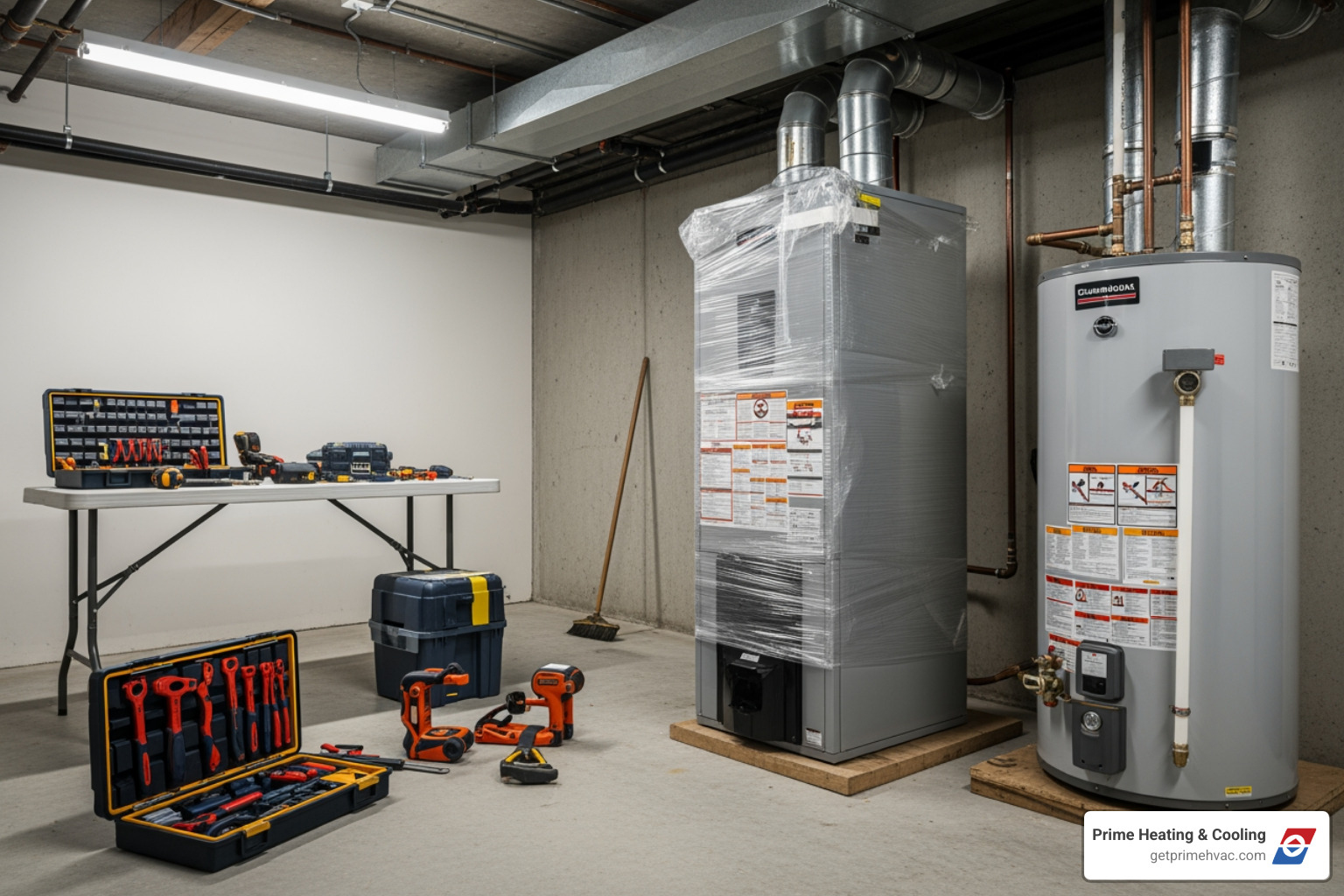
Proper site preparation is essential for a smooth and safe installation. Before any work begins, we always ensure that all necessary utilities—water, gas, and electricity—are completely shut off. This isn’t just a best practice; it’s a fundamental safety requirement.
Next, we clear the installation area, ensuring it’s well-lit and free of any obstructions. Commercial water heaters are significantly heavier and larger than residential units, so adequate structural support is a must. We ensure the water heater is positioned on a ground- or basement-level floor with sufficient load-bearing capacity, or on a specially reinforced platform if necessary. The surface must be perfectly level to ensure the unit operates efficiently and safely. We also install a suitable metal drain pan underneath the water heater, piped to an adequate drain. This pan acts as a crucial safeguard, managing potential leaks or safety releases and preventing costly water damage to your property. Finally, we handle the proper disposal of your old unit, adhering to all local regulations.
Plumbing, Venting, and Condensate Management
This is where the distinct challenges of commercial water heater installation truly come into play.
Plumbing Infrastructure: Commercial buildings demand higher water flow rates, making standard residential pipe sizes inadequate. Generally, commercial water heaters require piping that’s at least one inch in diameter, and often larger, to ensure consistent water pressure and flow across numerous fixtures. We carefully plan and install larger pipes to accommodate this higher demand. Pressure management is another critical concern. Residential units might get by with a single pressure valve, but commercial systems often require multiple pressure-reducing valves to maintain high pressure levels consistently throughout your facility. We also consider the installation of an expansion tank, especially if a check valve is present in the cold water supply line, to prevent thermal expansion issues that could damage the system. You can find more detailed guidance on these steps in resources like the Step-by-Step Guide To Installing a Commercial Water Heater.
Venting and Exhaust Systems for Gas Heaters: For gas-powered water heaters, proper ventilation and exhaust systems are non-negotiable. These systems prevent the dangerous accumulation of gases like carbon monoxide. We use high-quality materials, such as stainless steel, which guard against deterioration and blockage. A well-designed system requires careful planning of vent lengths, diameters, and angles. In older commercial facilities, retrofitting ventilation can be particularly challenging, sometimes necessitating alternative options like direct or power vents, which we are equipped to design and install.
Condensate Management: Modern high-efficiency gas water heaters often produce condensate, which is inherently acidic. If not properly managed, this acidic liquid can corrode metallic piping. We install a condensate neutralizer, carefully sized to the water heater’s BTU/Hr. rating or its gallons per hour of condensate production, to balance the pH and protect your plumbing infrastructure.
Noise Mitigation: Commercial water heaters, especially their robust ventilation and exhaust systems, can be noisy. To minimize disruption for your employees or customers, we strategically use insulating materials during installation to muffle sound and ensure your business environment remains peaceful.
Best Practices for Electrical and Gas Connections
Connecting the power and fuel supply to your commercial water heater demands the highest level of expertise and strict adherence to safety standards. This is not a DIY task; it requires licensed professionals.
For electrical connections, we ensure proper grounding and verify voltage compatibility to protect your equipment and prevent electrical hazards. All wiring is performed according to local electrical codes.
When it comes to gas connections, safety is paramount. We install a readily accessible manual shut-off valve in the gas supply line, allowing for quick and easy isolation of the fuel source if needed. A sediment trap is also installed to prevent debris from entering the gas control valve, protecting the unit’s internal components. After all gas connections are made, we perform rigorous leak testing using an approved noncorrosive leak-detection solution to guarantee the integrity of every joint. Our commitment to safety and compliance in all commercial services is unwavering; you can learn more at More info about Commercial Services.
Post-Installation: Testing, Calibration, and Maintenance
The installation isn’t truly complete until we’ve thoroughly tested and calibrated your new commercial water heater, ensuring it’s operating safely and efficiently. But our commitment doesn’t end there; we also help you establish a robust maintenance schedule to maximize your investment.
Testing and Calibrating the System
Once the physical installation is done, we carefully restore utilities—water, gas, and electricity—gradually, monitoring the system closely. The first critical step is to fill the tank completely with water and purge any air from the lines before turning on the power or gas. Then, we carefully check for leaks at all connection points, leaving no stone unturned.
Calibration involves adjusting the thermostat to the ideal temperature range, typically between 120 and 140°F, balancing safety (to prevent scalding) with efficiency. We also test the pressure relief valve to ensure it’s functioning correctly, a vital safety component. Finally, we verify that all controls and safety mechanisms are operating as designed, giving you confidence in your new system.
Routine Maintenance for Longevity and Efficiency
Regular maintenance is the secret sauce to extending the lifespan of your commercial water heater and maintaining its energy efficiency. Think of it as a wellness check-up for your most hardworking appliance. Here are the essential tasks we recommend:
- Annual Flushing: For tank systems, flushing out sediments annually prevents buildup that can reduce efficiency and cause damage.
- Anode Rod Inspection: This rod fights corrosion in tank systems. We recommend inspecting it after a maximum of three years and annually thereafter. If its diameter is less than 3/8″, it’s time for a replacement.
- Descaling Tankless Units: Tankless units benefit from periodic descaling to combat mineral deposits from hard water, which can lead to scaling and reduced performance.
- Burner Flame Check: For gas units, ensuring the burner flame is clean and blue indicates efficient combustion.
- Venting Inspection: Annually inspecting the venting and air supply system ensures proper airflow and prevents dangerous carbon monoxide buildup.
- Pressure Relief Valve Test: Periodically testing this valve ensures it will function in an emergency.
By following these routine maintenance procedures, you’ll ensure your commercial water heater provides reliable hot water for years to come. For more insights on keeping your system in top shape, check out our article on More info about Regular Hot Water Services in Smithfield, RI.
Why Professional Installation is Non-Negotiable
When it comes to commercial water heater installation, choosing a professional isn’t just a suggestion—it’s a critical decision that impacts safety, efficiency, and your bottom line. We’ve seen how the intricate nature of these systems demands specialized knowledge and experience.
Commercial water heaters are more complex than residential units, and their installation process is significantly more challenging. This complexity introduces various safety risks, from gas leaks and electrical hazards to improper venting that can lead to dangerous carbon monoxide accumulation. Our licensed professionals are trained to mitigate these risks, ensuring every connection is secure and every component functions safely.
Code compliance is another major factor. Local building codes, particularly in Rhode Island and Massachusetts, are stringent and constantly evolving. A DIY or inexperienced installation can easily miss critical requirements, leading to failed inspections, fines, and costly rework. We ensure every aspect of your installation adheres to all applicable codes and regulations.
Furthermore, professional installation often protects your warranty. Many manufacturers require installation by a certified technician for the warranty to remain valid. Beyond that, our expertise ensures long-term reliability and optimizes your system for maximum efficiency, saving you money on energy bills over time. For more on our comprehensive plumbing solutions, visit More info about Plumbing Installations & Repairs.
Avoiding Common Pitfalls in Commercial Water Heater Installation
Even experienced plumbers accustomed to residential units can stumble when faced with the unique challenges of commercial installations. Here are some common pitfalls we help our clients avoid:
- Improper Sizing: Under-sizing leads to insufficient hot water, while over-sizing wastes energy. We perform precise calculations to match your business’s specific demand.
- Incorrect Venting: For gas units, improper vent lengths, diameters, or angles can lead to dangerous gas accumulation or inefficient operation. Ventilation systems made with high-quality materials, such as stainless steel, are crucial to prevent deterioration or blockage.
- Poor Pipe Connections: Common mistakes include improper sealing, skipped tape applications, and unsecured connections, all of which can lead to costly leaks and water damage.
- Neglecting Thermal Expansion: In closed-loop systems, neglecting to install an expansion tank can lead to excessive pressure, damaging the water heater and other plumbing components.
- Skipping Safety Checks: Rushing through the installation and neglecting crucial safety checks, like leak testing gas lines or verifying pressure relief valve function, can have dire consequences.
- DIY Risks: Attempting a commercial water heater installation without proper licensing, tools, and experience is a gamble that rarely pays off, often leading to safety hazards, code violations, and premature system failure.
We believe in strategic thinking, advanced planning, and problem-solving skills to ensure your commercial water heater installation is done right the first time, every time.
Frequently Asked Questions about Commercial Water Heater Installation
We often hear similar questions from business owners considering a commercial water heater installation. Here are some of the most common, answered with our expert insights.
How long does a commercial water heater installation take?
The duration of a commercial water heater installation can vary significantly based on the complexity of the project. While a standard residential water heater replacement might take a few hours, commercial installations are typically more involved. Factors that influence the timeline include:
- Type of System: Tankless systems or multiple tank configurations can require more time.
- Location: Accessibility of the installation site.
- Plumbing Modifications: Upgrading pipe sizes (to the required 1-inch minimum or larger), adding pressure-reducing valves, or installing expansion tanks can extend the process.
- Venting Requirements: Complex or new ventilation systems for gas units will add time.
- Electrical/Gas Upgrades: If existing infrastructure needs modification to support the new unit, it can prolong the installation.
Generally, a straightforward commercial replacement might be completed within a day, but a more complex new installation or significant upgrade could take anywhere from one to two days, or even longer for very large-scale projects. We work efficiently to minimize disruption to your business operations.
How much does a commercial water heater installation cost?
The cost of a commercial water heater installation is highly variable, depending on several key factors:
- Type and Size of the Unit: Larger capacity units and specialized systems (like high-efficiency tankless or hybrid models) typically have higher upfront costs.
- Fuel Type: Gas and tankless models often cost more to install due to specific, often more complex, venting requirements.
- Labor and Installation Complexity: This includes the cost of skilled technicians, any necessary plumbing or electrical upgrades, and adherence to local codes.
- Site Preparation: Costs associated with structural reinforcement, drain pan installation, and old unit disposal.
- Permits and Inspections: Required by local authorities in Rhode Island and Massachusetts.
Given these variables, it’s challenging to provide a blanket figure. The best approach is to get a professional, detailed estimate from us. We’ll assess your specific needs and provide a clear breakdown of costs, ensuring there are no surprises.
What are the signs a commercial water heater needs replacement?
Keeping an eye on your commercial water heater can help you avoid unexpected breakdowns and costly emergency repairs. Here are the tell-tale signs that your unit might be nearing the end of its life and needs replacement:
- Inconsistent Temperatures or Insufficient Hot Water: If your business isn’t getting the consistent hot water it needs, or if the supply runs out too quickly, your water heater might be struggling to keep up.
- Leaks or Corrosion: Any visible leaks around the tank or corrosion on the unit or its connections are serious red flags.
- Strange Noises: Banging, rumbling, or popping sounds often indicate sediment buildup inside the tank, which reduces efficiency and can lead to damage.
- Discolored or Rusty Water: If the hot water from your taps appears rusty or discolored, it could mean the inside of your tank is corroding.
- Rising Energy Bills: If you notice a sudden, unexplained increase in your utility bills, your aging water heater might be losing efficiency and working harder to heat water.
- Unit Age: Commercial water heaters typically last between 8 to 12 years. If your unit is approaching or has exceeded this age range, even if it seems to be working, its efficiency is likely declining, and replacement is a wise proactive measure.
Don’t wait for a complete system failure to consider an upgrade. Addressing these signs early can save you significant headaches and expenses down the line.
Ensure Your Business Has a Steady Hot Water Supply
A reliable supply of hot water is more than a convenience for your business—it’s an operational necessity. From maintaining hygiene standards to facilitating daily tasks, a well-functioning commercial water heater is integral to your success. At Prime Heating & Cooling, we understand this deeply.
Proper commercial water heater installation is the bedrock of ensuring that steady hot water supply. It begins with meticulous planning and careful system selection, considering every facet of your business’s unique demands. It’s then executed with professional expertise, adhering to the highest standards of safety and compliance. The result is not just a new piece of equipment, but a long-term, energy-efficient solution that supports your business’s growth and daily rhythm.
We are proud to serve businesses across Rhode Island and Massachusetts, including East Greenwich, Johnston, Scituate, Smithfield, Providence, Lincoln, Coventry, Warwick, North Smithfield, North Scituate, North Providence, Franklin, and the East Side of Providence. With our 20 years of experience, skilled technicians, and customer-first approach, we are your trusted partners for all commercial plumbing needs.
Let us help you get it right. Contact us for professional plumbing installations and repairs today, and experience the Prime Heating & Cooling difference.