
Why Cleaning Commercial Air Ducts Matters More Than You Think
Cleaning commercial air ducts is the process of removing dust, debris, mold, and other contaminants from the ductwork and HVAC components of a commercial building. Here’s what you need to know at a glance:
- What it covers: Supply ducts, return ducts, air handlers, coils, blower fans, filters, and drain pans
- How often: Every 3-5 years for most commercial spaces; annually for healthcare and industrial facilities
- Why it matters: Cleaner ducts mean better air quality, lower energy bills, and a healthier workplace
- Who should do it: NADCA-certified professionals using negative pressure and mechanical agitation equipment
- Key warning signs: Visible dust at vents, musty odors, rising energy bills, or employee respiratory complaints
Most people spend roughly 22 hours a day indoors. For your employees and customers, that means the air inside your building isn’t just background — it’s something they’re breathing all day, every day.
The EPA ranks indoor air pollution among the top five environmental risks to public health. Yet the ductwork pushing air through your building is often the last thing on a maintenance checklist.
When ducts go uncleaned, contaminants build up. Your HVAC system works harder. Energy bills climb. Employees get sick more often. And in industries like healthcare, food service, or manufacturing, the consequences can go well beyond discomfort.
The good news? Regular, professional duct cleaning is one of the most straightforward ways to protect your building’s air quality and keep your HVAC system running efficiently.
I’m Tyler Steiner, CEO and founder of Prime Heating & Cooling, and I’ve spent my career working on complex commercial HVAC systems across New England. Cleaning commercial air ducts is something my team handles for businesses of all sizes — from small offices to large facilities — and I’ll walk you through everything you need to know to do it right.
The Critical Role of Cleaning Commercial Air Ducts for Business Health
In facility management, “out of sight, out of mind” is a dangerous philosophy when it comes to ventilation. Your ductwork is the respiratory system of your building. When it’s clogged with dust, pollen, or microbial growth, the entire “body” of your business suffers.
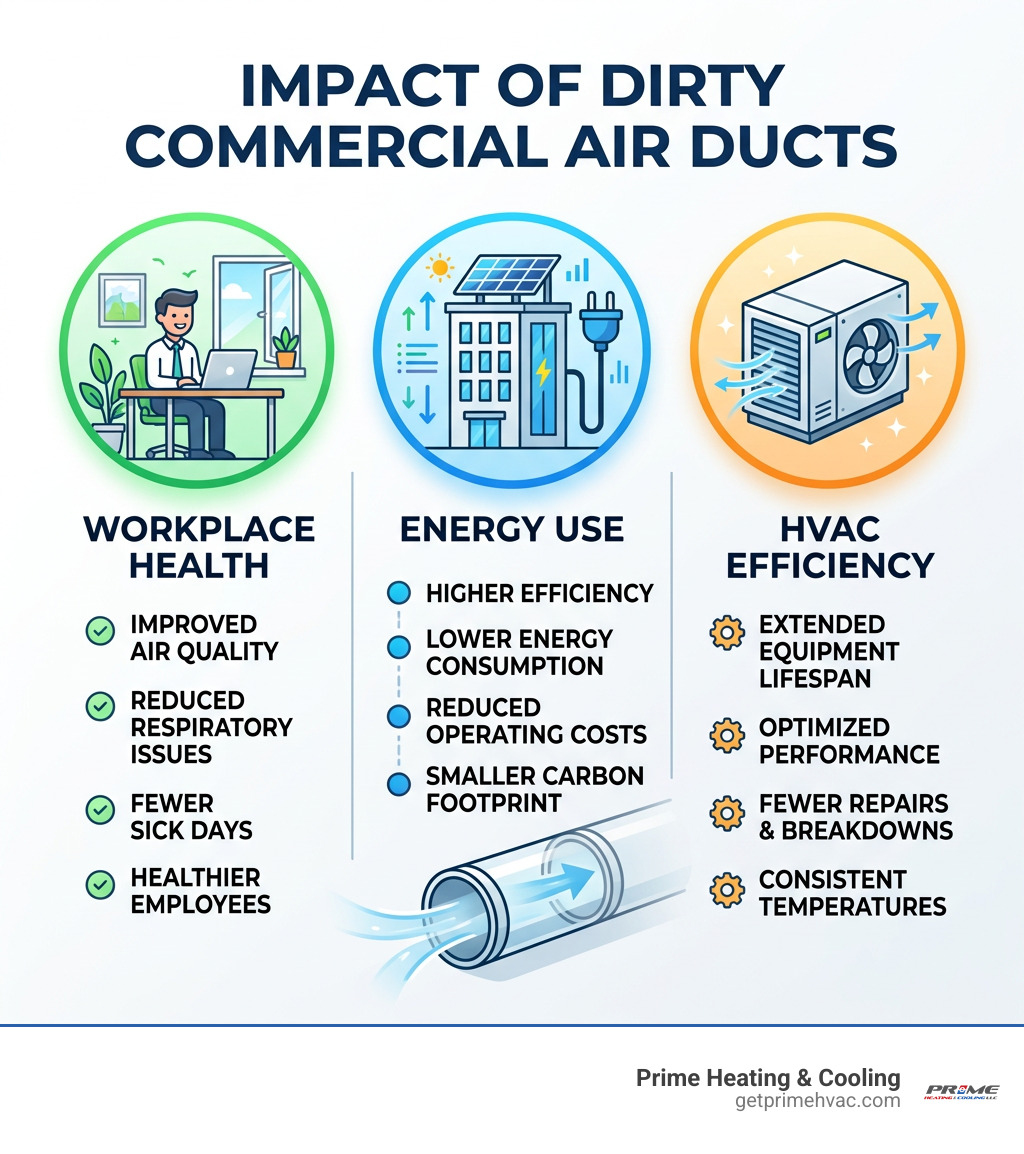
Energy Efficiency and Cost Savings
One of the most compelling reasons for cleaning commercial air ducts is the immediate impact on your bottom line. Studies by the EPA show that removing debris from ductwork and cleaning impacted cooling coils can reduce HVAC running time by as much as 30%. When your system doesn’t have to fight through layers of dust to move air, it consumes significantly less electricity. For a large facility in Rhode Island, that 30% reduction translates into thousands of dollars saved annually.
Improving Indoor Air Quality (IAQ)
The air circulating through your office or warehouse can be 2 to 5 times more polluted than outdoor air. Scientific research on the effectiveness of HVAC cleaning in improving air quality confirms that professional cleaning leads to lower bioaerosol concentrations. By removing the source of allergens and irritants, you create a space where employees are more productive and less likely to take sick days.
Equipment Lifespan and OSHA Compliance
A dirty HVAC system is a stressed HVAC system. Dust buildup acts as an insulator on motors and coils, causing them to overheat and fail prematurely. Regular maintenance helps you avoid the “Great Duct Debate”—knowing when duct cleaning pays off versus when you’re just throwing money away. Furthermore, staying on top of your ventilation hygiene ensures you remain in compliance with OSHA and health regulations, protecting you from potential fines.
Key Signs Your Facility Needs Professional Cleaning Commercial Air Ducts
How do you know if it’s time to call in the pros? Your building usually drops a few hints before a total system failure occurs.
- Visible Dust and Debris: If you see “dust bunnies” hanging off your supply registers or dark filtration lines on the ceiling tiles around vents, your ducts are likely over-capacity.
- Persistent Odors: Musty or “dirty sock” smells often indicate microbial growth or stagnant water in the drain pans.
- Rising Utility Bills: If your energy costs are creeping up despite no change in usage or rates, your HVAC system is likely struggling against restricted airflow.
- Pest Infestations: Rodents and insects love the dark, quiet environment of ductwork. If you’ve had a recent pest problem, a thorough cleaning is mandatory to remove droppings and nesting materials.
- Employee Health Complaints: Increased reports of headaches, itchy eyes, or respiratory issues among staff often point directly to the air they’re breathing.
- Post-Construction Residue: If you’ve recently renovated your Scituate office or Smithfield retail space, fine drywall dust has almost certainly found its way into your returns.
In some cases, cleaning isn’t enough. If your ducts are physically damaged or leaking air into the ceiling plenum, you may need to look into ductwork repair and replacement to restore proper pressure and efficiency.
Industry Standards and Recommended Frequency for Commercial Systems
We often get asked, “How often do we really need to do this?” The answer depends entirely on what you do inside your building. While a general rule of thumb is every 3 to 5 years, the National Air Duct Cleaners Association (NADCA) standards and resources suggest a more nuanced approach based on annual inspections.
| Building Use Classification | Air-Handling Unit Inspection | Supply Duct Inspection | Return/Exhaust Duct Inspection |
|---|---|---|---|
| Commercial (Office/Retail) | 1 Year | 1 Year | 1 Year |
| Industrial/Manufacturing | 1 Year | 1 Year | 1 Year |
| Healthcare Facilities | 1 Year | 1 Year | 1 Year |
| Marine/Residential | 1 Year | 2 Years | 2 Years |
Source: NADCA ACR-21 HVAC Cleanliness Inspection Schedule
While inspections should happen annually, the actual cleaning frequency varies:
- Healthcare: 1–2 years due to high sensitivity and infection control needs.
- Industrial: 1–3 years, especially if the facility produces combustible dust or airborne particulates.
- Office/Retail: 3–5 years is usually sufficient if high-quality filters are changed regularly.
Why Professional Expertise Outperforms DIY for Cleaning Commercial Air Ducts
We’ve seen some “creative” DIY attempts over the years involving shop vacs and leaf blowers. Please, for the sake of your equipment, don’t do this. Cleaning commercial air ducts requires specialized industrial tools that a standard maintenance crew simply doesn’t have.
- Negative Pressure: Professionals use high-powered, truck-mounted vacuums that put the entire duct system under negative pressure. This ensures that when we agitate the dust, it is sucked out of the building and into a containment unit, rather than being blown into your office.
- Mechanical Agitation: We use air whips, brushes, and “skipper balls” to physically dislodge stubborn debris from the duct walls.
- HEPA Filtration: Our equipment uses HEPA-rated filters to ensure that 99.97% of particulates are captured, preventing cross-contamination.
- ASCS Certification: Our technicians are Air Systems Cleaning Specialists (ASCS). They understand the blueprint of complex commercial systems, including how to navigate VAV boxes and fire dampers without causing damage.
- Liability and Insurance: Commercial HVAC systems are expensive. If a DIY attempt breaks a damper or punctures a lined duct, the repair costs will far exceed the price of a professional cleaning.
Executing a Professional HVAC Maintenance Strategy
A successful cleaning project starts long before the vacuums are turned on. It requires a methodical strategy that minimizes disruption to your business operations. At Prime Heating & Cooling, we emphasize “source removal”—the only method recognized by NADCA as truly effective. This means we don’t just “sanitize” the dust; we physically remove it from the building.
Before you book a service, understand the 5 things you need to know before duct cleaning, such as verifying the contractor’s credentials and ensuring they plan to clean the entire system, not just the easy-to-reach vents.
The Step-by-Step Commercial Duct Cleaning Process
When our team arrives at your facility in Providence or Warwick, we follow a strict protocol:
- Initial Inspection & Mechanical Prints: We review your building’s HVAC blueprints to identify all air handlers, zones, and access points.
- Site Containment: We protect your furniture and equipment with plastic sheeting and drop cloths. Work zones are isolated to prevent dust migration.
- System Preparation: The HVAC system is powered down. We create strategic access holes (which are professionally sealed afterward) to insert our agitation tools and vacuum hoses.
- The “Push-Pull” Method: While the vacuum pulls air from one end, we use compressed air tools to “push” debris toward the suction.
- Component Cleaning: We don’t just stop at the ducts. We clean the air-handling units (AHU), blower motors, and decontaminate the evaporator coils.
- Specialized Parts: We take care to clean VAV (Variable Air Volume) boxes, reheat coils, and dampers that are often missed by less experienced cleaners.
- Final Verification: We provide a post-cleaning report, often including before-and-after photos, to prove the system is clean.
Understanding Costs and Investment Factors
We believe in transparency, and while every building is unique, several key factors influence the cost of cleaning commercial air ducts.
- Square Footage and Duct Linear Footage: Larger buildings naturally require more time and labor.
- System Accessibility: Are the ducts easily reached via a drop ceiling, or are they 30 feet up in an industrial warehouse?
- Level of Contamination: A building that hasn’t been cleaned in 20 years will take longer than one on a regular 3-year cycle.
- Number of Units: A facility with ten small rooftop units (RTUs) is priced differently than one with a single massive penthouse air handler.
- After-Hours Labor: Many businesses prefer we work at night or on weekends to avoid interrupting operations, which can impact labor rates.
Think of this as an investment rather than an expense. The ROI comes in the form of lower utility bills, fewer emergency repairs, and a healthier workforce.
Partnering with Prime Heating & Cooling for Long-Term Efficiency
Choosing the right partner for your facility maintenance is about more than just finding the lowest bid. It’s about finding a team that understands the local climate and the specific needs of Rhode Island businesses.
With over 20 years of experience, we’ve built our reputation on a customer-first approach and 24/7 availability. Whether you are managing an office in East Greenwich, a retail space in North Providence, or an industrial site in Smithfield, our skilled technicians are equipped to handle the most complex commercial HVAC challenges. We don’t just clean; we optimize your system for maximum energy efficiency.
Don’t let hidden dust compromise your business health. Schedule expert commercial air duct cleaning services with us today and breathe easier knowing your facility is in professional hands. From Coventry to Woonsocket and everywhere in between, we are your local experts in keeping Rhode Island’s air clean and systems running strong.