
How Rhode Island Homeowners Can Save Big on HVAC Upgrades
Rhode Island HVAC tax credits can put thousands of dollars back in your pocket when you upgrade to an energy-efficient heating or cooling system. Here’s a quick snapshot of what’s available right now:
| Incentive | Amount | Who It’s For |
|---|---|---|
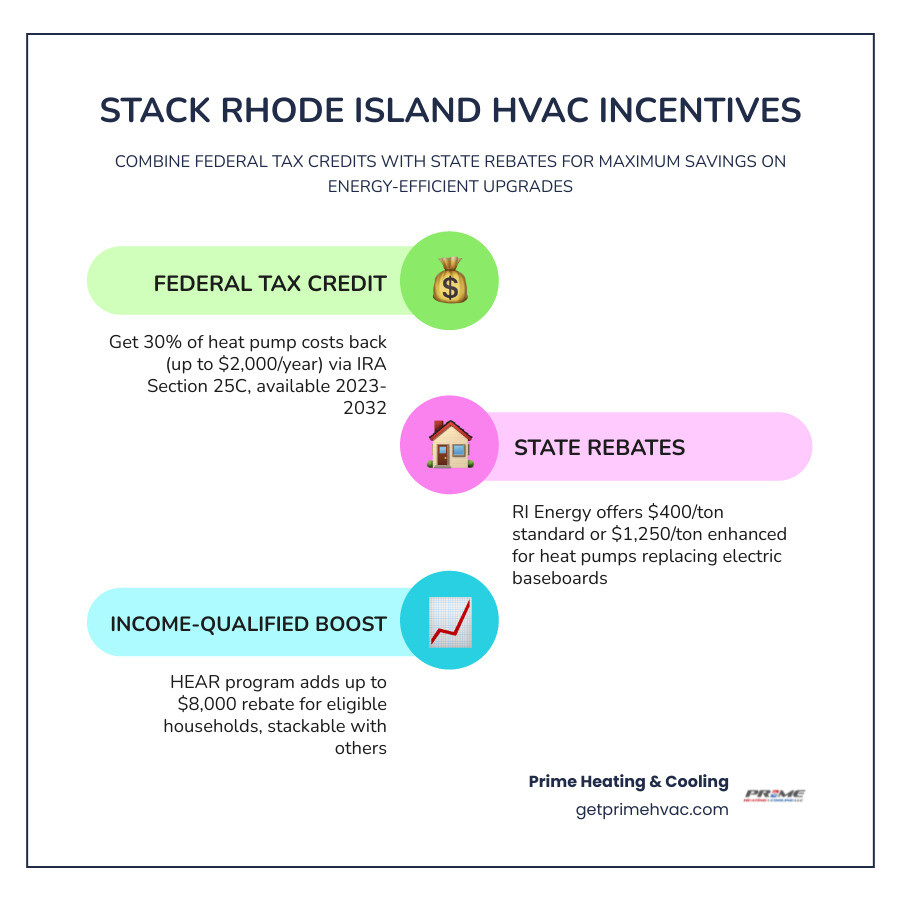
| Federal Heat Pump Tax Credit (IRA) | 30% of cost, up to $2,000 | Most homeowners, 2023-2032 |
| RI Energy Standard Heat Pump Rebate | $400 per ton (2025) | RI Energy electric customers |
| RI Energy Enhanced Heat Pump Rebate | $1,250 per ton | Homes replacing electric baseboard heat |
| HEAR Program Rebate | Up to $8,000 (heat pumps) | Income-qualified households |
| Heat Pump Water Heater Rebate | Up to $600 | RI Energy electric customers |
| Smart Thermostat Rebate | Up to $75 each | RI Energy electric customers |
The good news? You can stack most of these. A single heat pump installation can qualify for the federal tax credit and a state rebate at the same time — meaning your total savings can be significant.
This guide breaks down every major incentive available to Rhode Island homeowners, what equipment qualifies, and exactly how to apply.
I’m Tyler Steiner, CEO and founder of Prime Heating & Cooling, and I’ve spent years helping New England homeowners navigate Rhode Island HVAC tax credits and rebate programs to maximize their savings on high-efficiency upgrades. Let me walk you through everything you need to know.
Maximizing Your Savings with Rhode Island HVAC Tax Credits

When we talk about Rhode Island HVAC tax credits, we are primarily looking at the massive shift created by the Inflation Reduction Act (IRA). Signed into law in 2022, this federal initiative transformed how we think about home comfort. Instead of a small, one-time “lifetime” credit, homeowners now have access to an annual pot of money that resets every year through 2032.
The cornerstone of these incentives is the Section 25C tax credit. This allows you to claim 30% of the project cost for qualifying energy-efficient upgrades. For most HVAC equipment, like high-efficiency central air or furnaces, the credit is capped at $600. However, if you make the jump to a heat pump, that cap jumps significantly to $2,000 per year.
Because this is an annual limit, savvy homeowners in places like Warwick or East Greenwich can actually phase their upgrades. You might install a heat pump this year to claim the $2,000 credit, and then upgrade your windows or insulation next year to claim further credits under the same program.
To help you visualize how these different pots of money interact, we’ve put together a comparison of the primary financial drivers for Rhode Island residents:
| Feature | Federal Tax Credit (25C) | Standard RI Energy Rebate | Enhanced RI Energy Rebate |
|---|---|---|---|
| Max Amount | $2,000 (Heat Pumps) | $400 per ton (2025) | $1,250 per ton |
| Primary Requirement | Federal Efficiency Standards | AHRI/ENERGY STAR Certified | Replace Electric Baseboard |
| Application | Filed with Federal Taxes | Online/Mail Rebate Form | Assessment + Approved Contractor |
| Timeline | Available through 2032 | Annual Program (Jan-Dec) | Requires Pre-Verification |
For more detailed information on the federal side of things, you can visit the official Home energy tax credits | Internal Revenue Service page.
Understanding Federal Rhode Island HVAC Tax Credits Under the IRA
The Inflation Reduction Act isn’t just a single “coupon”; it’s a comprehensive framework designed to move us toward energy independence. For those of us living in the Ocean State, this means specific caps for different types of equipment:
- Air-Source Heat Pumps: These are the “stars” of the IRA, qualifying for a 30% credit capped at $2,000 annually.
- Central Air Conditioning: High-efficiency split systems (SEER2 of 16+) generally qualify for a 30% credit capped at $600.
- Gas Furnaces & Boilers: These must meet extremely high efficiency standards (97% AFUE for furnaces, 95% for boilers) to qualify for a $600 credit.
- Geothermal Systems: Under Section 25D, geothermal heat pumps actually qualify for a 30% credit with no upper dollar limit through 2032.
If you are wondering why there is such a push for these specific systems, it comes down to energy-efficient heating and cooling systems providing much better long-term value and lower monthly bills than older, legacy equipment.
State-Level Incentives: Clean Heat RI and Rhode Island Energy Rebates
While federal credits are great at tax time, state rebates provide more immediate financial relief. In Rhode Island, the primary players are Rhode Island Energy and the state-administered Clean Heat RI program.
As of 2025, the standard rebate for central and ducted mini-split heat pumps has increased to $400 per ton. For a typical 3-ton system, that’s $1,200 back in your pocket. If you are currently heating your home with expensive electric baseboard (resistance) heat, you may qualify for the Enhanced Rebate, which offers a staggering $1,250 per ton.
The CleanHeatRI.com program, administered by the Office of Energy Resources, focuses heavily on helping homeowners transition to fossil-free heating. This program is especially beneficial for families in environmental justice communities or those looking to replace oil or propane systems. Utilizing these state resources is one of the best ways to figure out how can I lower my heating bills during a Rhode Island winter without sacrificing comfort.
Income-Qualified Programs: HEAR and HER Incentives
Rhode Island has been allocated approximately $31 million for the Home Electrification and Appliances Rebates (HEAR) program and $32 million for the Home Efficiency Rebates (HER) program. These are specifically designed to ensure that energy efficiency isn’t just for those with large up-front budgets.
- HEAR Program: This is an income-eligible pathway. If your household income is below 80% of the Area Median Income (AMI), you could qualify for up to $8,000 for a heat pump, with total project coverage capped at $14,000. For those at 80-100% AMI, the program typically covers 50% of the costs.
- HER Program: This program focuses on “modeled” energy savings. If an upgrade is proven to reduce your home’s energy use by at least 20%, you become eligible for significant rebates, regardless of your specific equipment choice.
You can check your eligibility and find the latest AMI charts at the Home Energy Rebate Programs | Rhode Island Office of Energy Resources website.
How to Qualify and Apply for Rhode Island HVAC Incentives
Getting the money isn’t just about buying the right unit; it’s about following a specific process. For the most significant Rhode Island Energy rebates, the journey often begins with an EnergyWise Home Energy Assessment. This is a no-cost service where a specialist evaluates your home’s insulation and air sealing.
In fact, if you want that $1,250 per ton Enhanced Rebate, the assessment is mandatory. You must also ensure your home is “fully insulated/weatherized” according to the program’s standards before the heat pump is installed.
Key steps for a successful application include:
- Work with a Licensed Professional: Most rebates require installation by a licensed contractor. For enhanced rebates, you must use a contractor from the Rhode Island Energy “Participating Contractor” list.
- Sizing Matters: Your system must be sized according to an ACCA-approved Manual J load calculation. If the system is oversized (more than 130% of the cooling load), it won’t qualify for certain rebates.
- The 90-Day Rule: You generally have 90 days from the date of installation to submit your rebate paperwork. Don’t let your money expire on the kitchen counter!
- Documentation: Keep your invoices, the AHRI (Air-Conditioning, Heating, and Refrigeration Institute) reference number, and your Manual J report. You’ll need these for the online portal.
Technical Requirements for Rhode Island HVAC Tax Credits
Efficiency standards change almost every year. To qualify for the 2025 Rhode Island HVAC tax credits and state rebates, equipment must meet high bars:
- ENERGY STAR 6.1 Cold Climate: This is the gold standard for heat pumps in New England. It ensures the unit can still extract heat from the air even when it’s freezing in Johnston or Coventry.
- SEER2 and HSPF2: These are the updated metrics for cooling and heating efficiency. For ductless systems, you’re often looking for a SEER2 above 16 and an HSPF2 above 9.5.
- Thermostatic Expansion Valves (TXV): Most rebated systems require a TXV or an Electronic Expansion Valve (EXV) to ensure the refrigerant flows efficiently under different loads.
While these technical specs might sound like “alphabet soup,” they are vital for your contractor to verify. These high standards are also why smart thermostats save you money—they allow these advanced systems to communicate and run only when necessary.
Rebates for Water Heaters and Smart Controls
HVAC isn’t just about the air; it’s about the water, too. Heat pump water heaters are incredibly efficient, essentially acting like a refrigerator in reverse to heat your water. Rhode Island Energy offers a rebate of up to $600 for units 55 gallons or smaller with a Uniform Energy Factor (UEF) of 2.0 or higher.
Additionally, don’t overlook the smaller “instant” wins. You can get a $75 rebate for an ENERGY STAR certified smart thermostat (limit 2 per account). These devices must be Wi-Fi enabled to qualify, as the utility companies want to ensure you have the tools to manage your energy consumption actively.
Regularly checking in on these components is part of a smart home strategy. We always recommend looking into hvac-maintenance-plans-your-ticket-to-comfort-and-savings to ensure that your high-efficiency water heater and smart controls continue to perform at the levels required to keep your energy bills low.
Conclusion: Start Your Energy Upgrade with Prime Heating & Cooling
Navigating Rhode Island HVAC tax credits can feel like a full-time job, but it doesn’t have to be. At Prime Heating & Cooling, we have 20 years of experience helping homeowners across Providence, Warwick, Smithfield, and the surrounding areas turn these complex incentives into real-world savings.
We don’t just “install boxes.” We provide energy-efficient solutions tailored to the unique climate of Rhode Island. From performing the necessary Manual J calculations to ensuring your equipment meets the latest ENERGY STAR 6.1 Cold Climate standards, our skilled technicians handle the technical heavy lifting so you can focus on enjoying a comfortable home.
Whether you are looking to replace an old oil boiler, upgrade to a ductless mini-split, or finally get that smart thermostat installed, we are here for you with 24/7 availability and a customer-first approach.
Ready to maximize your rebates and lower your energy bills? Schedule your Rhode Island HVAC service today and let’s get started on your home’s energy transformation.


