When an AC Unit Upgrade Saves You More Than a Repair
Deciding whether to sink more money into an old unit or invest in a modern AC unit upgrade is one of the most common dilemmas we see here in Rhode Island. While the upfront cost of a new system can seem daunting, there is a clear “tipping point” where repairing an old unit becomes a literal waste of money.
Modern cooling technology has leaped forward in the last decade. According to scientific research on energy-efficient cooling systems, newer models can use 30% to 50% less energy than units installed just ten years ago. In our local climate—where humidity in East Greenwich or Warwick can make a 75-degree day feel like 90—an inefficient system works double time, leading to a massive spike in utility bills.
One of the biggest drivers for an upgrade today is the SEER2 rating. SEER2 (Seasonal Energy Efficiency Ratio 2) is the updated standard for measuring how much cooling a system delivers per watt of electricity. In northern states like Rhode Island, the minimum SEER2 is now 13.4, but top-tier models can reach up to 25. By choosing an Energy Star certified system, you aren’t just lowering your carbon footprint; you’re often qualifying for federal tax credits (up to 30% or $1,200) and local utility rebates that significantly offset the average installation costs. When you factor in these incentives and the monthly energy savings, the benefits of upgrading your cooling system often result in the unit paying for itself within a few years.
Identifying the Signs You Need an AC Unit Upgrade
How do you know if your system is just “having a bad day” or if it’s truly on its last legs? Most central AC units have a lifespan of 10 to 15 years. If yours is pushing the 15-year mark, it’s essentially a “zombie system”—it’s technically alive, but it’s costing you a fortune to keep it running.
Keep an eye out for these definitive signs to watch for:
- Frequent Breakdowns: If you have your HVAC technician on speed dial and are calling for repairs more than twice a season, you’re throwing money into a sinking ship.
- Rising Energy Bills: If your usage hasn’t changed but your bills are climbing every summer, your components are likely wearing out and losing efficiency.
- Humidity Issues: A healthy AC doesn’t just cool; it dehumidifies. If your home in Johnston or Smithfield feels “clammy” even when the air is blowing, the system is failing to manage moisture.
- Strange Noises: Grinding, squealing, or banging sounds often indicate a failing compressor or motor—repairs that are notoriously expensive.
It is always better to upgrade your HVAC unit before it gives up on you in the middle of a July heatwave when emergency service rates are at their peak.
The $5,000 Rule: A Decision Guide for Homeowners
At Prime Heating & Cooling, we like to give our customers a simple mathematical framework to take the emotion out of the decision. We call it the “$5,000 Rule.”
The Formula: Multiply the age of your AC unit by the cost of the quoted repair. If the total exceeds $5,000, it is mathematically wiser to replace the unit.
| Age of Unit | Repair Cost | Total (Age x Cost) | Recommendation |
|---|---|---|---|
| 5 Years | $400 | $2,000 | Repair |
| 10 Years | $600 | $6,000 | Upgrade |
| 12 Years | $500 | $6,000 | Upgrade |
| 15 Years | $300 | $4,500 | Borderline (Consider Upgrade) |
We also suggest the “50% Rule.” If a single repair—like a failed compressor or a leaking evaporator coil—costs 50% or more of what a new system would cost, an AC unit upgrade is the only logical path. This is especially true if your unit uses R-22 refrigerant (Freon). Since R-22 is phased out and no longer produced, the cost to “top off” a leaking system has become astronomical. To help you navigate this, check out the smart homeowner’s guide to a stress-free upgrade.
Why SEER2 Ratings and Sizing Matter for Your AC Unit Upgrade
One of the biggest ways an upgrade becomes a “waste of money” is through improper sizing. Many contractors will simply look at the sticker on your old unit and replace it with the same size. This is a mistake. If you’ve added insulation, replaced windows, or built an addition in your Providence home, your cooling needs have changed.
According to expert AC installation advice, a professional must perform a Manual J Load Calculation. This isn’t a “rule of thumb” based on square footage; it’s a scientific calculation that considers your home’s orientation to the sun, wall thickness, and even the number of people living there.
- Over-sizing Risks: If the unit is too big (too many tons), it will “short-cycle.” It turns on, blasts the house with cold air, and turns off before it has a chance to remove humidity. You’ll end up with a cold, damp house and a motor that burns out early.
- Under-sizing Consequences: If the unit is too small, it will run 24/7, struggling to reach the set temperature. This leads to high energy bills and a shortened lifespan for the equipment.
Getting the tonnage and BTUs right is the difference between a system that lasts 20 years and one that fails in seven.
Maximizing the Value of Your New Cooling System
Once you’ve decided to move forward with an AC unit upgrade, you need to choose the right type of system. In Rhode Island, we have a unique mix of historic homes in the East Side of Providence and modern builds in North Kingstown, which means a “one size fits all” approach doesn’t work.
You aren’t just limited to traditional central air anymore. You might also be facing the furnace dilemma—wondering if you should replace your heating and cooling at the same time. Often, replacing both ensures that the blower motor in your furnace is perfectly matched to the new AC coil, maximizing airflow and efficiency.
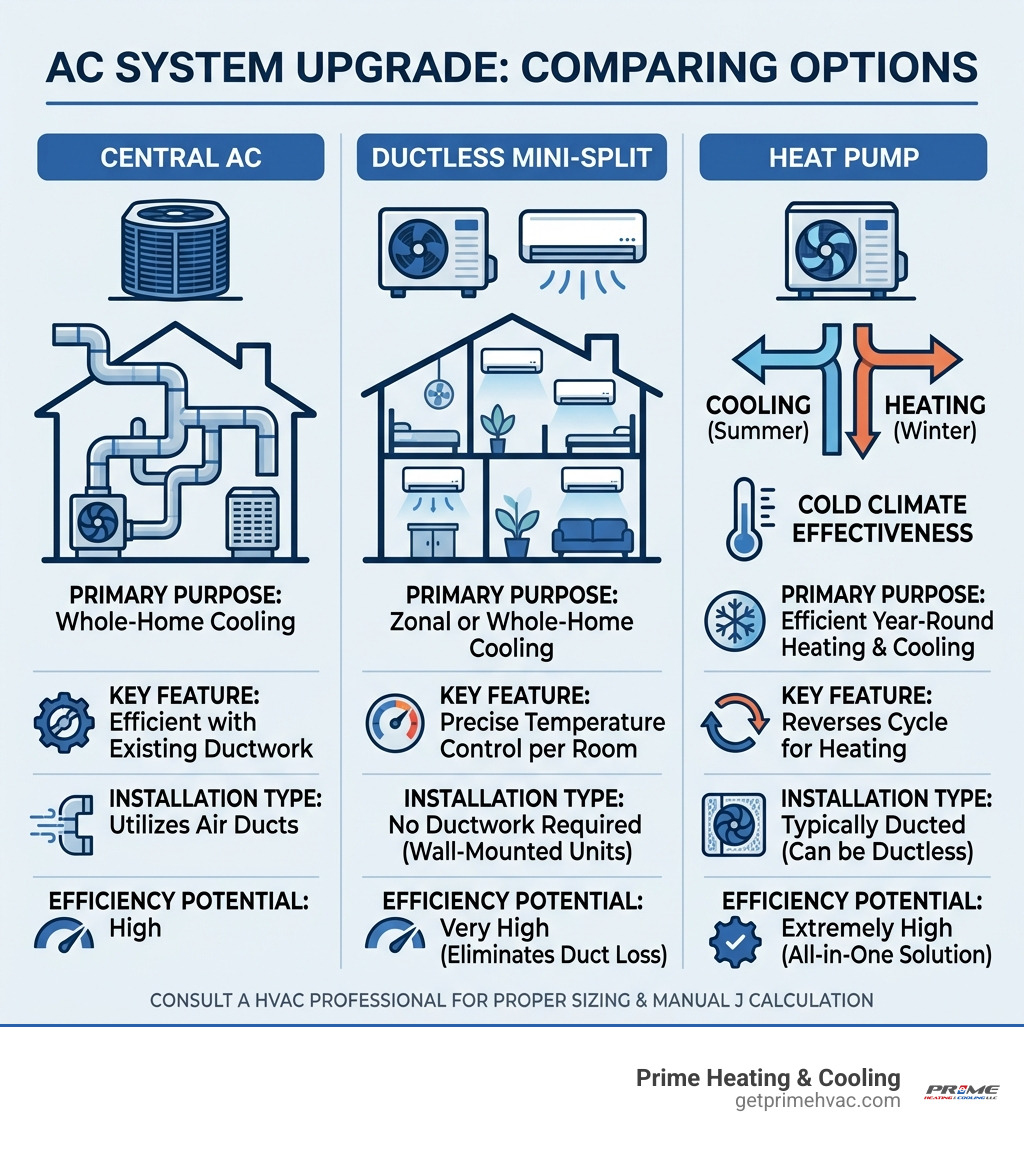
Choosing Between Central AC, Ductless, and Heat Pumps
There are three main paths for your upgrade:
- Central AC: Best for homes that already have functional ductwork. It’s the traditional choice, but modern high-efficiency models (like the Carrier Infinity series) offer variable-speed compressors that can adjust their output to maintain a perfect temperature within half a degree.
- Ductless Mini-Splits: Perfect for older Rhode Island homes without ducts, or for specific areas like a finished basement or a hot upstairs bedroom. These systems are incredibly efficient because they don’t lose energy through leaky ductwork—which can account for up to 30% of air loss.
- Heat Pumps: This is the “all-in-one” solution. A heat pump looks just like an AC unit but can reverse its process to provide heat in the winter. Modern cold-climate heat pumps are now effective even in our freezing New England winters. Upgrading to a heat pump is often the most eco-friendly and cost-effective long-term choice for AC installation in RI.
The Best Time of Year to Invest in a Replacement
Timing is everything. If you wait until your AC dies on a 95-degree day in July, you’re going to pay a premium. You’ll be competing with every other homeowner in Rhode Island, and contractor availability will be thin.
The “Sweet Spot” for an AC unit upgrade is the off-season: Late Fall or Early Spring.
- Lower Costs: Manufacturers often offer “shoulder season” rebates to keep inventory moving.
- Flexible Scheduling: We can get you on the calendar faster and spend more time fine-tuning your system’s calibration.
- Peace of Mind: You’ll be 100% ready before the first heatwave hits.
While many people think about their heaters in October, fall is actually a great time to upgrade because the weather is mild enough that you won’t miss your climate control during the 4-to-8-hour installation process.
Ensuring a Professional Installation for Long-Term ROI
The most expensive AC unit in the world will perform poorly if it isn’t installed correctly. In fact, poor installation can reduce a system’s efficiency by up to 30% and can even void your manufacturer’s warranty.
At Prime Heating & Cooling, we bring 20 years of experience to every job. Our process involves:
- EPA Certified Handling: We safely recover old refrigerants and ensure your new system is charged to exact specifications.
- Nitrogen Testing: We pressurize the lines with nitrogen to ensure there are zero leaks before we ever introduce refrigerant.
- Performance Testing: We don’t just “turn it on.” We measure airflow, static pressure, and temperature “delta” to ensure the system is performing exactly as the manufacturer intended.
Whether you need to stay cool this summer in Smithfield or you’re looking for the benefits of professional installation in North Smithfield, our team is available 24/7 to help.
An AC unit upgrade shouldn’t be a gamble. By following the $5,000 rule, choosing the right SEER2 rating, and insisting on a professional load calculation, you can turn a stressful breakdown into a smart, long-term investment in your home’s comfort and value. For more expert tips, browse our cooling services category.