
When Your AC Is Running But Your House Is Still Sweltering
AC unit not cooling is one of the most common HVAC complaints homeowners face — especially when temperatures climb and your system seems to be running just fine. The fan is blowing. You can hear the unit humming outside. But the air coming through your vents feels lukewarm at best.
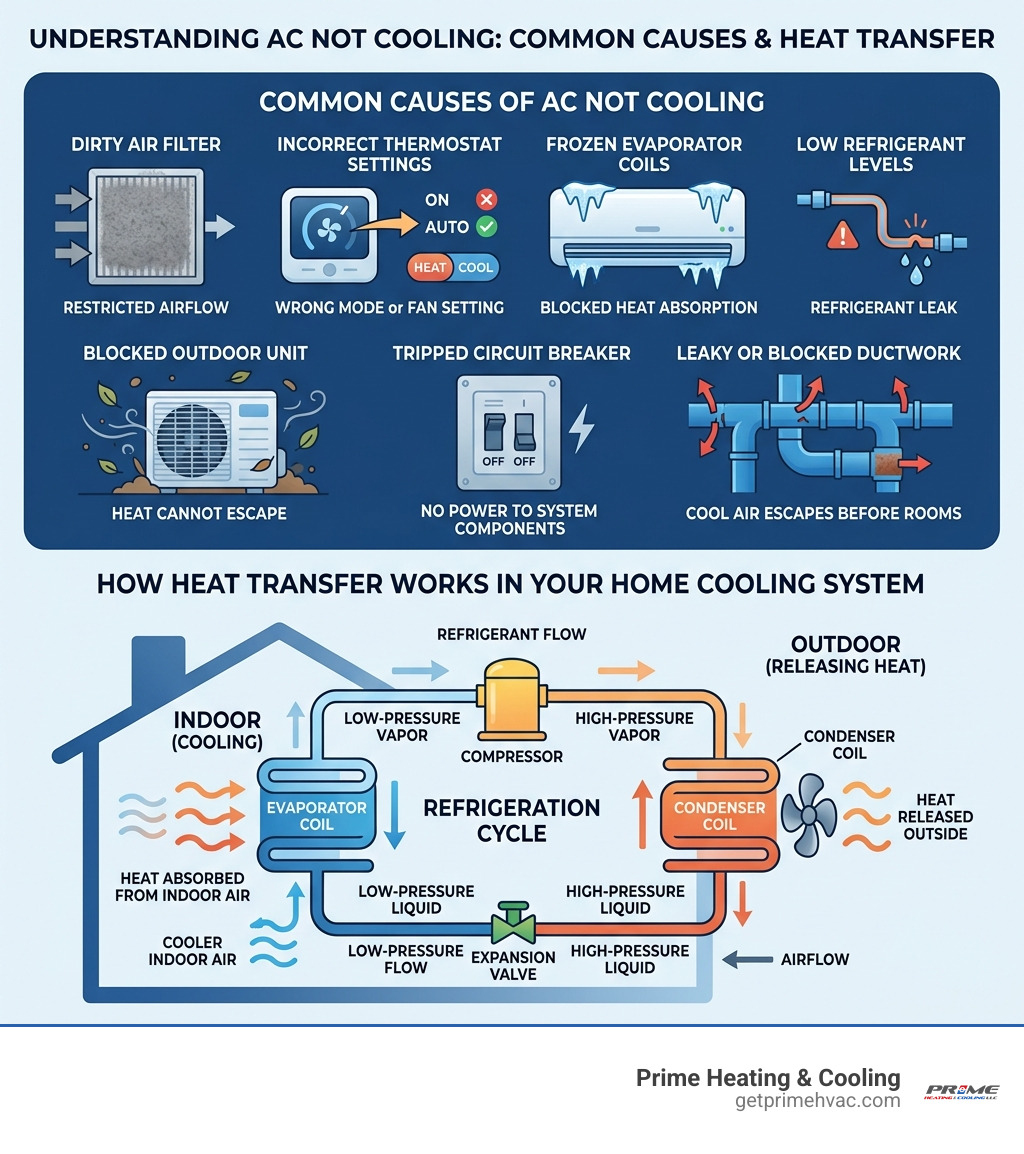
Here are the most common reasons your AC is running but not cooling your home:
- Dirty or clogged air filter — restricts airflow and starves the system
- Incorrect thermostat settings — fan set to “On” instead of “Auto,” or wrong mode
- Frozen evaporator coils — ice buildup blocks heat absorption entirely
- Low refrigerant levels — almost always caused by a leak in the system
- Blocked outdoor condenser unit — debris prevents heat from escaping outside
- Tripped circuit breaker — cuts power to part of the system silently
- Leaky or blocked ductwork — cool air escapes before it reaches your rooms
Most of these issues have a clear fix. Some are simple enough to handle yourself in under 10 minutes. Others require a licensed technician — especially anything involving refrigerant or internal electrical components.
There is a specific kind of frustration that comes with an AC that appears to be working. It gives you just enough false hope to be annoying. You adjust the thermostat, wait 20 minutes, and still nothing. Before you assume the worst, most “no cool” calls turn out to be something straightforward.
I’m Tyler Steiner, CEO and founder of Prime Heating & Cooling, and after years of diagnosing and repairing AC systems across Rhode Island and Massachusetts, I’ve seen how often an AC unit not cooling comes down to one small, fixable issue. In this guide, I’ll walk you through exactly how to find it — and what to do next.
Common Reasons for an AC Unit Not Cooling
When your home starts feeling like a sauna in the middle of a July afternoon in Warwick or East Greenwich, the culprit is usually a breakdown in the refrigeration cycle. Your AC doesn’t actually “create” cold; it removes heat from your indoor air and dumps it outside. If any part of that “hand-off” fails, your AC unit not cooling becomes your new reality.

The most frequent reason an air conditioner stops cooling is a dirty air filter. We often see filters so clogged they look like they’re wearing a “gray felt blanket” of dust and pet hair. This restricts airflow, which starves the evaporator coil of the warm air it needs to function. When airflow is restricted, the system has to work twice as hard for half the results, leading to airflow restriction and system strain.
Clogged vents and blocked return grilles are another common headache. If you’ve recently rearranged furniture in your Smithfield home and accidentally covered a large floor vent, you’re essentially suffocating your AC. Always ensure your registers are open and clear of rugs or furniture to maintain proper system pressure.
Is Your Thermostat the Reason for Your AC Unit Not Cooling?
Before you panic about mechanical failure, check the “brain” of your system. It sounds simple, but we receive many calls where the thermostat was accidentally bumped into “Heat” mode or the “Fan” was set to “On.”
When the fan is set to “On,” it blows air continuously, even when the cooling cycle isn’t running. This means you’ll feel warm air coming out of the vents during the “off” periods. Always set your fan to “Auto” so it only blows when the air is actually being chilled. If your thermostat screen is blank, it might just need a battery replacement. Also, consider the placement; if your thermostat is in a drafty hallway or under a sunny window in Providence, it might be getting “ghost” readings that prevent it from cooling your home accurately.
Blocked Outdoor Condenser Units
Your outdoor unit (the condenser) needs to breathe. Its job is to release the heat collected from inside your house. If it’s buried under overgrown weeds, mulch, or fallen leaves, that heat has nowhere to go.
As of May 2026, standard maintenance guidelines recommend at least two feet of clear space around the unit on all sides. Grass clippings from your weekly yard work in Johnston or North Providence can easily coat the delicate aluminum fins, acting like an insulating parka that traps heat inside. If the coils are dirty, the refrigerant can’t shed the heat, and the air coming out of your vents will stay stubbornly lukewarm.
Step-by-Step Troubleshooting for Homeowners
If your system is acting up, don’t lose hope just yet. Use this DIY troubleshooting guide to see if you can resolve the issue before calling in the pros.
| Task | DIY Difficulty | Professional Needed? |
|---|---|---|
| Replace Air Filter | Easy | No |
| Reset Circuit Breaker | Easy | No (if it only trips once) |
| Clear Debris Around Unit | Easy | No |
| Clean Condenser Coils | Moderate | Optional |
| Recharge Refrigerant | Illegal for DIY | Yes (EPA Certification Required) |
| Replace Capacitor | Dangerous | Yes (High Voltage Risk) |
How to Perform a Hard Reset
Sometimes the electronics in your AC just need a fresh start, especially after a summer thunderstorm power flicker in Coventry. To reset your system properly, follow the “3-minute rule.” This allows refrigerant pressures to equalize, preventing mechanical stress on the compressor.
- Turn off the AC at the thermostat.
- Find your electrical panel and flip the breakers for both the indoor air handler and the outdoor unit to “Off.”
- Wait at least 3 to 5 minutes.
- Flip the breakers back to “On.”
- Set your thermostat to “Cool” and lower the temperature to 3 degrees below the current room temp.
- Wait 10–15 minutes for the system to reach steady operation.
Cleaning Your Outdoor Unit Safely
You can improve your system’s efficiency by cleaning the outdoor coils yourself. First, always disconnect the power at the outdoor shut-off box (the “disconnect”). Use a garden hose on a gentle setting — never a pressure washer, as it will flatten the fragile fins! Aim the water at a 45-degree angle to wash away dirt and pollen. Monthly maintenance like this can prevent an AC unit not cooling during a record-breaking heatwave.
When the Problem is Under the Hood: Mechanical Failures
When DIY fixes don’t work, the problem is likely internal. Mechanical failures often present specific red flags that require an expert’s eye.

Low Refrigerant: A Major Cause of an AC Unit Not Cooling
Refrigerant is the “lifeblood” of your AC. A common misconception is that refrigerant is “used up” like gasoline in a car. In reality, it circulates in a closed loop. If your levels are low, you have a leak.
Signs of a leak include a hissing or gurgling sound near the unit and a gradual loss of cooling power over several days. Handling refrigerant requires EPA Section 608 certification because these chemicals can be toxic and are strictly regulated. If you suspect a leak, turn the system off immediately; running a system low on refrigerant can cause the compressor to overheat and fail entirely.
Frozen Evaporator Coils and Airflow Issues
If you see ice on the copper lines leading to your outdoor unit, your evaporator coils are likely frozen solid. Ice acts as an insulator, preventing the refrigerant from absorbing heat. This is usually caused by either a dirty filter or low refrigerant.
To fix this, turn the system to “Fan Only” mode. This allows the ice to melt without putting further strain on the compressor. Do not try to scrape the ice off, as you could puncture the coils. Once the ice has melted (which can take several hours), you can check your filter and vents. If it freezes again, it’s time to call a technician to check for deeper issues like a failing blower motor or a refrigerant leak.
Preventing Future Breakdowns and Estimating Repair Costs
Regular maintenance is the best way to avoid the “ghosting” AC. We recommend a professional tune-up twice a year — once in the spring for cooling and once in the fall for heating. This ensures your AC repairs in Rhode Island are kept to a minimum by catching small issues like a bulging capacitor before it leaves you in the heat.
The 5,000 Rule for System Replacement
If your system is older and struggling with the high Rhode Island humidity, you might be wondering if it’s time to move on. We use the “5,000 Rule”: Multiply the age of your unit by the estimated repair cost. If the total is more than $5,000, a replacement is usually the smarter financial move. Modern units are 20% to 40% more efficient than systems from just 10 years ago, meaning they often pay for themselves in energy savings.
Typical Costs for Common AC Repairs
While we won’t quote specific numbers here, it’s helpful to know what to expect. Simple electrical fixes, like replacing a run capacitor (the “battery” that starts your motor), are common and relatively affordable. Refrigerant recharges and leak repairs are more involved, while a compressor replacement is the most significant repair a system can undergo. If your unit is over 12–15 years old and the compressor fails, we almost always recommend a full system upgrade.
Frequently Asked Questions about AC Cooling Issues
Why is my AC running but not blowing cold air?
This is typically caused by a dirty air filter, a blocked outdoor condenser, or a refrigerant leak. If the air is moving but not cold, the system is failing to transfer heat effectively.
Should I turn off my AC if it is not cooling?
Yes! If your AC unit not cooling is blowing warm air or showing signs of ice, turn it off. Running a malfunctioning system can destroy the compressor, turning a simple repair into an expensive replacement.
How do I reset my central AC unit properly?
Turn it off at the thermostat, flip the breakers for 5 minutes, turn them back on, and wait 10 minutes for the cooling cycle to engage. This allows the system’s internal sensors to reboot.
Conclusion
Dealing with an AC unit not cooling doesn’t have to be a nightmare. By checking your filters, verifying your thermostat settings, and keeping your outdoor unit clear, you can solve many issues on your own. However, when the problem is “under the hood,” you need a team you can trust.
At Prime Heating & Cooling, we bring 20 years of experience to every home in Rhode Island, from Lincoln to Scituate and everywhere in between. Our skilled technicians are available 24/7 to ensure your family stays comfortable, no matter how high the mercury rises. Whether you need a quick repair or a high-efficiency system upgrade, we are here to help.
Don’t spend another night sweating in a hot house. Schedule professional service with us today and get your cool back!


