
Is Your AC Running But Not Cooling Your House? Start Here
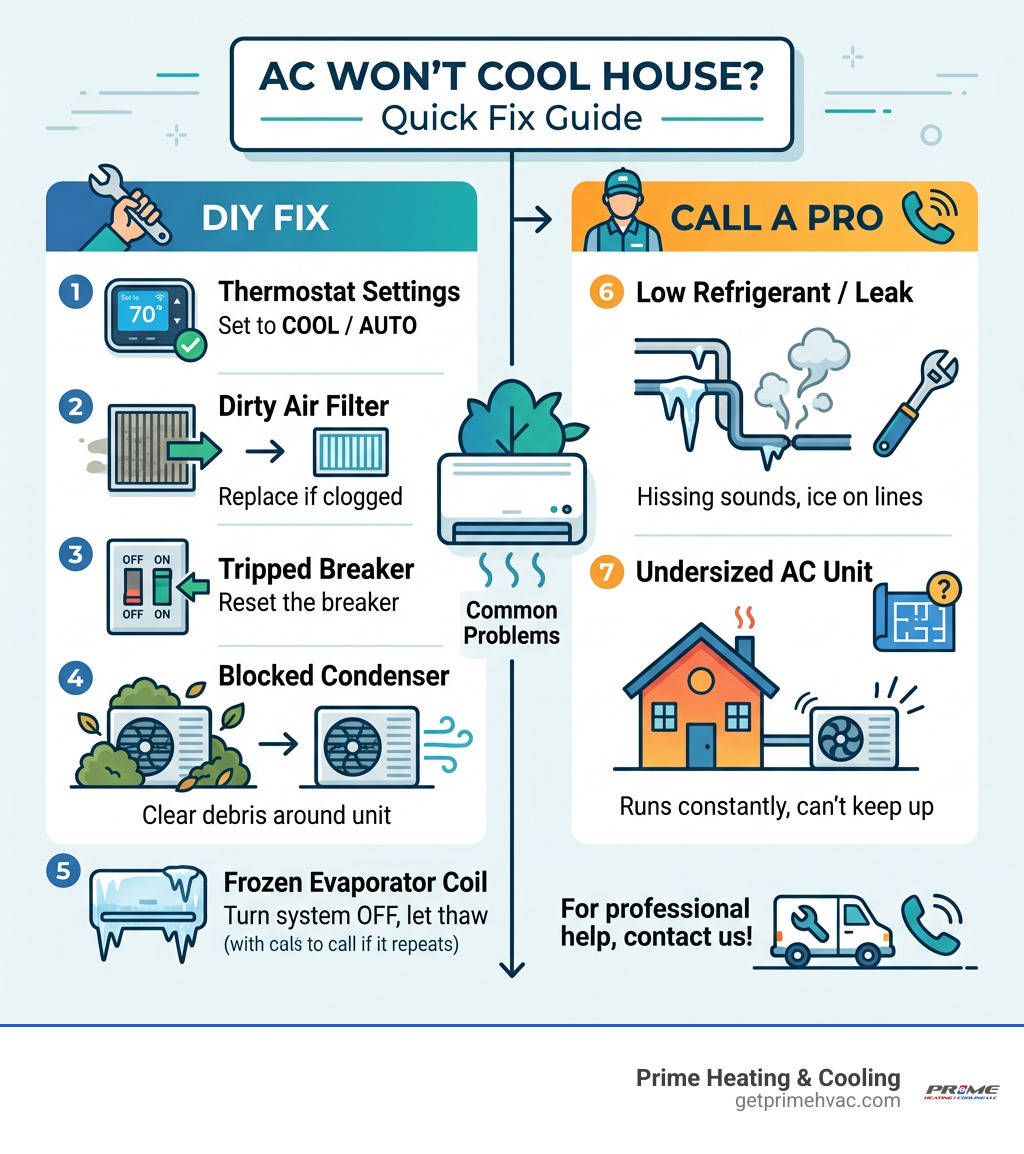
If your AC won’t cool house to a comfortable temperature, you’re not alone — and the fix is often simpler than you think. Here are the most common reasons and what to do first:
| Problem | Quick Check | DIY or Pro? |
|---|---|---|
| Wrong thermostat settings | Set to “Cool,” fan to “Auto” | DIY |
| Dirty air filter | Replace if clogged | DIY |
| Tripped circuit breaker | Reset the breaker | DIY |
| Blocked outdoor condenser | Clear debris around unit | DIY |
| Frozen evaporator coil | Turn system off, let thaw | DIY (then call if it repeats) |
| Low refrigerant / leak | Hissing sounds, ice on lines | Pro required |
| Undersized AC unit | Runs constantly, can’t keep up | Pro required |
Over three-quarters of all homes in the US have air conditioners. That makes air conditioning some of the most popular equipment around the country. There’s a good reason why homeowners spend a significant amount of money on efficient cooling; the sweltering heat of a Rhode Island summer can be unbearable. When your system loses its cooling capacity, it isn’t just a matter of comfort—it’s about energy efficiency and protecting your investment.
In this guide, we’ll walk you through exactly how to diagnose and fix them — from the simplest thermostat tweak to knowing when it’s time to call a professional.
I’m Tyler Steiner, CEO and founder of Prime Heating & Cooling, and after years of diagnosing and resolving every kind of AC won’t cool house scenario across Rhode Island and Massachusetts, I’ve seen how a systematic approach saves homeowners time, money, and a lot of unnecessary stress. Let’s get your home comfortable again.
Troubleshooting Why Your AC Won’t Cool House Effectively

When your AC won’t cool house spaces effectively, the first step is to stay calm and look at the control center: your thermostat. It sounds simple, but a significant number of service calls we receive in places like Warwick and Providence end up being related to simple setting errors.
If your air conditioner is running but the temperature isn’t dropping, check the power supply first. Is the display on the thermostat blank? It might just need new batteries. If the unit isn’t turning on at all, head to your electrical panel. Air conditioners draw a lot of power, and a surge or a particularly hot day can cause a tripped circuit breaker.
For more detailed steps on handling these initial hurdles, you can check our guide on DIY AC troubleshooting or explore our thermostat repair and installation guide to see if a calibration issue is the culprit.
Quick DIY Checks When Your AC Won’t Cool House
Before you assume the worst, perform these three quick checks. They solve the majority of “warm house” complaints.
- The Air Filter: This is the most common reason an AC won’t cool house interiors. A clogged filter restricts airflow, meaning your system has to work twice as hard to move half as much cool air. In some cases, the lack of airflow causes the indoor coil to freeze over entirely. We recommend checking your filter monthly and replacing it every 1-3 months. Learn more about the role of air filters in your AC system to understand how this simple part protects your compressor.
- Thermostat Settings: Ensure the system is set to “Cool” and the temperature is at least 5 degrees below the current room temperature.
- “Auto” vs. “On”: This is a big one. If your fan is set to “On,” the blower runs 24/7, even when the outdoor unit isn’t actually cooling the air. This results in the system blowing unconditioned, humid air back into your rooms during the “off” cycles. Switching to “Auto” ensures the fan only blows when the air is actually being chilled.
Identifying Airflow and Outdoor Unit Blockages
Your air conditioner doesn’t “create” cold; it removes heat from your home and dumps it outside. This happens at the outdoor condenser unit. If that unit is dirty or crowded, the heat has nowhere to go, and your AC won’t cool house air because it’s essentially “choking.”
- Vegetation and Debris: We often see outdoor units in North Providence or Smithfield overgrown with shrubs or covered in grass clippings. Clear at least two feet of space around the unit.
- Dirty Coils: The aluminum fins on the outdoor unit can get plugged with cottonwood, dust, and dirt. A gentle rinse with a garden hose (with the power off!) can often restore performance.
- Indoor Obstructions: Dirty or blocked registers are another silent performance killer. Ensure furniture or curtains aren’t covering your supply or return vents.
- Ductwork Issues: Did you know that up to 30 percent of conditioned air can vanish through gaps in attic or crawl-space ducts? If you have leaky ductwork, you’re paying to cool your attic while your living room stays warm. Pests like squirrels or rats in the attic can also damage ducts, leading to massive efficiency losses.
Signs of Mechanical Failure or an Undersized AC
If your airflow is clear and your settings are correct, but your AC won’t cool house rooms, you might be dealing with a mechanical failure.
Frozen Evaporator Coils: If you see ice on the copper lines leading to your indoor unit or frost on the coil itself, your system is literally “frozen.” This is usually caused by either restricted airflow (dirty filter) or low refrigerant. If this happens, turn the system off immediately and set the fan to “on” to thaw it out. You can find permanent fixes for frozen coils here.
Refrigerant Leaks: Your AC doesn’t “use up” refrigerant like a car uses gas. If it’s low, there is a leak. Signs include hissing noises, ice buildup, and high energy bills. Because refrigerant poisoning is a risk and handling these chemicals requires EPA certification, you must call a pro for refrigerant leak repair.
Undersized Units: Sometimes the unit itself is the problem. If your AC was installed without a proper Manual J calculation, it might be too small for your square footage. An undersized unit will run constantly but will never be able to keep up with a 90-degree day in East Greenwich.
| Symptom | Likely Cause | Recommended Action |
|---|---|---|
| Hissing/Bubbling noise | Refrigerant leak | Call a Professional |
| AC runs, but air is weak | Clogged filter/Duct leak | Change filter / Inspect ducts |
| Outdoor fan not spinning | Capacitor/Motor failure | Call a Professional |
| Ice on copper lines | Airflow issue/Low Freon | Thaw unit, then call Pro |
Professional Solutions and Maintenance to Keep Your Home Cool
When DIY steps fail, professional intervention is necessary to protect the heart of your system: the compressor. A struggling unit can draw 20 percent more power, leading to spiked energy bills and premature equipment death.
Modern systems are rated by SEER (Seasonal Energy Efficiency Ratio). If you have an older unit with a low SEER rating, it may simply lack the “muscle” to cool efficiently compared to modern, high-efficiency models. Understanding AC compressor repair is vital, as the compressor is often the most expensive part to replace—sometimes making a full system upgrade more cost-effective.
When to Call a Pro for an AC That Won’t Cool House
There are certain red flags that mean you should put down the screwdriver and pick up the phone. If you notice any of the following signs your air conditioner needs repair, it’s time to call in the experts:
- Electrical Issues: If your breaker trips repeatedly, do not keep resetting it. This indicates a high-amp draw or a short circuit that could cause a fire.
- Capacitor Failure: If you hear a humming sound from the outdoor unit but the fan isn’t spinning, the capacitor (which provides the “kick” to start the motor) has likely failed.
- Refrigerant Recharge: Only licensed technicians can legally handle and recharge refrigerants like R-410A or the now-phased-out R-22.
- Strange Smells: A burning smell indicates electrical trouble, while a musty odor often points to mold growth in the drain pan or ductwork.
While repair costs can vary, most common cooling issues like sensor replacements, capacitor swaps, or drain clearings typically fall within a $100–$2,000 range. Knowing when to call an AC technician early can prevent a $200 repair from turning into a $3,000 compressor replacement.
Seasonal Maintenance Tips for Peak Efficiency
The best way to ensure your AC won’t cool house problems don’t happen in the first place is through preventative maintenance. A typical central air conditioning system lasts between 15 and 20 years, but only if it’s cared for.
Our top 5 AC maintenance tips emphasize the “Big Three”:
- Annual Tune-ups: A professional should inspect your system every spring. We check refrigerant levels, tighten electrical connections, and lubricate the blower motor.
- Coil Cleaning: We use specialized cleaners to remove the “gunk” from your evaporator and condenser coils that a garden hose can’t reach.
- Duct Inspections: We ensure your ductwork is sealed and insulated, preventing that 30% air loss we mentioned earlier.
The importance of regular AC maintenance cannot be overstated. It keeps your SEER rating high and your utility bills low.
Conclusion: Restoring Comfort with Prime Heating & Cooling
Don’t spend another night tossing and turning in a humid house. If your AC won’t cool house rooms after you’ve checked the filter and thermostat, it’s time for a professional eye.
At Prime Heating & Cooling, we are your local Rhode Island HVAC experts. Whether you are in Johnston, Scituate, Coventry, or the East Side of Providence, our skilled technicians are ready to help. With over 20 years of experience and 24/7 availability, we pride ourselves on delivering reliable, energy-efficient solutions with a customer-first approach.
We understand the local climate and the unique challenges of cooling homes in the Ocean State. From quick repairs to full high-efficiency installations, we have the tools and the expertise to get your system running perfectly.
Ready to get your cool back? Schedule Professional AC Repairs in RI with Prime Heating & Cooling today and experience the difference that 20 years of local expertise makes.