
What Is Emergency Commercial HVAC and When Do You Need It?
Emergency commercial HVAC refers to urgent repair or replacement services for heating, ventilation, and air conditioning systems in business settings — available 24/7 when a failure can’t wait.
Here’s when you need emergency commercial HVAC service:
- Your system has completely stopped working
- You detect unusual odors (burning, gas, or rotten egg smell)
- A carbon monoxide detector has been triggered
- There are visible refrigerant or water leaks
- Airflow is so weak it violates safe workplace conditions
- Electrical components are failing or causing tripped breakers
Business operations depend on climate control more than most people realize. A failed HVAC system doesn’t just mean discomfort — it can halt production, spoil inventory, endanger employees, and put you out of compliance with OSHA ventilation standards.
The longer a system stays down, the more it costs you. Fast, expert response is the difference between a minor disruption and a major business crisis.
I’m Tyler Steiner, founder of Prime Heating & Cooling, and after years of working in complex commercial mechanical environments across New England, I’ve seen how quickly an emergency commercial HVAC situation can spiral without the right plan in place. In this guide, I’ll walk you through everything you need to know — from spotting the warning signs early to protecting your business long-term.
Explore more about Emergency commercial HVAC:
Identifying and Responding to an Emergency Commercial HVAC Crisis

When you are managing a property in Providence or Warwick, a system failure isn’t just a “maintenance ticket”—it’s a crisis. Identifying a true Emergency commercial HVAC situation requires distinguishing between a minor inconvenience and a threat to building integrity or occupant safety.
A total system failure is the most obvious emergency, but safety hazards often lurk in more subtle forms. Electrical distress, characterized by flickering lights when the AC kicks on or a repeatedly tripping breaker, can indicate a serious fire risk. Furthermore, for businesses using gas-powered boilers or furnaces, carbon monoxide (CO) is a major concern. Because CO is colorless, odorless, and tasteless, it is a silent killer. If a detector goes off, or if employees report sudden headaches and nausea, you must treat it as a life-threatening emergency.
Environmental factors in Rhode Island also play a role. According to FEMA research on HVAC flood mitigation, HVAC components are generally not flood-resistant. Exposure to water can destroy primary components like air handling units and compressors instantly. If your facility experiences flooding or severe storm damage, the electrical and mechanical risks are compounded, requiring a professional “all-clear” before attempting to restart the system.
Common Signs You Need Emergency Commercial HVAC Repair
Not every emergency starts with a bang. Often, the system gives you “hints” that a total breakdown is imminent. Recognizing these signs can help you call for Emergency commercial HVAC service before the building becomes uninhabitable.
- Refrigerant Leaks: If your AC is running but the air coming from the vents is lukewarm, you may have a refrigerant leak. This doesn’t just hurt cooling performance; it can damage the compressor, leading to a much more expensive replacement.
- Unusual Odors: A burning smell often points to electrical distress or a seized motor. A “rotten egg” smell usually indicates a natural gas leak.
- Strange Noises: Banging, screeching, or grinding sounds are signs of loose or broken internal parts. If ignored, these parts can fly loose and destroy the entire cabinet.
- Frozen Coils: If you see ice on your evaporator coils in the middle of a humid Rhode Island summer, your system has a serious airflow or refrigerant issue.
- Short-Cycling: When the unit turns on and off every few minutes, it is under immense stress. This rapidly wears out the starter components and hikes up your utility bills.
For a deeper dive into how we handle these complex issues, check out our more info about commercial services.
Immediate Steps for Facility Managers During a Breakdown
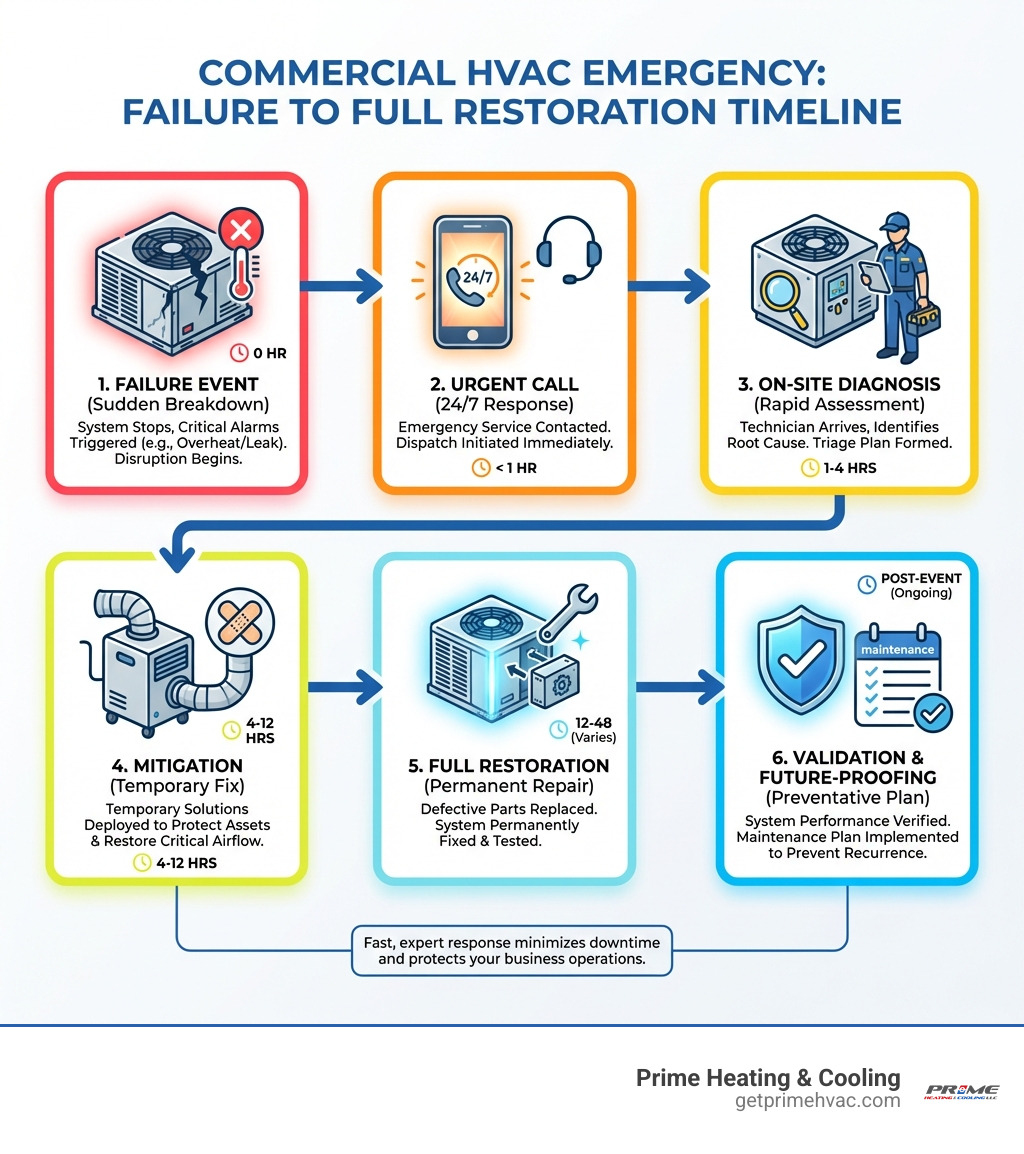
When the system quits, the first 15 minutes are critical. Following a structured emergency response plan can help minimize damage and keep people safe.
- Safety First: Check for immediate hazards like smoke, sparks, or the smell of gas. If you suspect a gas leak or fire, evacuate the building and call 911 immediately.
- Check the Basics: Verify that the thermostat is set correctly and hasn’t lost power. Check your electrical panel for tripped breakers, but do not reset a breaker more than once; if it trips again, there is a dangerous short circuit.
- Identify Priority Zones: In many commercial buildings, certain areas are more critical than others. Server rooms, laboratories, or areas with temperature-sensitive inventory should be your first focus for temporary cooling.
- Communicate Clearly: Inform your team and occupants about the situation. Provide an estimated timeline if you have one, and advise them on whether they need to relocate to a different part of the building.
- Call the Professionals: Contact a trusted 24/7 provider. At Prime Heating & Cooling, we recommend having our number saved in your emergency contact list to shave precious minutes off your response time.
Temporary Solutions and Emergency Commercial HVAC Rentals
Sometimes, a permanent fix takes time—especially if a custom part needs to be ordered for an older system. In these cases, we look toward temporary stabilization to keep your business running.
| Solution | Best For | Speed of Deployment |
|---|---|---|
| Portable AC Units | Small offices, server rooms, and retail “hot spots.” | Immediate |
| Rental Chillers | Large industrial plants or hospitals needing massive cooling. | 12–24 Hours |
| Mobile Boilers | Providing heat and hot water during winter outages. | 24 Hours |
| Power Generation | Keeping HVAC running during a utility grid failure. | 4–8 Hours |
Temporary cooling and heating can bridge the gap, ensuring you don’t lose thousands in revenue while waiting for a specialized component. For businesses in our local area, we offer tailored more info about commercial services in Rhode Island to help manage these transitions smoothly.
Protecting Your Business with Proactive Planning and Expert Support
The best way to handle an Emergency commercial HVAC situation is to prevent it from happening in the first place. At Prime Heating & Cooling, we’ve been serving Rhode Island for 20 years, and we’ve noticed a pattern: most emergencies happen to systems that haven’t seen a technician in over a year.
Preventative maintenance is the “secret sauce” for business continuity. Regular checks ensure that small issues—like a frayed belt or a slightly low refrigerant charge—are caught before they turn into a 2:00 AM emergency call. Furthermore, maintenance keeps your system running at peak energy efficiency. If your commercial system is 10 years old or older, it may be time to consider an upgrade. Older systems are notorious for causing utility bills to climb as they struggle to maintain setpoints, and their parts become increasingly difficult to source in a hurry.
Investing in a maintenance plan isn’t just an expense; it’s an insurance policy for your equipment’s lifecycle. For our neighbors across the border, you can find more info about commercial services in MA to see how we help businesses stay ahead of the curve.
The Critical Role of 24/7 Professional Service
When a rooftop unit fails in Johnston or a boiler quits in Smithfield, “business hours” don’t matter. You need a partner who answers the phone at midnight. The critical role of 24/7 service cannot be overstated for businesses that operate around the clock or house sensitive materials.
A professional response team brings more than just a ladder; they bring stocked vehicles filled with common replacement parts, allowing for “one-and-done” repairs in many cases. This speed is essential for maintaining OSHA guidelines regarding indoor air quality and ventilation. Without proper airflow, CO2 levels can rise, and pollutants can accumulate, creating a “Sick Building Syndrome” that tanks employee productivity.
We take pride in our rapid response times and technical expertise. Learn more about our local impact by visiting our page on more info about commercial HVAC in Johnston RI.
Mitigation Strategies for Natural Disasters
Rhode Island businesses face unique challenges, from coastal flooding to high-wind winter storms. Protecting your HVAC system requires specific mitigation strategies:
- Equipment Elevation: Following FEMA guidelines, elevating outdoor compressors and indoor units onto platforms above the flood protection level is the most effective way to prevent total loss during a storm.
- Wind Anchoring: Rooftop units should be securely anchored to the building structure to resist high-velocity winds and prevent them from shifting or being blown off the roof.
- Watertight Enclosures: For systems that cannot be elevated, dry floodproofing using watertight walls or gasketed enclosures can protect equipment for flood depths up to 12 inches.
- Isolation Valves: Installing isolation valves and dampers above expected flood levels allows technicians to isolate damaged sections of the system quickly, speeding up the overall repair process.
If you’re located near the coast, you might find our specific advice for more info about commercial HVAC in Warwick RI particularly helpful for storm readiness.
Choosing the Right Partner for Long-Term Reliability
When the pressure is on, you don’t want to be searching for a contractor. You want a partner who knows your building, your system, and your specific business needs. Prime Heating & Cooling brings 20 years of experience to every job, combining deep technical knowledge with a customer-first approach.
We believe in upfront pricing—no hidden “emergency fees” that catch you off guard. Our goal is to solve the root of the problem the first time, not just slap on a temporary bandage. By offering customized maintenance agreements, we help you transition from reactive “firefighting” to proactive management.
Whether you are in Providence, Lincoln, or East Greenwich, we are ready to serve. If you’re facing a crisis now or want to make sure you never have one, contact us for expert HVAC services today. We’ll keep your business comfortable, compliant, and—most importantly—operational.


