
How Long Do AC Units Last? Here’s What Most Homeowners Don’t Know
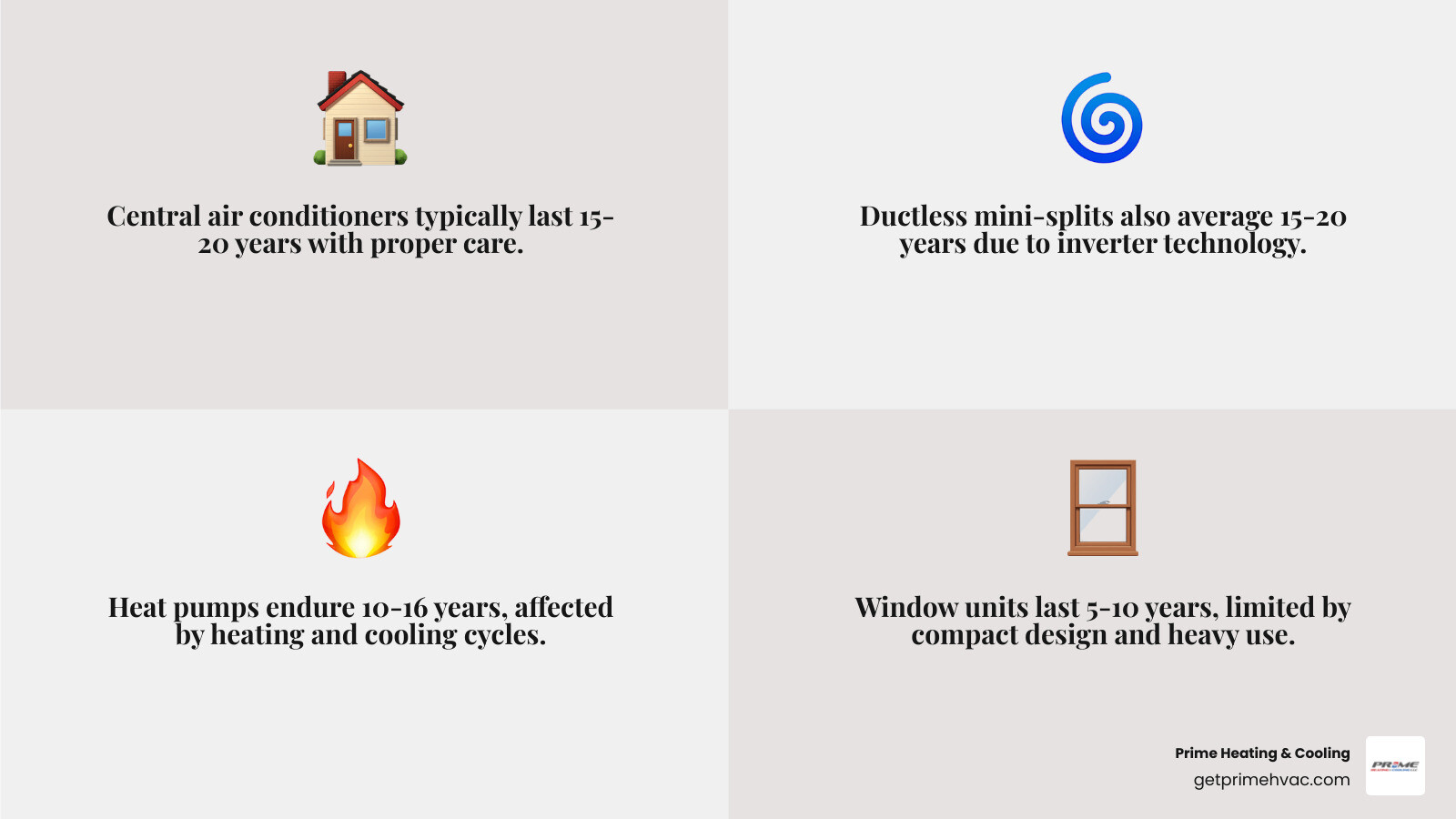
How long do AC units last? The short answer depends on the type of unit you have — but here’s a quick breakdown:
| AC Unit Type | Average Lifespan |
|---|---|
| Central Air Conditioner | 15-20 years |
| Ductless Mini-Split | 15-20 years |
| Heat Pump | 10-16 years |
| Window Unit | 5-10 years |
The bottom line: With proper maintenance, most AC systems will serve you well for 15 to 20 years. Without it, that number drops — sometimes dramatically.
But lifespan isn’t just about the calendar. Two identical AC units can have very different endings. One installed in a well-insulated Rhode Island home, serviced every year, might run strong past the 20-year mark. Another in a coastal property, skipped on maintenance, might struggle past 10.
That variability is exactly why this question doesn’t have one simple answer.
Factors like how often your system runs, where you live, how it was installed, and how well it’s been maintained all play a role. We’ll break all of that down in this guide.
I’m Tyler Steiner, founder and CEO of Prime Heating & Cooling, and over my career installing and servicing HVAC systems across New England, I’ve seen how the answer to how long do AC units last changes based on the choices homeowners make. Let’s walk through what actually drives those numbers — so you can protect your investment.
Factors That Determine How Long Do AC Units Last?
When we talk about the lifespan of an air conditioner, we often compare it to a car. If you drive a truck 50,000 miles a year through salt-covered winter roads and never change the oil, it isn’t going to last as long as the sedan that sits in a garage and gets a tune-up every spring. Your AC is no different.
Several key factors dictate whether your system will be a “marathon runner” or an early retiree.
The Importance of Maintenance
The single most influential factor in determining how long do AC units last is maintenance. We cannot stress this enough. A system that is neglected will accumulate dust on the coils, strain the compressor, and eventually burn out its most expensive components years before its time.
Professional AC maintenance ensures that your system operates at peak efficiency. When a technician performs regular AC maintenance, they are looking for the “silent killers” of HVAC systems—things like refrigerant leaks, failing capacitors, or clogged drain lines that the average homeowner might not notice until the unit stops blowing cold air entirely.
Usage Patterns and Thermostat Settings
How hard do you push your system? If you like your home to feel like a walk-in freezer (say, 68°F) when it is 90°F outside in Providence, your unit is going to run significantly more hours than a neighbor who keeps their thermostat at 78°F.
Frequent “cycling”—the turning on and off of the unit—also adds wear and tear. Systems that run in long, efficient cycles generally last longer than those that are constantly jolted into action by extreme thermostat settings.
The Rhode Island Climate Factor
Living in the Ocean State brings unique challenges. Our humidity levels can be quite high, which forces the AC to work double duty: cooling the air and removing moisture. Furthermore, if you live in coastal areas like East Greenwich or Warwick, the salt air is a real threat. Salt is highly corrosive to the delicate aluminum fins on your outdoor condenser coils. Without specialized coatings or frequent cleaning, coastal units often see a lifespan reduction of several years compared to units in inland towns like Smithfield or Johnston.
Proper System Sizing and Installation
You could buy the most expensive, top-of-the-line unit on the market, but if it is installed poorly, it won’t last. Proper system sizing is critical. We use what is called a Manual J calculation to determine the exact cooling load of your home.
- Oversized units cool the house too fast, leading to “short cycling,” which beats up the compressor.
- Undersized units never stop running, leading to premature motor failure.
Getting the size right from day one is the foundation of a long-lasting system.

Average Lifespan: How Long Do AC Units Last by Type?
Not all air conditioners are created equal. Depending on the technology and the physical location of the unit, you can expect different levels of durability.
Central Air Conditioners (15–20 Years)
Central AC is the workhorse of Rhode Island homes. These systems typically consist of an indoor evaporator coil and an outdoor condensing unit. Because the “guts” of the system are split, and the outdoor portion is built to withstand the elements, a well-maintained central AC can easily hit the 20-year mark. However, in our region, we generally suggest homeowners start planning for a replacement once the unit hits 15 years, as efficiency begins to drop significantly.
Ductless Mini-Splits (15–20 Years)
Mini-split systems have gained massive popularity in places like the East Side of Providence and older homes in Scituate where ductwork isn’t feasible. These units are incredibly efficient and often use inverter technology, which allows the compressor to vary its speed rather than just turning full-on or full-off. This reduced strain often leads to a lifespan of 20 years or more if the filters are kept clean.
Heat Pumps (10–16 Years)
Wait, why do heat pumps last less time than central AC? It’s a common question. The answer is simple: they work twice as hard. A central AC only runs for 3–4 months of the year in New England. A heat pump provides both cooling in the summer and heating in the winter. Because it is running year-round, it accumulates “mileage” much faster. According to a comprehensive HVAC lifespan guide, while newer models are getting more durable, 10–15 years is the realistic window for a primary heat pump.
Window and Portable Units (5–10 Years)
These are “disposable” appliances in the eyes of the industry. They are built with cheaper components and are often subjected to harsh storage conditions (like being shoved into a dusty attic or damp basement during winter). If you get 8 years out of a window unit, you’ve done well.
How Maintenance Affects How Long Do AC Units Last?
If you want to know the secret to extending HVAC life, it boils down to one word: Airflow. Anything that restricts air from moving through your system makes the components work harder, get hotter, and fail sooner.
The Power of the Filter
The most important DIY task you have is filter replacement. A clogged filter is like trying to breathe through a straw while running a marathon. It forces the blower motor to work overtime and can actually cause your indoor coils to freeze into a block of ice. We recommend checking your filters every 30 days during the peak of summer.
Coil Cleaning and Debris Removal
Your outdoor unit (the condenser) is responsible for releasing the heat collected from inside your home. If the coils are covered in dirt, grass clippings, or “cottonwood” fuzz, the heat gets trapped. This causes the refrigerant temperature to skyrocket, putting immense pressure on the compressor. Cleaning your coils and keeping a 2-foot “clear zone” around your outdoor unit can add years to its life.
Professional Annual Inspections
While DIY tasks are great, a professional technician has tools you don’t. During an annual inspection, we check:
- Refrigerant Charge: Too much or too little refrigerant will kill a compressor.
- Electrical Connections: Loose wires can cause “pitting” and electrical shorts.
- Condensate Drains: We clear these to prevent water damage to your home.
- Airflow Optimization: We ensure your ductwork is delivering the air correctly.
When to Replace Your Aging Air Conditioner
Even with the best care, entropy eventually wins. There comes a point where pouring money into an old unit is like putting a new transmission in a car with 300,000 miles.
Signs You Need Replacement
Knowing the signs you need replacement can save you from a “no-cooling emergency” in the middle of a July heatwave. Watch for these red flags:
- Frequent Repairs: If you’ve called us for HVAC repair services more than twice in the last two years, your unit is telling you it’s tired.
- Strange Noises: Squealing, grinding, or banging sounds often indicate a failing motor or compressor. Don’t ignore these red flags.
- Rising Energy Bills: If your usage hasn’t changed but your bills are creeping up, your system is losing its efficiency.
- The R-22 Factor: If your unit was built before 2010, it likely uses R-22 (Freon). This refrigerant has been phased out for environmental reasons. Repairing a leak in an R-22 system is now prohibitively expensive because the gas is no longer manufactured.
If you are unsure about your system’s health, it’s best to call an AC technician for a professional assessment. At Prime Heating & Cooling, we believe in transparency—if a repair makes sense, we’ll tell you. If you’re throwing “good money after bad,” we’ll help you schedule expert HVAC services to find a replacement that fits your budget.
Repair vs. Replace: Making the Right Choice
This is the $64,000 question (though hopefully, the repair isn’t that much!). How do you decide?
The $5,000 Rule
A popular industry benchmark is the $5,000 Rule. You multiply the age of the unit by the cost of the repair. If the total is more than $5,000, you should replace it.
- Example: A 12-year-old unit needs a $500 repair. (12 x 500 = 6,000). Replace it.
- Example: An 8-year-old unit needs a $300 repair. (8 x 300 = 2,400). Repair it.
The 50% Rule
If a single repair costs 50% or more of the value of a new system, it’s almost always better to upgrade. New systems come with a fresh warranty (usually 10 years), giving you peace of mind that a repair bill doesn’t.
Efficiency Gains (SEER2)
Modern units are measured by their SEER2 (Seasonal Energy Efficiency Ratio) rating. A unit from 15 years ago might have a SEER of 10. Today’s minimum is 14 or 15, and high-efficiency models go much higher. Upgrading can often slash your cooling costs by 30-50%, meaning the new unit eventually pays for itself in energy savings.
Impact of Climate and Location on Durability
Rhode Island presents a unique “micro-climate” for HVAC equipment.
Coastal vs. Inland
As mentioned, salt air in North Kingstown or Warwick can lead to “coil rot.” The salt eats away at the heat transfer surfaces. If you live within five miles of the coast, we highly recommend rinsing your outdoor unit with a gentle stream of fresh water from a garden hose once a month to remove salt deposits.
Humidity and the Evaporator Coil
In humid climates, the evaporator coil (the indoor part) is constantly wet. This can lead to the growth of biological organisms or “dirty sock syndrome.” If your air smells musty, it’s a sign that the coil is struggling. High humidity also places a heavier load on the blower motor, as damp air is “heavier” and harder to move than dry air.
The Role of Installation and Sizing
We often say that the most important day in the life of an air conditioner is the day it is installed.
Airflow Balance and Ductwork
Even the best AC can’t perform if the “veins” of the house—the ducts—are leaking or restricted. During a professional installation, we assess the ductwork integrity. If air is leaking into your attic or crawlspace, the AC has to run longer to satisfy the thermostat, shortening its life.
Component Matching
When replacing an outdoor unit, some contractors try to save money by leaving the old indoor coil. This is a mistake. Modern refrigerants operate at different pressures, and mismatched components lead to “slugging” (liquid refrigerant entering the compressor), which causes instant and catastrophic failure. Always ensure your system is a “matched set.”
Tips to Maximize Your Unit’s Longevity
Want to push that 15-year average toward 20 or 25? Follow these expert tips:
- Use a Smart Thermostat: These prevent “overshooting” and allow you to program temperature swings so the unit isn’t cooling an empty house.
- Improve Home Insulation: The less heat that leaks into your home, the less your AC has to work. Seal air leaks around windows and doors in older homes in Lincoln or Coventry.
- Shade the Outdoor Unit: If your condenser is in the direct afternoon sun, it has to work harder to shed heat. Planting a tall hedge (at least 3 feet away) or installing it on the north side of the house can help.
- Set Consistent Temperatures: Avoid “cranking it down” to 65°F when you get home. It doesn’t cool the house faster; it just makes the system run a marathon. Set it and forget it.
- Seasonal Preparation: Before the first heatwave hits, do a test run. Listen for odd noises and ensure the air coming out of the vents is at least 15-20 degrees cooler than the room temperature.
Conclusion
So, how long do AC units last? In Rhode Island, you should expect a solid 15 to 20 years for a central system, provided you treat it with respect.
Your air conditioner is a complex piece of machinery. It’s the heart of your home’s comfort during our humid New England summers. By staying on top of filter changes, keeping the outdoor unit clear, and scheduling that all-important annual tune-up, you can ensure your system doesn’t “lose its cool” prematurely.
If your system is getting up there in age, or if you’ve noticed it’s struggling to keep up with the Rhode Island humidity, don’t wait for it to fail on a 95-degree day. Reach out to us at Prime Heating & Cooling. With over 20 years of experience serving our neighbors from Woonsocket to Westerly, we have the expertise to keep your home comfortable for decades to come.