Why Homeowners Are Choosing Ductless Mini Split Systems
Ductless mini split installation is the process of setting up a highly efficient heating and cooling system that requires no ductwork—just an indoor unit, an outdoor compressor, and a small conduit connecting them. Here’s what you need to know:
The Basic Installation Process:
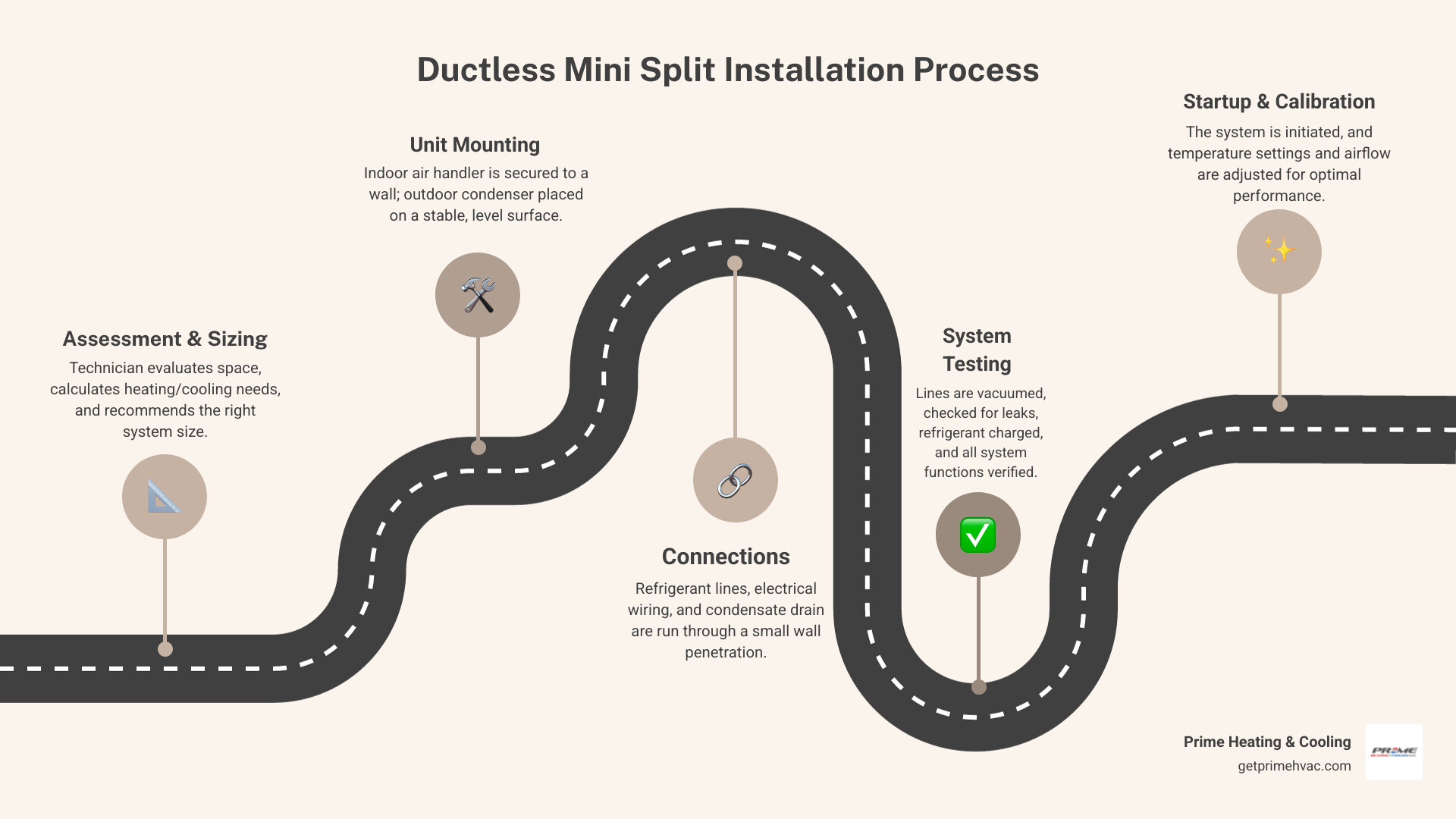
- Professional Assessment – A technician evaluates your space, calculates heating/cooling needs, and recommends the right system size.
- Indoor Unit Mounting – The air handler is secured to an interior or exterior wall.
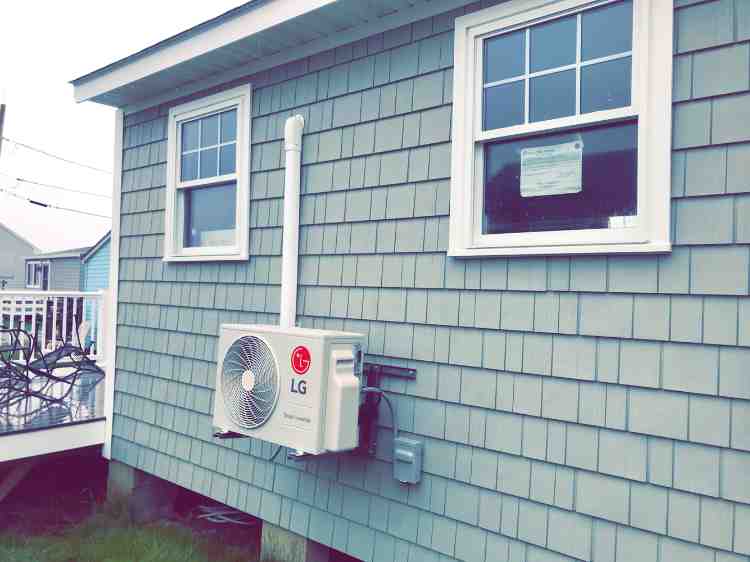
- Outdoor Unit Placement – The condenser is installed on a stable, level surface with proper airflow clearance.
- Connecting Components – A small hole (2-3 inches) is drilled through the wall for refrigerant lines, electrical wiring, and a condensate drain.
- System Testing – The technician vacuums lines, checks for leaks, charges refrigerant, and tests all functions.
- Final Calibration – Temperature and airflow are adjusted for optimal performance.
Average Installation Cost: $2,000 – $10,500 (typically around $7,500)
Installation Time: Most single-zone systems are completed in one day.
Key Benefit: These systems can cut energy costs by up to 60% compared to traditional HVAC, thanks to high efficiency ratings (SEER2 from 17-42) and zoned operation.
Tired of uneven temperatures and high energy bills? Ductless mini splits offer a flexible, energy-efficient alternative to traditional central air, especially for older homes without existing ductwork. They’re quickly becoming the go-to solution for homeowners across New England.
The appeal is simple: no ducts, no waste, no problem. Unlike conventional HVAC systems that lose 20-30% of their energy through leaky ductwork, ductless systems deliver conditioned air directly into each room. You’re not paying to heat or cool empty spaces.
As Tyler Steiner, founder of Prime Heating & Cooling, I’ve overseen hundreds of ductless mini split installations across Rhode Island and Massachusetts. My team and I have seen how the right installation transforms homes—and how the wrong one creates headaches.
Why Go Ductless? The Unbeatable Benefits for Your Home
When we talk about ductless mini split installation, we’re not just installing an appliance; we’re upgrading your entire home comfort experience. These systems bring advantages that traditional HVAC can’t match, especially for homes in Rhode Island and Massachusetts.
One of the biggest draws is energy efficiency. Mini-splits eliminate the energy loss—up to 30%—common in conventional systems with leaky ducts. Conditioned air is delivered directly into the room. Plus, their inverter-driven compressors adjust speed to meet demand, avoiding the energy waste of constantly cycling at full power. This efficiency can cut homeowner energy costs by up to 60%!
This incredible efficiency translates directly into significant cost savings. Imagine saving up to 50% on your utility bills! Ductless heat pumps are cost-effective because they allow for zoned cooling and heating. You only condition the rooms you are using, eliminating wasted energy.
Beyond savings, ductless systems offer unparalleled zoned heating and cooling. This is a game-changer for household harmony. Each indoor unit operates independently, allowing for room-by-room temperature control. If one person prefers a cool bedroom while another likes a warm office, everyone can be comfortable.
Improved indoor air quality is another key benefit. Without extensive ductwork, there are fewer places for dust, allergens, and contaminants to accumulate and circulate. While filters still need regular cleaning, the inherent design of ductless systems contributes to a cleaner, healthier home.
Then there’s the quiet operation. Traditional HVAC systems can be noisy. Mini-splits are designed to operate very quietly, both indoors and out. The indoor units are typically whisper-quiet, allowing you to enjoy your space without the constant hum of conventional systems.
The flexible installation is particularly beneficial for older homes in Rhode Island and Massachusetts that lack ductwork for central air. Mini-splits are the perfect solution for these properties, as well as for home additions, basements, or garages where extending ductwork would be costly or impractical.
Finally, let’s not forget the environmental benefits. By significantly reducing energy consumption, ductless systems lower your home’s carbon footprint. Modern systems use refrigerants with lower global warming potential and have advanced features that improve their eco-credentials.

The Professional Ductless Mini Split Installation Process
A professional ductless mini split installation with a team like ours at Prime Heating & Cooling ensures a smooth and rewarding experience. Proper installation is the bedrock of your system’s performance and longevity.
The process begins with a thorough professional assessment. Our licensed technicians visit your home in Smithfield, Johnston, Smithfield, or anywhere across Rhode Island and Massachusetts to evaluate your space. This involves a detailed load calculation (Manual J), which considers your home’s square footage, insulation, windows, ceiling height, and local climate. An improperly sized unit will run inefficiently and wear out faster. We are dedicated to recommending the best mini-split solution for your specific needs.
Following the assessment, we help you with choosing a quality system. We guide you toward trusted, energy-efficient options that fit your budget. A key metric is the SEER2 rating. As of January 1, 2023, the Department of Energy mandated a minimum SEER2 rating of 15. However, many mini-splits boast ratings from 17 to 42. A higher SEER2 rating means greater energy efficiency and lower operating costs.
Before work begins, we handle the necessary permits and regulations. In most areas of Rhode Island and Massachusetts, installing a mini-split requires permits. Our team is well-versed in local building codes, ensuring your installation is safe, efficient, and fully compliant. We take care of this paperwork for you.
Key Factors for Your Ductless Mini Split Installation: Sizing and Location
Proper sizing and location are paramount for your mini-split to perform optimally.
For sizing, we look at:
- Room size: Larger rooms require more BTU capacity.
- Insulation levels: Well-insulated rooms retain conditioned air better. Older homes in Providence or Warwick might require higher capacity.
- Window placement: Large, south-facing windows can increase heat gain, impacting the required BTU output.
- Climate considerations: Our New England climate requires a system robust enough to handle extreme temperatures efficiently, even sub-zero conditions.
For location, we consider:
- Indoor unit placement: We help you choose a spot on an interior wall for even air distribution and aesthetics.
- Outdoor unit placement: The condenser needs a stable, level surface with proper clearance requirements for airflow, away from direct sun and accessible for maintenance.
- Proximity of units: Minimizing the distance between indoor and outdoor units generally improves efficiency and reduces installation complexity.
Step-by-Step: What to Expect on Installation Day
Here’s a rundown of what to expect during your ductless mini split installation:
- Mounting the Indoor Unit: Our team securely attaches a mounting bracket to the chosen wall to hold the indoor air handler.
- Drilling for the Conduit: A small hole (2-3 inches) is drilled through the wall for the line set (refrigerant lines, wiring, drain hose). We drill at a slight angle for drainage and seal the opening.
- Placing the Outdoor Condenser: The outdoor unit is positioned on a solid, level pad or mounted on a sturdy wall bracket with sufficient clearance.
- Running Lines and Wiring: The pre-insulated line set is routed from the indoor unit to the outdoor condenser. We also run the necessary electrical wiring, ensuring it complies with local codes.
- Connecting Refrigerant and Drain Lines: Refrigerant lines are carefully connected to both units using specialized tools. The condensate drain line is routed to ensure proper moisture disposal.
- Vacuuming and Pressure Testing: This critical step removes all air and moisture from the refrigerant lines, which can damage the compressor. We then perform a pressure test to confirm there are no leaks.
- System Startup and Calibration: We open the refrigerant valves, power up the unit, and test all functions. We then calibrate the system for peak efficiency and comfort.
- Final Walkthrough and Cleanup: We clean the work area, remove all debris, and conduct a walkthrough with you, explaining how to operate and maintain your new system.

DIY vs. Professional Installation: A Critical Decision
The idea of a DIY ductless mini split installation might seem appealing for its potential cost savings and flexibility. However, our 20 years of experience at Prime Heating & Cooling has shown us that professional expertise is essential.
Let’s look at a critical comparison:
| Factor | DIY Installation | Professional Installation |
|---|---|---|
| Cost | Lower upfront costs (no labor fees), but high risk of costly errors and repairs. | Higher upfront cost, but long-term savings from optimal efficiency and extended system life. |
| Time | Can be flexible, but often takes significantly longer due to learning curve and issues. | Most single-zone systems completed in 1-2 days. |
| Safety | High risk of electrical hazards, refrigerant burns, and improper unit handling. | Licensed technicians minimize risks, ensuring safe electrical and refrigerant practices. |
| Warranty | Most manufacturer warranties are voided without professional installation. | Manufacturer warranties remain valid, protecting your investment. |
| Tools | Requires specialized, expensive tools (vacuum pump, manifold gauges, flare tools). | Technicians arrive with all necessary, calibrated, professional-grade equipment. |
| Performance | High risk of inefficiency, leaks, and premature failure due to improper setup. | Optimal performance, energy efficiency, and reliable operation guaranteed. |
The cons of DIY installation are significant. These systems demand technical know-how. The electrical work requires understanding wiring and local codes to prevent electrical hazards like system damage, fire, or injury.
Then there’s the refrigerant. Mini-splits use refrigerants like R-410A that operate at high pressures. Improper handling can cause serious burns, and releasing it is illegal. Proper handling requires EPA certification and specialized equipment like a vacuum pump to remove moisture from the lines. Without this, your system will be inefficient and fail prematurely.
Perhaps the biggest drawback is voiding the manufacturer warranty. Most reputable brands require installation by a licensed HVAC professional to keep the warranty valid. Trying to save money upfront could cost you thousands in future repairs.
Furthermore, code compliance is a must. Ductless mini split installation in Rhode Island and Massachusetts requires permits. Professionals ensure all work adheres to local codes, preventing fines and safety issues.
The value of professional installation extends beyond avoiding problems. Our team ensures proper sizing, optimal placement, and meticulous execution of every step. This attention to detail maximizes your system’s energy efficiency, comfort, and lifespan. We provide comprehensive HVAC installation and maintenance services, ensuring your system runs smoothly for years.
Understanding the Costs and Long-Term Savings
Let’s talk numbers – because understanding the financial aspect of a ductless mini split installation is crucial for homeowners in Rhode Island and Massachusetts. While the initial investment might seem substantial, it’s important to view it through the lens of long-term savings and increased home value.
The average cost to install a ductless mini split system ranges between $2,000 and $10,500 for a single-zone system. However, the actual mini split cost can range more broadly, from $1,200 to $17,000, with an average around $7,500. This wide range depends on several factors influencing price:
- Number of zones: Single-zone systems are less expensive than multi-zone systems with multiple indoor units.
- System size (BTUs): The heating and cooling capacity impacts the unit’s cost. Larger or poorly insulated spaces require higher BTU systems, increasing the price.
- SEER2 rating: Higher efficiency units (higher SEER2) cost more upfront but offer greater long-term energy savings. Since the Department of Energy mandated a minimum SEER2 of 15, modern units are quite efficient, but opting for a SEER2 of 20+ can provide substantial returns.
- Brand and features: Premium brands or units with advanced features like smart controls will influence the cost.
- Installation complexity: Factors like the distance between units, wall material, and electrical work can affect labor costs.
If you want to explore how efficiency is measured in more detail, the U.S. Department of Energy explains how ratings like SEER2 relate to energy use and savings in its guide to central air conditioner and heat pump efficiency standards.
While the upfront cost might seem like a hurdle, consider the long-term utility bill savings. Mini-split systems can cut your energy costs by up to 60%, and you could save up to 50% on your utility bills each month. This significant reduction quickly offsets the initial investment, leading to a strong return on investment.
We often help homeowners explore available rebates and incentives in Rhode Island and Massachusetts for installing high-efficiency HVAC systems, which can further reduce your net cost. What you’ll really pay for ductless AC installation is a combination of the initial price and the ongoing operational savings.
Post-Installation: Maintenance and Troubleshooting
Congratulations, your ductless mini split installation is complete! To ensure your system delivers optimal comfort and efficiency for years, regular maintenance is key. A little preventative care goes a long way.
There are a few required maintenance tasks you can easily handle:
- Clean filters: Regularly clean the washable filters on your indoor units (every few weeks or months). Just rinse, dry, and replace them to maintain good airflow and air quality.
- Keep the outdoor unit clear: Ensure the outdoor condenser is free of debris, leaves, and snow. Good airflow is crucial for efficiency.
However, some tasks are best left to professionals. We recommend scheduling professional service at least once a year. Our comprehensive HVAC maintenance includes:
- Cleaning coils: We use specialized cleaners on the indoor and outdoor coils to restore efficiency.
- Checking drain lines: We ensure the condensate drain is clear to prevent water leaks and mold.
- Inspecting electrical connections: We verify that all wiring is secure and safe.
- Checking refrigerant levels: We ensure the system has the correct charge for optimal performance.
- Tightening and lubricating components.
Regular professional maintenance extends your system’s lifespan and maintains its energy efficiency, ensuring you continue to reap cost savings. It’s one of the best “HVAC maintenance every homeowner should know.”
Knowing the common signs of failure can help you address issues promptly:
- Increased energy bills: A sudden spike in bills could indicate an underlying problem.
- Inconsistent temperatures: If the system struggles to reach your desired temperature, it’s a sign of reduced performance.
- Grinding noises: Unusual noises can indicate worn parts or a failing motor that requires immediate attention.
- Leaking water: Water dripping from the indoor unit is a clear sign of a clogged drain line.
- Reduced airflow: Weak airflow could be a filter issue or a more complex problem.
For any of these issues, or any “common AC problems, troubleshooting and repair tips” beyond simple filter cleaning, it’s always best to contact our expert team. We have the tools and skills to quickly identify and resolve problems, ensuring your comfort is restored safely.
Frequently Asked Questions about Mini-Split Installation
We often get great questions from homeowners in Rhode Island and Massachusetts considering a ductless mini split installation. Here are some of the most common ones:
Do I need a mini-split in every room?
Not necessarily. It depends on your comfort goals and home layout. You need an indoor unit in each room you want to control independently. For example, to control three bedrooms and a living room separately, you’d likely need four indoor units. However, a single-zone system may be enough to condition a new addition or a single problem area. The flexibility of mini-splits allows us to design a system that perfectly matches your needs.
What is a good SEER2 rating for a mini-split?
A good SEER2 rating is generally 18 or higher. As of January 1, 2023, the Department of Energy mandated a minimum of 15. Today’s mini-splits range from 17 to 42. While higher SEER2 ratings mean greater efficiency and lower operating costs, they also come with a higher upfront price. The “best” rating for you balances initial cost with long-term savings, considering our New England climate and your budget. We can help you choose the most cost-effective unit for your home.
How long does a typical ductless mini-split installation take?
Most single-zone ductless mini split installations can be completed within a day. For multi-zone systems, the installation might take two to three days, depending on the number of indoor units and the complexity of the job. Our team works efficiently to minimize disruption while ensuring a flawless installation. We’ll provide a clear timeline during your initial consultation.
Your Path to Effortless, Efficient Comfort
A ductless mini split installation offers an best blend of comfort, efficiency, and flexibility. With benefits like significant cost savings, zoned control, better air quality, and quiet operation, it’s a smart investment that improves your daily life and adds value to your home.
However, the key to open uping these advantages lies in a correct, professional installation. An improperly installed system can lead to inefficiency, premature failure, and costly repairs. That’s why choosing experienced, licensed professionals is paramount.
For expert guidance and a flawless ductless mini split installation in Rhode Island, trust the experienced technicians at Prime Heating & Cooling. We bring 20 years of expertise and a deep understanding of our local climate to every project. We’re here to ensure your path to effortless, efficient comfort is smooth and successful.
Schedule your ductless mini-split installation in Smithfield, RI today!