

Why Understanding Boiler Gas Valve Replacement Cost Matters
Boiler gas valve replacement cost is a critical concern for homeowners facing heating issues, especially during New England’s harsh winters. Here’s what you need to know right away:
Average Boiler Gas Valve Replacement Cost:
- Gas Boiler Valve: $100-$400 for parts + labor
- Electric Boiler Valve: $200-$450 total
- Oil Boiler Valve: $200-$500 total
- Gas Valve Repair: Up to $1,100 (most expensive repair)
- Zone Valve Repair: $200-$500
- Radiator Valve Repair: $180-$330
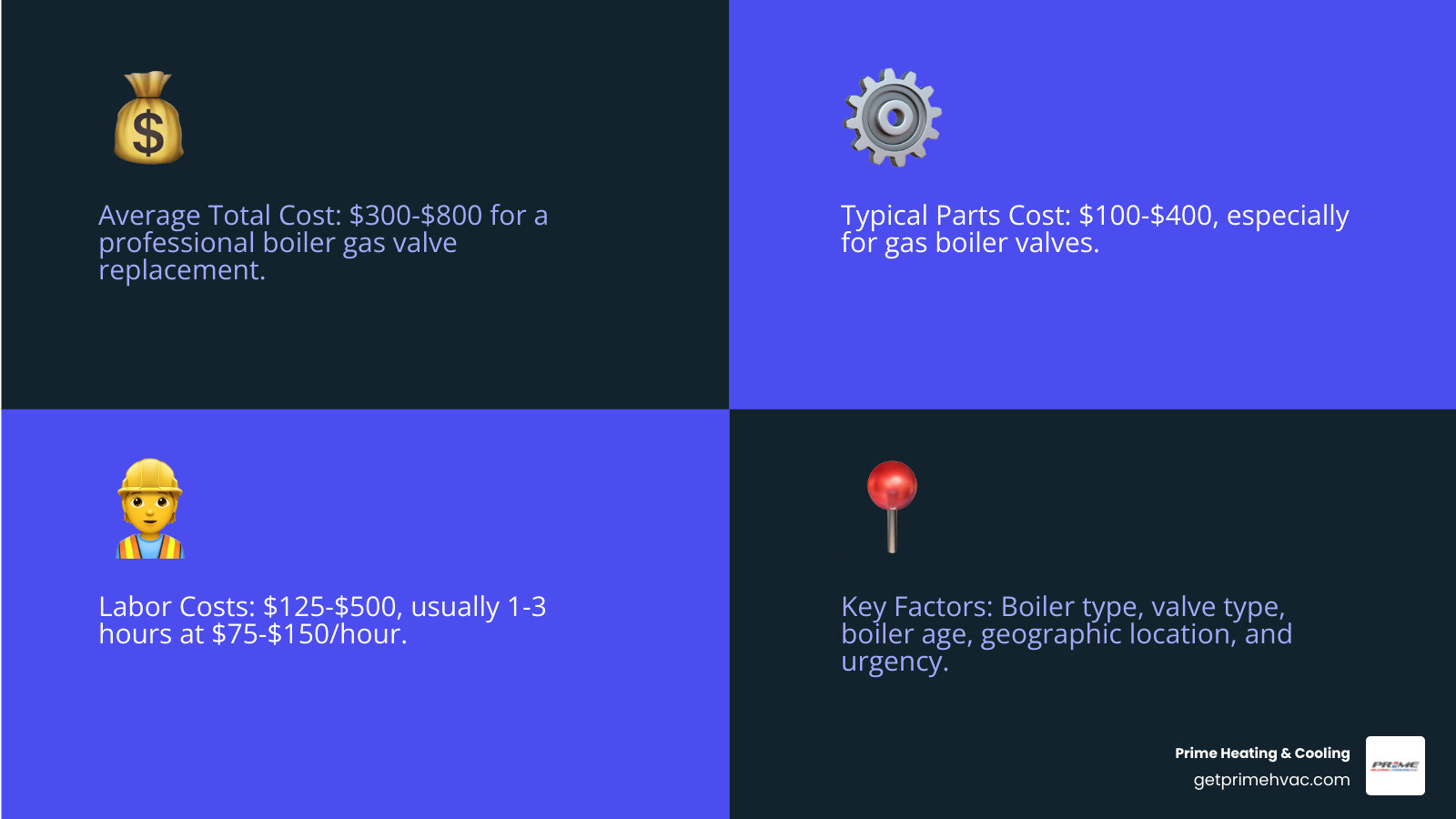
- Labor Costs: $125-$500 (typically 1-3 hours at $75-$150/hour)
- Total Project Cost: $300-$800 on average
Did you know that roughly 9 million U.S. homes are heated by boilers? When your gas valve fails, you’re not just dealing with an inconvenient repair—you’re facing a potential safety hazard that can leave your home without heat and put your family at risk of gas leaks or carbon monoxide exposure.
The gas valve is the component that controls fuel flow to your boiler’s burner. When it malfunctions, your entire heating system can shut down. You might notice your pilot light going out repeatedly, hear strange noises from your boiler, or—worst case—smell gas in your home.
The cost to replace this critical component varies widely based on several factors: your boiler type (gas, oil, or electric), the specific valve that needs replacement (gas valve, zone valve, or radiator valve), your boiler’s age and brand, and whether you need emergency service. Labor costs alone can range from $125 to over $500, depending on the complexity of the job and your location.
I’m Tyler Steiner, CEO and Founder of Prime Heating & Cooling, and I’ve spent over a decade helping New England homeowners steer through complex HVAC repairs, including countless boiler gas valve replacement cost estimates and installations. My team and I understand that knowing what to expect financially can help you make informed decisions when your heating system fails.
What Is the Average Boiler Gas Valve Replacement Cost?
When your boiler’s gas valve decides to call it quits, the first question on most homeowners’ minds is, “How much is this going to set me back?” The good news is that replacing a boiler gas valve is often a more affordable fix than a full boiler replacement. The overall boiler gas valve replacement cost typically falls within a range, largely depending on the cost of the part itself and the labor involved.
On average, homeowners can expect to pay anywhere from $300 to $800 for a professional boiler gas valve replacement. This national average provides a good benchmark, but as we’ll explore, several factors can nudge that number up or down here in Rhode Island and Massachusetts. It’s a combination of the part’s price tag and the expert hands needed to install it safely and correctly.
Typical Parts Cost for a Boiler Gas Valve Replacement
The gas valve itself is a specialized component, and its price can vary significantly. Generally, you can expect the part alone to cost between $100 and $400. This range reflects the different types, brands, and complexities of gas valves available.
- OEM (Original Equipment Manufacturer) Parts: These are valves made by the original manufacturer of your boiler. They ensure perfect compatibility and often come with a manufacturer’s warranty. While sometimes pricier, using OEM parts can guarantee the best performance and longevity for your system. For instance, some specific Weil-McLain gas valve models can range from around $186 to over $640.
- Aftermarket Parts: These are manufactured by third-party companies. They can be a more budget-friendly option, but it’s crucial to ensure they meet the quality and safety standards of your boiler. We always recommend consulting with a professional to ensure any aftermarket part is suitable for your specific boiler model.
- Brand Influence: Just like cars, different boiler brands have different pricing structures for their parts. A valve for a high-end, high-efficiency boiler might cost more than one for a standard model.
- Valve Complexity: Gas valves aren’t all created equal. Some are simple, single-stage valves that are either fully open or fully closed. Others are more complex, like two-stage or modulating valves, which can adjust gas flow incrementally for more precise temperature control and efficiency. These more sophisticated valves naturally come with a higher price tag.
Understanding Labor Costs for Boiler Gas Valve Replacement
While the gas valve part has its cost, the lion’s share of the boiler gas valve replacement cost often comes down to labor. This isn’t just about the time spent wrenching; it’s about the expertise, safety protocols, and specialized tools required to work with natural gas lines and complex heating systems.
- HVAC Technician Rates: In Rhode Island and Massachusetts, HVAC technicians typically charge $75 to $150 per hour. The exact rate can vary based on the technician’s experience, licensing, and the specific company.
- Job Duration: Replacing a boiler gas valve is a delicate task that involves shutting off gas and power, disconnecting and removing the old valve, installing and connecting the new one, and then carefully testing for leaks and proper operation. This process usually takes between 1 to 3 hours.
- Diagnostic Fees: Before any work begins, a technician will need to diagnose the problem. Many companies charge a diagnostic fee, which can range from $75 to $200. This fee often covers the technician’s travel and initial assessment. Sometimes, if you proceed with the repair, this fee might be waived or applied to the total cost.
- Emergency Service Charges: Boilers rarely break down during convenient hours. If your heat goes out on a freezing winter night in Johnston or a holiday weekend in Providence, you might need emergency service. Emergency rates are typically higher, ranging from $140 to $210 per hour, reflecting the urgency and inconvenience for the technician.
We pride ourselves on transparent pricing and ensuring our skilled technicians handle your boiler with the care and expertise it deserves. For more information on our repair services and what to expect, you can always check out our heating repair services.
Key Factors That Influence Your Final Bill
Understanding the average boiler gas valve replacement cost is a great starting point, but it’s crucial to remember that your final bill can be influenced by a variety of factors. It’s like ordering a pizza – you start with a base price, but then toppings, delivery, and whether it’s a specialty pie all add up.
Here in Rhode Island and Massachusetts, we see these factors come into play regularly:
- Boiler Type: Is it gas, oil, or electric?
- Valve Type: Are we talking about the main gas valve, a zone valve, or a radiator valve?
- Boiler Age: Older systems can sometimes be trickier.
- Geographic Location: While we serve all of RI and MA, costs can vary slightly even within our service areas like Smithfield versus Franklin.
- Urgency of Repair: Emergency calls often carry a premium.
Let’s dive deeper into how each of these contributes to your overall expense.
Boiler Type: Gas, Oil, and Electric
The type of boiler you have is one of the primary determinants of the boiler gas valve replacement cost. Each system operates differently and uses distinct components.
- Gas Boiler Valve Cost: Gas boilers are common in our area, and replacing their gas valves is generally the most straightforward and, consequently, the least expensive. You can expect the parts for a gas boiler valve replacement to fall in the $100-$400 range. The parts are typically more standardized and readily available.
- Electric Boiler Valve Cost: Electric boilers don’t have a gas valve in the traditional sense; instead, they have control valves that regulate water flow or electrical components that control heating elements. While not a “gas valve,” if a valve in an electric boiler needs replacement, the costs are usually in the $200-$450 range. Electric boilers are often considered safer due to the absence of combustion.
- Oil Boiler Valve Cost: Oil boilers, while less common than gas in new installations, are still prevalent in many older homes across New England. Replacing a valve in an oil boiler is comparable to an electric boiler, typically costing between $200-$500. The overall system complexity and the specialized nature of oil combustion components can sometimes lead to slightly higher costs for parts and labor.
Valve Type: Gas, Zone, and Radiator Valves
It’s important to differentiate between the various valves that might need attention in your boiler system, as their replacement costs vary significantly.
- Gas Valve: This is the big kahuna we’re focusing on. Its primary function is to dictate the precise flow of natural gas or propane to your boiler’s burner. If it can’t open, your burner won’t get gas, and you’ll have no heat. If it stays open or leaks, it’s a serious safety concern. Replacing this can be complex, and while the part itself might be $100-$400, the total gas valve repair cost (which often means replacement due to safety concerns) can be up to $1,100 when considering labor and other factors.
- Zone Valve: If your home has multiple heating zones (e.g., different thermostats for different areas), you likely have zone valves. Their function is to control the flow of hot water or steam to specific sections of your heating system. If a zone valve breaks, it might prevent water flow to a particular area, leaving a room or floor cold, or it could stay constantly open, leading to inefficient heating and straining your system. Repairing a zone valve, including labor, typically costs around $200-$500.
- Radiator Valve: These are the valves directly on your radiators. Their function is to control how much hot water enters each individual radiator, allowing you to fine-tune the temperature in specific rooms. They are generally the simplest valves in your system and the easiest to replace. Consequently, the radiator valve repair cost is the lowest, usually between $180-$330 to fix.
Boiler Brand, Age, and Efficiency
The specific brand, age, and efficiency rating of your boiler can also play a role in the boiler gas valve replacement cost.
- Older Boilers (15+ years): Many homes in our service areas like North Smithfield or East Greenwich have boilers that have been faithfully serving them for decades. While these older units are often robust, they can become less efficient and more prone to breakdowns as they age. Parts for very old models might be harder to find, sometimes requiring special ordering or even custom fabrication, which can increase the cost. If your boiler is over 15 years old and experiencing frequent issues, it might be time to consider a full replacement, as ongoing repairs can become a money pit.
- Part Availability: Some specialized or older boiler brands may have proprietary gas valves that are not widely stocked. This can lead to delays and potentially higher costs for the part itself.
- High-Efficiency Models: Modern, high-efficiency boilers often incorporate more advanced components, including sophisticated modulating gas valves. While these systems save you money on energy bills, the specialized parts can sometimes be more expensive to replace. However, the overall long-term savings often outweigh these individual component costs. A functioning gas valve is a crucial part of an efficient heating system, ensuring your boiler runs smoothly and effectively.
Regardless of your boiler’s specifics, we emphasize the Importance of Professional HVAC Installation and Maintenance Services to keep your system running optimally and to diagnose any issues accurately.
Signs of a Failing Gas Valve and When to Act
Knowing the signs that your boiler’s gas valve might be failing can save you a lot of headache, and potentially a lot of money, by allowing you to address the issue before it escalates. Think of your boiler as having a language; you just need to learn to listen.
Here are the common indicators that your gas valve might be on the fritz:
- No Heat or Inadequate Heating: This is the most obvious sign. If your boiler isn’t firing up, or if it’s producing lukewarm heat, a faulty gas valve could be preventing gas from reaching the burner.
- Pilot Light Issues: For older boilers with a standing pilot, if it frequently goes out, or if you can’t get it to light at all, the gas valve might not be supplying enough gas. A healthy pilot light should be blue. If you see a yellow or orange flame, it indicates incomplete combustion, which is a major red flag for potential carbon monoxide.
- Strange Noises: Your boiler shouldn’t sound like a haunted house. If you hear humming, banging, whistling, or rumbling sounds coming from the boiler, it could be a sign of various issues, including a struggling gas valve trying to regulate gas flow.
- Gas Smell: This is perhaps the most serious and immediate warning sign. If you smell gas near your boiler, it indicates a potential leak from the gas valve or connections. Do not ignore this!
- Inconsistent Heating: If some rooms are warm while others are cold, or if your boiler seems to struggle to maintain a consistent temperature, it could be a sign that the gas valve isn’t regulating fuel flow properly.
- System Short Cycling: This is when your boiler turns on for a short period, then shuts off, only to turn on again shortly after. A faulty gas valve can cause this by intermittently cutting off the gas supply, leading to inefficient operation and added wear and tear.
Is it an Emergency?
Some boiler issues are simply inconvenient, but a problem with the gas valve, especially a gas leak, is an immediate and severe emergency.
- Gas Leak Dangers: Natural gas is highly flammable and explosive. Even small leaks can pose a significant fire and explosion risk. Furthermore, incomplete combustion caused by a malfunctioning gas valve can produce carbon monoxide, a colorless, odorless, and lethal gas.
- Immediate Steps: If you smell gas, or suspect a carbon monoxide leak (symptoms include headaches, dizziness, nausea), your immediate steps are crucial:
- Evacuate everyone from the building immediately.
- Do NOT use any electrical switches, phones, or ignition sources. This could trigger an explosion.
- Once safely outside, call 911 or your gas company’s emergency line.
- Do NOT re-enter the building until emergency services deem it safe.
- When to Call for Emergency Heating Services: For any suspected gas leak, carbon monoxide issue, or if your boiler completely stops working in freezing temperatures, do not hesitate to call for emergency Heating Services. Our team at Prime Heating & Cooling is available 24/7 for such critical situations across Rhode Island and Massachusetts. Safety is always our top priority.
DIY vs. Professional Replacement: A Cost and Safety Analysis
When your boiler’s gas valve acts up, the thought of a DIY fix might cross your mind, especially when looking at the boiler gas valve replacement cost. However, when it comes to gas appliances, safety should always be your absolute top priority. We cannot stress this enough: working with gas lines and boilers is incredibly dangerous and should only be handled by trained, licensed professionals.
Here’s a comparison to help illustrate why professional service is not just recommended, but essential:
| Feature | DIY Boiler Gas Valve Replacement | Professional Boiler Gas Valve Replacement |
|---|---|---|
| Cost | Potentially lower upfront cost for the part. | Higher initial cost, but includes expertise, proper tools, and warranty. |
| Time | Can take significantly longer for someone inexperienced. | Typically completed in 1-3 hours by a trained technician. |
| Risks | High risk of gas leaks, explosions, carbon monoxide poisoning, and further damage to the boiler. | Minimal risk due to professional training, experience, and proper safety protocols. |
| Outcome | May not fix the problem, could create new ones, and will likely void your boiler’s warranty. | Correct and safe installation, ensuring the system operates efficiently and reliably. |
The Hidden Costs of a DIY Attempt
Attempting to replace a gas valve yourself can lead to several unforeseen and potentially catastrophic consequences:
- Incorrect Installation: A small mistake can lead to a gas leak, which is a serious fire and explosion hazard.
- Damage to the Boiler: Improper handling can damage other components of your boiler, leading to more expensive repairs.
- Lack of Proper Tools: Specialized tools are often required for a safe and effective replacement. Without them, you risk damaging the new valve or the gas lines.
- Voided Warranties: Most manufacturer warranties are voided if an unlicensed individual performs repairs.
- Code Violations: Gas work is heavily regulated. A DIY job might not meet local building codes, which can cause issues if you ever sell your home.
When to Repair vs. When to Replace the Valve
Sometimes, a gas valve issue can be repaired rather than replaced. Here’s a general guide:
- Minor Repairs: Issues like a faulty thermocouple or a dirty pilot assembly can often be cleaned or replaced without needing a full valve replacement.
- Age of the Valve: If your boiler is older (15+ years), it might be more cost-effective to replace the entire unit rather than just the valve, especially if other components are also showing signs of wear.
- Cost of Repair vs. Replacement: If the cost of repairing the valve is close to the cost of a new one, replacement is usually the better long-term solution.
The decision to repair or replace should be made by a qualified HVAC technician. They have the expertise to diagnose the problem accurately and recommend the safest and most cost-effective solution. For expert diagnosis and repair, explore our Boiler Installation & Repair Services.
Conclusion
Dealing with a faulty boiler gas valve can be stressful, but understanding the potential costs and the importance of professional service can make the process smoother. The boiler gas valve replacement cost typically ranges from $300 to $800, including parts and labor, but can vary based on your specific boiler and location.
This is not a DIY project. The risks associated with gas lines are too high. Always rely on a licensed and experienced HVAC technician, like the team at Prime Heating & Cooling, to ensure the job is done safely and correctly. A properly functioning gas valve is crucial for the efficient and safe operation of your heating system, keeping your home warm and your family safe. If you suspect an issue, don’t hesitate to call for a professional diagnosis.


