
Introduction: What is a Heating System Tune-Up?
A heating system tune-up is a professional preventative maintenance service that keeps your furnace or boiler running safely and efficiently all winter long.
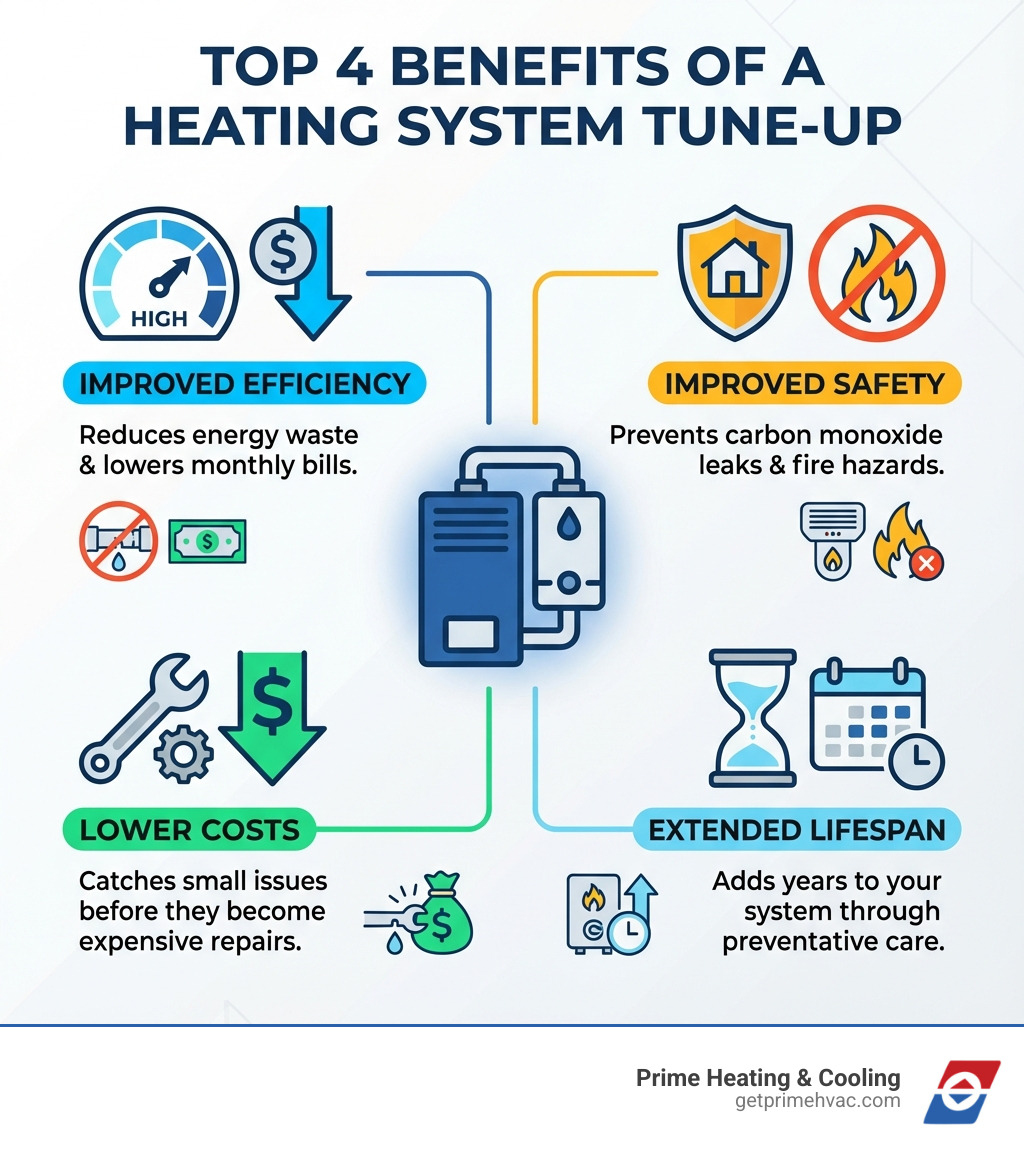
Key Benefits of a Heating System Tune-Up:
- Improved Safety – Prevents dangerous carbon monoxide leaks and gas hazards
- Lower Energy Bills – Restores peak efficiency, reducing heating costs by up to 20%
- Extended Equipment Life – Protects your investment and avoids premature replacement
- Warranty Protection – Maintains manufacturer warranty requirements
- Fewer Breakdowns – Catches small problems before they become expensive emergencies
Think of it like an annual physical for your heating system. A trained technician inspects, cleans, and adjusts all critical components, checking for safety issues, testing controls, cleaning burners, and lubricating moving parts to ensure peak performance.
With nearly half of the average household’s $2,200 annual energy bill going to heating and cooling, regular tune-ups are crucial. They help you avoid becoming one of the 42% of homeowners who experience HVAC system failures during extreme weather.
Most experts recommend scheduling your heating tune-up annually in the fall—before the cold weather hits and HVAC contractors get swamped with emergency calls. If you have a heat pump that both heats and cools, you’ll want service twice a year.
A typical tune-up takes 60 to 90 minutes and costs a fraction of an emergency repair, which can range from $120 to over $6,000 for a full replacement mid-winter.
I’m Tyler Steiner, CEO and Founder of Prime Heating & Cooling, with years of hands-on experience in HVAC systems and a commitment to helping New England homeowners stay warm and safe. Throughout my career, I’ve seen how a simple heating system tune-up can prevent costly breakdowns and keep families comfortable all winter long.
Why a Tune-Up is Your Best Winter Investment
Winter in Rhode Island and Massachusetts can be unpredictable and harsh. The last thing any homeowner wants is a heating system breakdown when the temperatures drop. A heating system tune-up is more than just a routine check; it’s a proactive investment in your home’s comfort, safety, and peace of mind. Let’s explore the significant returns this investment offers.
Boost Energy Efficiency and Lower Your Bills
Since nearly half of home energy use goes to heating and cooling, improving efficiency offers significant savings. An inefficient system works harder and consumes more fuel, which is where a heating system tune-up shines.
During a tune-up, technicians clean and adjust key components. For example, a dirty air filter restricts airflow, forcing the system to work harder and waste energy. Professional cleaning and regular filter changes dramatically improve airflow and effectiveness.
Ductwork leaks are another silent energy thief, losing up to 30% of heated air through holes or poor connections. While a tune-up doesn’t include major duct repair, our technicians can identify these issues. We can then recommend solutions like sealing and insulating ducts, which can improve efficiency by 20% or more.
We also calibrate your system’s settings to prevent unnecessary energy use. By restoring peak operational efficiency, a heating system tune-up significantly reduces energy consumption and lowers your monthly heating bills.
To learn more about how we can help you achieve maximum energy savings, explore our [energy-efficient systems](https://getprimehvac.com/energy-efficient-heating-and-cooling-systems/). For additional tips on maintaining an efficient home, check out [Heat & Cool Efficiently ](https://www.energystar.gov/saveathome/heating-cooling).
Improve Home Safety and Peace of Mind
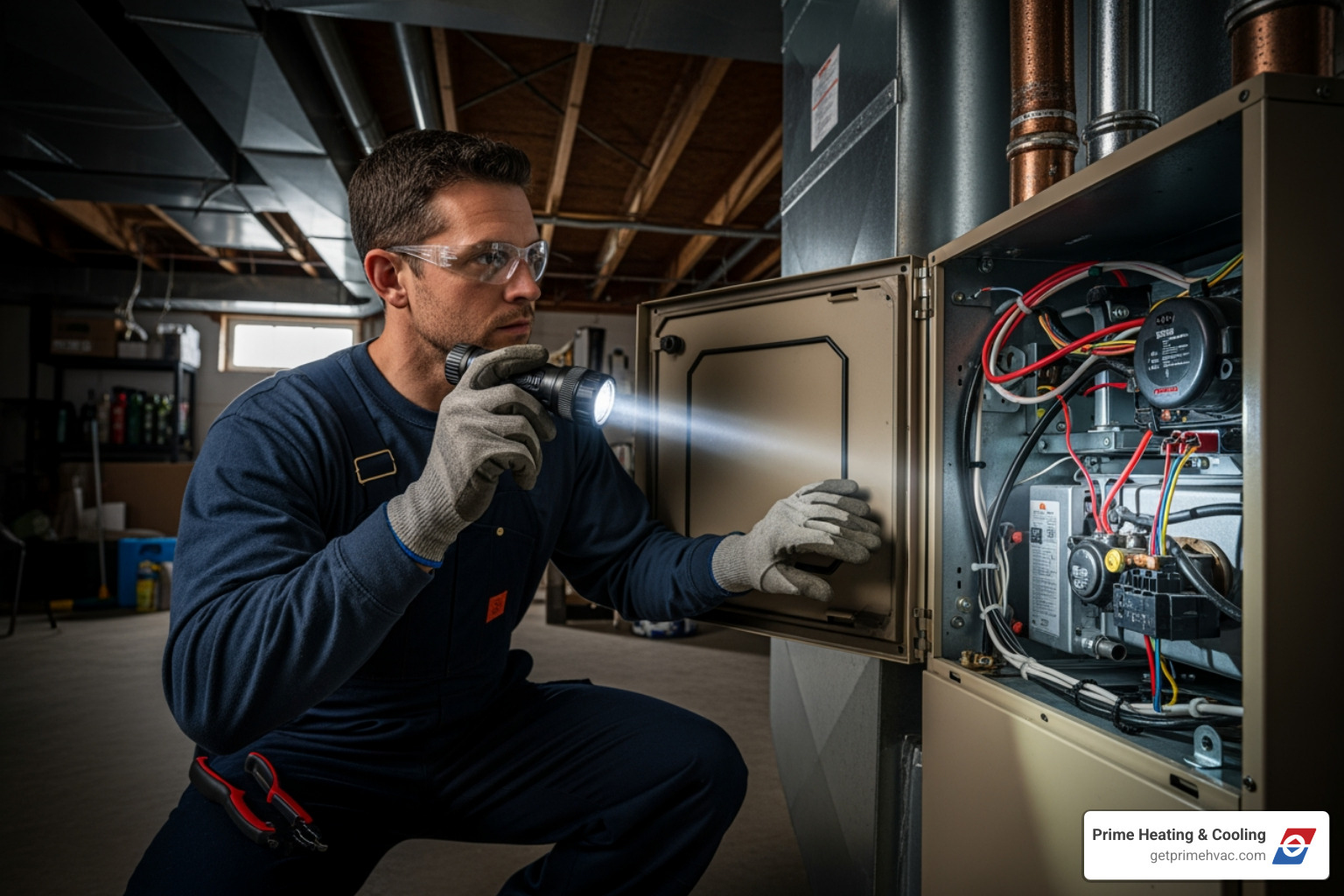
Safety is paramount with combustion heating systems. Furnaces burn fuel to create heat, and an imprecise combustion process can release carbon monoxide (CO)—a colorless, odorless, and deadly gas. Even a small furnace issue can lead to dangerous CO levels.
During a heating system tune-up, our technicians perform crucial safety checks:
- Carbon Monoxide Detection: We carefully inspect your system for any potential CO leaks, paying close attention to the heat exchanger. A cracked heat exchanger is a serious hazard that can allow carbon monoxide to enter your home.
- Gas Leak Detection: For gas-fired systems, we check all gas connections and lines to ensure there are no leaks, which can pose a significant fire hazard.
- Electrical Connections: Faulty or loose electrical connections can lead to unsafe operation, overheating, and even fire. We inspect and tighten all electrical connections to ensure everything is secure.
- Proper Venting: We verify that your system’s venting and flue pipes are clear and properly installed, allowing harmful exhaust gases to safely exit your home.
These thorough safety inspections provide invaluable peace of mind, knowing that your heating system is operating safely and not posing a hidden threat to your family.
Extend Your System’s Lifespan and Protect Your Warranty
Your heating system is a significant investment, and a regular heating system tune-up is the best way to ensure its longevity. Neglecting it can lead to premature wear and expensive repairs.
While HVAC systems can last 15-25 years, this lifespan depends on consistent preventative maintenance. Without it, minor issues escalate, causing undue stress on components and premature failure. A well-maintained system simply lasts longer, serving you reliably for more winters.
Beyond extending the physical life of your equipment, a heating system tune-up also protects your manufacturer’s warranty. Most manufacturers require annual professional maintenance to keep warranties valid. Skipping this can void your warranty, leaving you responsible for the full cost of repairs or replacement if a major component fails.
Our comprehensive tune-ups ensure that your system is running according to manufacturer specifications, documenting the service history that can be vital for any warranty claims. This proactive approach saves you from the potential financial burden of unexpected, out-of-pocket repair costs. Learn more about how regular maintenance contributes to the longevity of your system here: [How An HVAC Tune-Up Can Extend The Life Of Your System](https://getprimehvac.com/how-an-hvac-tune-up-can-extend-the-life-of-your-system/).
What’s on the Checklist? A Look Inside a Professional Heating System Tune-Up
When you schedule a professional heating system tune-up with Prime Heating & Cooling, you get a comprehensive, multi-point inspection. Our service is designed to optimize performance, improve safety, and extend equipment life. Our technicians follow a meticulous checklist to address every critical component.
The Professional Heating System Tune-Up Checklist
While the exact steps might vary slightly depending on your specific system, a typical professional heating system tune-up includes:
- Inspect Thermostat Settings: We verify that your thermostat is accurately reading temperatures and communicating correctly with your heating system. We’ll also check programmable settings to ensure they’re optimized for your comfort and energy savings.
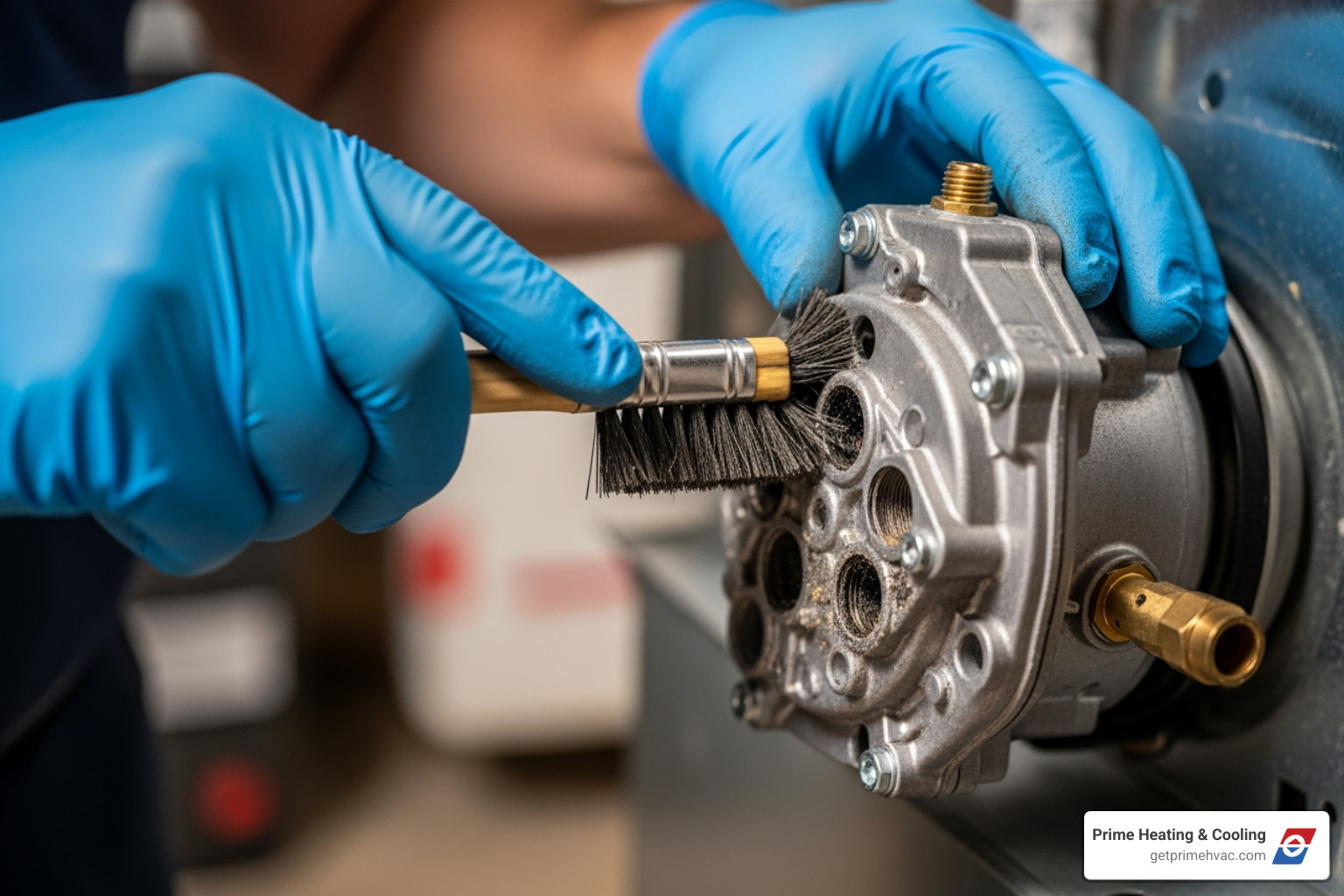
- Clean and Adjust Burner Assembly: For furnaces, clean burners are essential for efficient combustion. We clean away any soot or debris that could impede proper burning and adjust the burner to ensure an optimal flame.
- Inspect Heat Exchanger for Cracks: This is a critical safety check for furnaces. A cracked heat exchanger can allow dangerous carbon monoxide to leak into your home. We perform a thorough visual and sometimes diagnostic inspection to ensure its integrity.
- Check and Tighten All Electrical Connections: Loose electrical connections can cause intermittent operation, reduce component lifespan, and even pose a fire hazard. We ensure all wiring is secure and free from corrosion.
- Lubricate All Moving Parts: Motors, bearings, and fans often have moving parts that require lubrication to reduce friction. This prevents premature wear and tear, reduces energy consumption, and ensures quiet operation.
- Test System Safety Controls: Your heating system has several safety mechanisms designed to shut it down if a problem arises. We test these controls to ensure they are functioning correctly and will protect your home and family in an emergency.
- Inspect Condensate Drain: High-efficiency furnaces and boilers produce condensate (water) as a byproduct of combustion. We inspect and, if necessary, flush the condensate line to prevent clogs that could lead to water damage or system shutdowns.
- Check Blower Motor and Wheel: For forced-air systems, the blower motor and wheel are responsible for circulating heated air throughout your home. We inspect them for cleanliness and proper operation, as a dirty blower wheel can significantly reduce airflow and efficiency.
- Test for Gas Leaks and Carbon Monoxide: Using specialized equipment, we diligently check for any gas leaks around the unit and test for the presence of carbon monoxide, prioritizing your family’s safety.
- Inspect Flue Piping/Venting: We ensure that the exhaust flue is clear of obstructions and properly sealed, allowing combustion byproducts to safely exit your home.
This detailed approach ensures that your system is not only running but running right. For a more in-depth look at what goes into these checks, you can refer to an excellent [Boiler and Furnace TuneUp Checklist ](https://www.ecomfort.com/stories/1136-Important-Pre-Heating-Season-Maintenance.html).
Furnace vs. Boiler Tune-Up: What’s the Difference?
While both furnaces and boilers benefit from annual tune-ups, their operational differences mean their maintenance checklists have unique elements.
Furnace Tune-Up (Forced-Air Systems):
Furnaces heat air and distribute it through ductwork. Our tune-ups focus on components specific to these systems:
- Blower Assembly: Cleaning and inspecting the blower motor and fan to ensure efficient air distribution.
- Ductwork Integrity (Visual Check): While not a full duct sealing service, we’ll visually inspect accessible ductwork for obvious leaks or damage.
- Air Filter Assessment: We’ll check your air filter and advise on the appropriate type and replacement schedule.
If you’re interested in our furnace services, you can find more information on [Furnace Installation Repair Services](https://getprimehvac.com/furnace-installation-repair-services/).
Boiler Tune-Up (Hydronic Systems):
Boilers heat water for circulation through pipes to radiators or radiant flooring. Boiler tune-ups include specific checks for these hydronic components:
- Water Pressure Check: Ensuring the boiler’s pressure is within the manufacturer’s recommended range.
- Radiator Bleeding: We can advise on or perform bleeding of trapped air from radiators, which can cause cold spots.
- Circulation Pump Inspection: Checking the pump that circulates hot water for proper operation and lubrication.
- Expansion Tank Check: Ensuring the expansion tank isn’t water-logged, which can cause excessive pressure.
- Relief Valve Testing: Testing the pressure relief valve, a critical safety device that prevents over-pressurization.
For more details on maintaining your boiler, visit our [Boiler Installation Repair Services](https://getprimehvac.com/boiler-installation-repair-services/) page.
Whether you have a furnace or a boiler, our goal is to ensure your system runs optimally, safely, and efficiently through the cold months in Rhode Island and Massachusetts.
When to Schedule & What You Can Do
Timing is everything, especially when it comes to preparing your home for the colder months. Knowing when to schedule your heating system tune-up and what you can do yourself between professional visits can make a big difference in your comfort and budget.
The Best Time to Schedule and Signs You Need Service
The best time of year to schedule your heating system tune-up is in the fall, ideally before the peak heating season begins. This “off-season” window, typically from late summer through early fall, offers several benefits:
- Convenience: HVAC technicians are less busy during this period, making it easier to schedule an appointment that fits your schedule.
- Proactive Problem Solving: If our technicians find any issues during the tune-up, you’ll have ample time to address them before you rely heavily on your system. This avoids emergency repairs in freezing temperatures.
- Optimal Readiness: Your system will be clean, efficient, and ready to tackle the demands of a New England winter from day one.
While an annual tune-up is always recommended, sometimes your heating system will give you subtle (or not-so-subtle) hints that it needs attention sooner. Here are some signs that your heating system needs a tune-up:
- Unusual Noises: If your furnace or boiler starts making banging, grinding, squealing, or whistling sounds, it’s often a sign of a mechanical issue that needs professional diagnosis.
- Uneven Heating: Are some rooms toasty while others remain chilly? This could indicate airflow problems, duct issues, or a system struggling to distribute heat effectively.
- Increased Energy Bills: A sudden or gradual spike in your heating costs without a corresponding increase in usage or fuel prices is a strong indicator of declining efficiency.
- Frequent Cycling: If your furnace or boiler is constantly turning on and off (short-cycling), it could be a sign of an oversized system, a clogged filter, or a faulty thermostat. This is inefficient and puts extra strain on your system. You can read more about this common issue on our
[Furnace Keeps Turning On and Off](https://getprimehvac.com/furnace-keeps-turning-on-and-off/)page. - Pilot Light Issues (for gas furnaces): If your pilot light frequently goes out, or if the flame is yellow or orange instead of a crisp blue, it indicates a combustion problem that requires immediate attention for safety.
- Strange Odors: A persistent burning smell, a musty odor, or the smell of rotten eggs (which could indicate a gas leak) should never be ignored.
If you notice any of these signs, don’t wait for your annual tune-up. Contact us immediately to schedule an inspection.
DIY Maintenance Between Professional Heating System Tune-Ups
While professional tune-ups are essential, there are several simple tasks you can perform yourself to keep your heating system running smoothly and efficiently between our visits. These DIY steps can also help improve indoor air quality and catch potential issues early.
- Change Air Filters Regularly: This is perhaps the most important DIY task. A dirty filter restricts airflow, making your system work harder and reducing efficiency. We recommend checking your filter monthly and changing it every 30 to 90 days, or more frequently if you have pets, allergies, or if your system is in heavy use. High-efficiency pleated air filters (also known as MERV 11 or 12 filters) can capture the smallest particles, filtering out bacteria, viruses, dust, pollen, mold, and pet dander.
- Keep Vents and Registers Clear: Ensure that no furniture, rugs, or drapes are blocking your heating vents and return air registers. Blocked vents impede airflow and can lead to uneven heating and reduced efficiency.
- Clean Around Outdoor Unit (for heat pumps): If you have a heat pump, keep the outdoor unit clear of debris, leaves, snow, and vegetation. There should be at least two feet of clearance around the unit to ensure proper airflow.
- Test CO Detectors Monthly: For homes with gas or oil-fired heating systems, carbon monoxide detectors are lifesavers. Test them monthly and replace batteries annually.
- Dust the System Exterior: A quick dusting of the outside of your furnace or boiler a couple of times a year helps prevent dust and dirt from being drawn into the system.
By performing these basic tasks, you contribute to your system’s efficiency and longevity. For a more comprehensive guide on homeowner maintenance, visit our [HVAC Maintenance Every Homeowner Should Know](https://getprimehvac.com/hvac-maintenance-every-homeowner-should-know/) page.
The Cost of Comfort: Tune-Up vs. Emergency Repair Costs
When considering a heating system tune-up, it’s crucial to view it as a preventative measure that saves you money in the long run. The cost of a tune-up is a minor expense compared to the potential financial burden of an emergency repair or a full system replacement.
Let’s look at the numbers. A tune-up is a fraction of the cost of a major repair, which averages $350 but can reach $3,000. A full system replacement can cost $7,500 or more.
Here’s a simplified comparison:
| Service Type | Average Cost Range | Notes |
|---|---|---|
| Heating System Tune-Up | $75 – $150 | Proactive, preventative, often includes discounts with maintenance plans. |
| Blower Motor Replacement | $400 – $2,000+ | Essential for air circulation, often fails due to lack of lubrication or dirt. |
| Ignitor Replacement | $200 – $600 | Small part that ignites fuel, common failure point. |
| Heat Exchanger Repair | $1,000 – $3,000+ (often leads to replacement) | Critical safety component; repair is complex, and replacement is common due to high cost. |
| Gas Valve Replacement | $300 – $1,000+ | Controls gas flow; failure can lead to no heat or dangerous leaks. |
| Furnace Replacement | $2,500 – $7,500+ | If repairs are too costly or system is beyond its lifespan, a full replacement is needed. |
| Boiler Replacement | $4,000 – $12,000+ | More complex installation and higher material costs than furnaces. |
As you can see, a small investment in a heating system tune-up can potentially save you thousands of dollars by preventing these costly failures. It’s a classic case of an ounce of prevention being worth a pound of cure.
The Risks of Skipping Annual Maintenance
About 47% of homeowners admit to skipping annual HVAC servicing. This neglect carries significant risks beyond just financial costs:
- Unexpected Breakdowns: Your system is most likely to fail during a cold snap, leading to discomfort, frozen pipes, and premium-priced emergency service calls.
- Costly Emergency Repairs: Repairs for neglected systems are often more extensive and expensive. A simple adjustment can turn into a major component replacement. We’d rather help you prevent costly repairs with our
[Heating Repair RI](https://getprimehvac.com/heating-repair-ri/)services. - Voided Warranties: As mentioned, skipping annual maintenance can void your manufacturer’s warranty, leaving you to pay the full cost for major repairs.
- Reduced System Lifespan: A neglected system works harder and wears out faster, requiring premature replacement and reducing the value of your investment.
- Poor Indoor Air Quality: Dirty components circulate dust, allergens, and mold, harming your home’s air quality and potentially triggering respiratory issues.
- Safety Hazards: The most critical risk is life-threatening carbon monoxide leaks, gas leaks, or electrical fires. Annual tune-ups are vital for mitigating these dangers.
Ignoring annual maintenance isn’t just about saving a few dollars today; it’s about exposing yourself to greater expenses, discomfort, and even danger tomorrow.
Frequently Asked Questions about Heating Tune-Ups
We understand that homeowners in Rhode Island and Massachusetts have questions about their heating systems and regular maintenance. Here, we address some of the most common inquiries about heating system tune-ups.
How often should a heating system be tuned up?
For most furnaces and boilers, we strongly recommend an annual heating system tune-up. Scheduling it in the fall ensures your system is prepared for winter.
If you have a heat pump system, which provides both heating and cooling, we advise scheduling tune-ups twice a year: once in the spring for cooling and once in the fall for heating. This is because heat pumps work year-round.
Consistent annual maintenance helps us track performance, identify potential issues early, and ensure safe, efficient operation. Learn more in our guide: [How Often Should You Schedule HVAC Maintenance?](https://getprimehvac.com/how-often-should-you-schedule-hvac-maintenance/).
Does a brand-new heating system need a tune-up?
Yes, absolutely. While it may seem counterintuitive, tuning up a new system is highly beneficial and often required. Here’s why:
- First-Year Check: A professional check after the first season ensures everything is performing as expected.
- Validating Warranty: Most manufacturers require annual professional maintenance to keep your warranty valid. Skipping this could void your coverage.
- Ensuring Proper Installation: A tune-up verifies that the installation was done correctly. Improper installation can reduce system efficiency by up to 30%.
- Baseline Performance: A first-year tune-up establishes a performance baseline for future maintenance checks.
Don’t hesitate to schedule that first tune-up for your new heating system. It’s an investment in its long-term health and your peace of mind.
How long does a heating tune-up take?
A professional heating system tune-up typically takes 60 to 90 minutes, though the exact time varies based on:
- System Complexity: A high-efficiency boiler with multiple zones might take longer than a standard furnace.
- System Condition: Finding and resolving minor issues on the spot can extend the service time.
- Accessibility: Easily accessible systems allow for quicker service.
Our technicians will communicate their findings and recommendations. Afterward, you’ll receive a detailed report on the work performed and advice for maintaining optimal performance. We are thorough and efficient, ensuring your system is ready for winter without delay.
Conclusion: A Small Investment for a Warm and Worry-Free Winter
As we’ve explored, a heating system tune-up is far more than just a routine service; it’s a critical component of responsible homeownership in Rhode Island and Massachusetts. It’s the proactive step that safeguards your family’s comfort, ensures your home’s safety, and protects your hard-earned money.
Choosing preventative maintenance over reactive repairs is always the smarter choice. It leads to long-term savings by extending your system’s lifespan, lowering your energy bills, and keeping your manufacturer’s warranty intact. More importantly, it provides the reliability and safety you need to face the coldest New England winters with complete peace of mind.
At Prime Heating & Cooling, we bring expertise, experience, and a customer-first approach to every heating system tune-up we perform. Our skilled technicians are dedicated to delivering energy-efficient solutions and ensuring your home remains a haven of warmth and comfort. Don’t let the chill catch you off guard this winter.
[Schedule your heating maintenance with our expert team today!](https://getprimehvac.com/hvac-services-ri/) and experience the Prime Heating & Cooling difference in Rhode Island and Massachusetts.