Understanding Your Options When the Heat (or AC) Goes Out
HVAC financing allows homeowners to spread the cost of a new heating or cooling system over time through monthly payments instead of paying thousands upfront. Most homeowners need this option because a new HVAC system can cost around $19,000 or more—money that few families have readily available in savings.
In New England, going without reliable heating or cooling is not just uncomfortable—it can be unsafe. A failed furnace during a Rhode Island cold snap or a dead AC unit during a humid July heat wave in Providence or Warwick can quickly turn into an emergency. Financing gives you a way to act quickly without having to delay the decision while you save up.
Quick Answer: Your Main HVAC Financing Options
- Contractor Financing – Apply directly through your HVAC company, often with 0% APR promotional periods (12-60 months).
- Personal Loans – Borrow from banks or credit unions at rates typically ranging from 6.99% to 30% APR.
- Home Equity Loans/HELOCs – Use your home’s equity for lower rates (around 6.5%-11.6% APR) but with longer approval times.
- Credit Cards – Quick funding with possible 0% intro rates (12-18 months), but high standard APR around 21%.
The upfront cost of a new HVAC system can be high, especially if you purchase an energy-efficient model. But financing makes it possible to upgrade now without depleting your emergency fund or waiting until your system completely fails—often in the middle of winter or during a summer heat wave.
Beyond comfort, modern heating and cooling systems also impact indoor air quality, humidity control, and energy consumption. For many Rhode Island homeowners in communities like East Greenwich, Smithfield, Coventry, and Smithfield, a new system can mean significantly lower monthly utility bills compared to an older, inefficient unit.
Many financing plans offer special promotional rates like 0% APR for 60 months for qualified buyers. But watch out for hidden costs. Some rental agreements or long-term loans can result in paying two to three times more than the system is worth. The key is matching your loan term to your equipment’s warranty period (typically 10 years) so you own your system while it’s still covered.
Financing also lets you consider higher-efficiency systems or add-ons such as smart thermostats, zoning, or indoor air quality upgrades that you might otherwise delay. Spreading the cost over time can make these comfort and efficiency improvements much more manageable.
Why This Matters for New England Homeowners
The decision to finance an HVAC system isn’t one to take lightly. Your heating and cooling equipment keeps your family safe from extreme temperatures, maintains indoor air quality, and impacts your monthly energy bills. Whether you’re facing an emergency replacement or planning an upgrade to a more efficient system, understanding your financing options helps you make smart choices for your budget.
Rhode Island homeowners—from the East Side of Providence to North Smithfield, Lincoln, and Scituate—also deal with older housing stock and changing energy codes. An outdated system can cost you more month after month, while a properly sized, efficient system can stabilize costs and increase comfort for years.
As Tyler Steiner, founder and CEO of Prime Heating & Cooling, I’ve helped hundreds of New England homeowners steer HVAC financing decisions over the past decade, ensuring they get the right system at terms they can afford. Our team works with multiple financing partners to provide transparent options that match your budget and comfort needs.
When you call Prime Heating & Cooling, our specialists can walk you through system options, expected operating costs, and financing choices side by side so you can see the full picture—not just the monthly payment.
What is HVAC Financing and How Does It Work?
At its core, HVAC financing is a program designed to make expensive heating and cooling system upgrades or replacements affordable. Instead of demanding a large lump sum upfront, it allows you to spread the cost over a period of time through convenient, fixed monthly payments. This is a game-changer for many homeowners, especially when an unexpected furnace breakdown or AC failure hits in the middle of a sweltering summer or frigid winter.
Imagine your old furnace decides to call it quits on the coldest day of the year. You need a new one, and fast. Or perhaps your AC fails in late August while you are hosting guests. The thought of paying thousands of dollars out of pocket can be daunting. This is where HVAC financing steps in. It ensures you can get the essential repairs or a brand-new system installed without draining your savings or resorting to high-interest credit cards.
For homeowners in Rhode Island and Massachusetts, we understand that maintaining a comfortable home is non-negotiable. That’s why we offer comprehensive HVAC Services RI that often include flexible financing solutions. Whether you are in Providence, Warwick, Johnston, or East Greenwich, our team can help you compare system options and payment plans in a single visit.
The Typical HVAC Financing Process
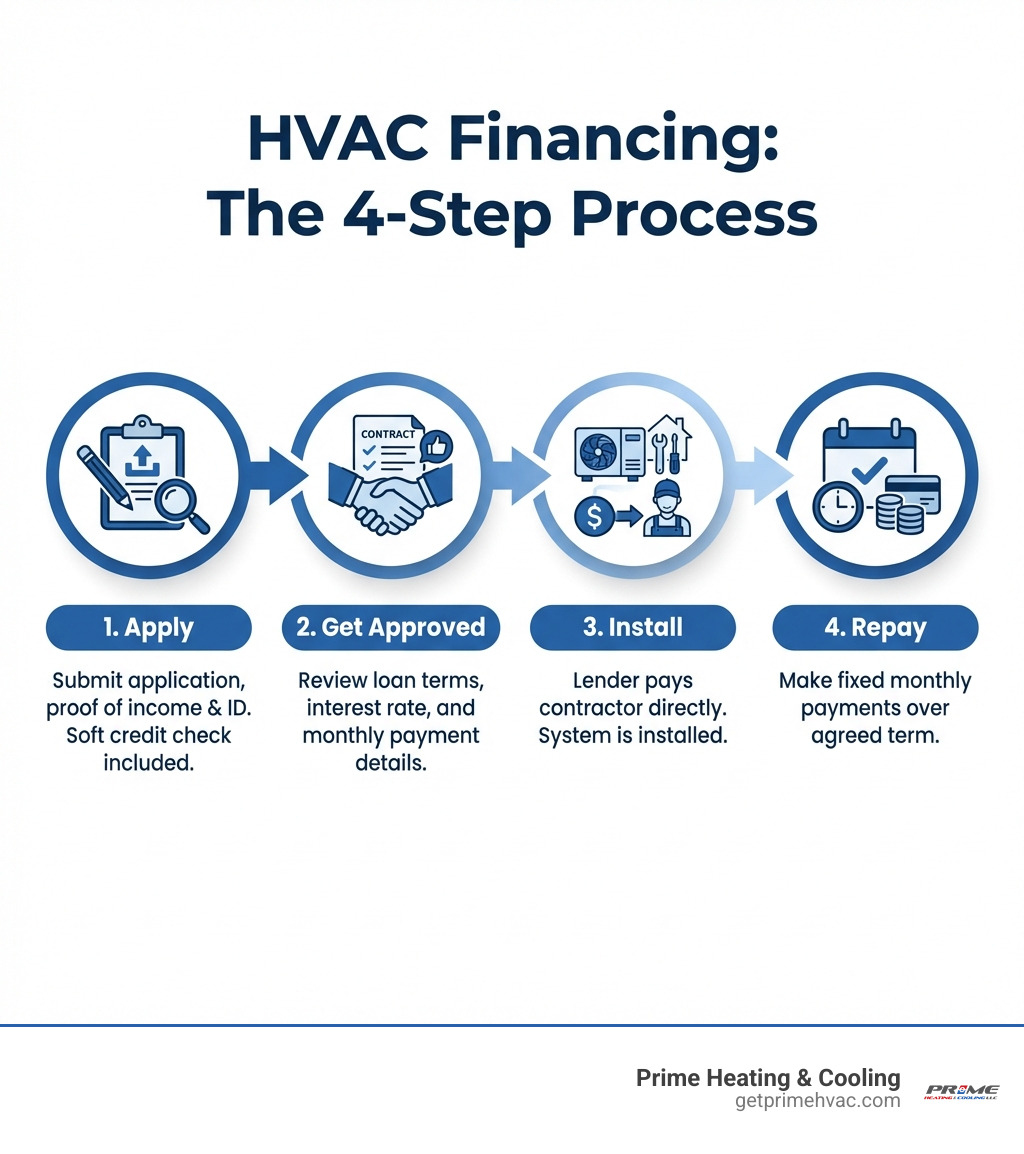
The financing process itself is typically straightforward and can often be completed in a single day:
- Application: You’ll fill out a quick application, often either online or directly through your HVAC contractor. This usually involves providing some personal information. Many Rhode Island homeowners complete this step on a tablet or smartphone while a technician is on-site reviewing system options.
- Soft Credit Check: Many financing applications start with a “soft credit check.” This is great news because it doesn’t negatively impact your credit score. It simply gives the lender an initial idea of your creditworthiness.
- Required Documents: To get approved, you’ll generally need:
- Valid government-issued identification.
- Proof of income (such as recent pay stubs or tax documents).
- An active bank account.
- Proof of residence (like a utility bill).
- Steady income is often a key requirement for approval.
- Lender Approval & Terms: If approved, the lender will present you with the loan terms, including the interest rate (APR), monthly payment amount, and the total repayment period. This is your chance to understand exactly what you’re agreeing to. You can often choose from more than one term length—for example, a shorter term with a higher monthly payment, or a longer term with a lower payment.
- Installation: Once you agree to the terms, the lender pays your HVAC company directly. Then, our skilled technicians at Prime Heating & Cooling get to work installing your new, energy-efficient system. In many Rhode Island homes, this can be done in a single day so your downtime is minimal.
- Repayment Schedule: You’ll then make regular, fixed monthly payments to the lender according to your agreed-upon schedule. Many lenders offer autopay and online account access so you can track your remaining balance and payoff date.
What Can You Finance?
Most lenders and contractor programs allow you to finance:
- Full system replacements (furnace, boiler, central AC, or heat pump).
- Ductless mini-split systems for additions or homes without existing ductwork.
- Major repairs when replacing the system is not yet necessary.
- Related accessories such as thermostats, air cleaners, or humidifiers when bundled with a system.
This structured approach means you can enjoy a comfortable home immediately, while managing the cost in a way that fits your budget. Instead of putting off an upgrade or settling for temporary fixes, you can choose the right long-term solution for your home and spread the investment over time.
For many of our customers in communities like North Providence, Lincoln, and Scituate, this combination of fast approval, clear terms, and professional installation makes HVAC financing an attractive, low-stress option.
A Deep Dive into HVAC Financing Options
Choosing the right HVAC financing plan is crucial. It’s not just about getting approved; it’s about finding terms that work for your financial situation, minimize long-term costs, and align with your goals for comfort and efficiency. Let’s explore the most common options available to homeowners.
Comparing Your HVAC Financing Choices
Here’s a quick overview of the main options, their typical features, and what makes them stand out. For a more detailed look at what might be the best fit for you, check out this guide on the Best Ways to Finance a New HVAC System: A Homeowner’s Guide.
| Financing Option | Typical APR | Loan Term (Months) | Pros | Cons |
|---|---|---|---|---|
| Contractor Financing | 0% – 30% APR (promotional often 0%) | 12-60 months (promotional) up to 10 years | Fast approval, convenience, special promotional rates (0% APR), no-money-down options, handled directly through your HVAC contractor. | May include retroactive interest if the promo period is not paid off, limited choice of lenders, some plans may have higher rates after promotional period, requires careful review of contract terms. |
| Personal Loans | 6.5% – 30% APR | 24-84 months | Predictable fixed payments, no collateral needed, can improve credit with on-time payments, funds can often be used for related home projects. | Higher APR if you have fair or poor credit, monthly payments may be higher than long-term contractor financing, approval and funding time can vary by lender. |
| Home Equity Loans / HELOCs | Around 6.5% – 11.6% APR | 60-240 months | Lower interest rates because the loan is secured by your home, potential tax benefits in some situations, longer repayment terms mean lower monthly payments. | Longer application and approval process, closing costs may apply, your home is used as collateral (risk of foreclosure if you cannot repay), may not be ideal for small projects. |
| Credit Cards | 0% intro APR offers, then around 21% standard APR | Intro offers often 12-18 months | Immediate funding, possible rewards points or cash back, 0% intro APR can make short-term financing very affordable if paid off on time. | High interest rates after introductory period, easy to accumulate debt, high utilization can hurt your credit score, not ideal for large balances carried long term. |
When we meet with homeowners in Rhode Island—from Warwick and Coventry to North Smithfield and the East Side of Providence—we often compare two or three of these options side by side. The “best” choice depends on how quickly you need the system, your credit profile, and how long you plan to stay in your home.
Contractor Financing (In-House Plans)
Many HVAC companies, including Prime Heating & Cooling, partner with third-party lenders to offer in-house financing plans. These plans are designed to be convenient and fast, so you can move from estimate to installation with minimal delay.
Key features of contractor financing include:
- Applications completed on-site or online with quick decisions.
- Promotional 0% APR offers for 12, 36, or even 60 months for qualified buyers.
- Options with no money down, which can be helpful in an emergency.
- Bundling of equipment, installation, and sometimes extended warranties into one monthly payment.
However, there are a few details you should watch carefully:
- Some promotional offers use deferred or retroactive interest. If the balance is not fully paid by the end of the promotional period, interest may be charged on the original purchase amount.
- Your lender choice is typically limited to the partners your contractor works with.
- Longer-term plans (for example, 10 years) may have higher overall interest costs, even if the monthly payment looks attractive.
You can learn more about common structures in this resource on What Type of HVAC Financing Plans Are Available?. At Prime Heating & Cooling, we take time to walk through these details so you understand whether a particular promotion fits your goals.
Personal Loans for HVAC Financing
Personal loans are another flexible way to cover the cost of a new system. These loans are typically unsecured, meaning they do not require you to use your home as collateral.
You can obtain a personal loan through:
- Local banks and credit unions in Rhode Island and Massachusetts.
- Online lenders that specialize in home improvement loans.
- Some marketplace platforms that compare offers from multiple lenders.
Personal loans generally feature:
- Fixed interest rates and fixed monthly payments.
- Clear payoff dates, often between 2 and 7 years.
- Faster processing than most home equity products.
You can read more about how these work in this overview of a personal loan.
Typical APRs vary widely. According to recent Federal Reserve data, the average rate on a 24‑month personal loan is around 11.7%, but your specific rate may be higher or lower depending on your credit score, income, and debt-to-income ratio.
For many Prime Heating & Cooling customers who do not want to tie financing to their homes, a personal loan strikes a good balance between speed, predictability, and flexibility.
Home Equity Loans and HELOCs
If you have significant equity in your home, a home equity loan or home equity line of credit (HELOC) can be one of the least expensive ways to finance a new HVAC system over the long term.
- A home equity loan is a lump-sum loan with a fixed interest rate and predictable monthly payments. Learn more about these in this explanation of a home equity loan.
- A HELOC works like a revolving line of credit, usually with a variable interest rate. You can draw only what you need for your HVAC upgrade and repay it over time.
Because these loans are secured by your property, interest rates are typically lower than for unsecured personal loans or credit cards. In some cases, the interest you pay might be tax-deductible if the funds are used to substantially improve your home—see the IRS guidance on deduction of home equity interest and consult a tax professional for your specific situation.
Things to consider:
- The application and approval process can take longer and may involve an appraisal or closing costs.
- Because your home is collateral, there is an added level of risk if you experience financial hardship.
- For smaller HVAC projects, the time and fees involved may outweigh the benefits of a slightly lower rate.
Home equity financing may make sense for larger whole-home upgrades—for example, replacing a boiler and adding central air at the same time, or combining HVAC work with other renovations.
Using Credit Cards
Credit cards can also play a role in HVAC financing, especially for smaller repairs or when you can realistically pay off the balance within a 0% introductory APR period.
Key advantages:
- Immediate funding when an emergency arises.
- Potential rewards, points, or cash back on a large purchase.
- 0% introductory APR offers for 12–18 months that can make short-term financing very affordable.
However, there are important downsides:
- Standard APRs are often around 21% or higher once the intro period ends.
- Carrying a large balance can significantly increase your credit utilization ratio, which may lower your credit score.
- If you cannot pay off the balance quickly, interest charges can make the system much more expensive over time.
Credit cards are usually best for:
- Smaller repairs or add-ons.
- Bridging a short gap while you finalize longer-term financing.
- Homeowners disciplined about paying off promotional balances on time.
For more on what to consider when planning HVAC work to fit your budget, see Affordable HVAC Services in Smithfield, What to Look For.
When you work with Prime Heating & Cooling, our team can help you estimate what your monthly payment might look like under each of these options so you can choose the approach that makes the most sense for your home and your finances.