
Why Geothermal HVAC Systems Are Redefining Home Comfort in New England
Geothermal HVAC systems are ground-source heat pumps that use the Earth’s stable underground temperature — around 55°F year-round — to heat and cool your home far more efficiently than traditional systems.
Here’s what you need to know at a glance:
- What they do: Transfer heat between your home and the ground instead of generating heat by burning fuel
- How efficient: Can achieve over 400% efficiency — producing four units of heating or cooling per unit of electricity used
- Energy savings: Cut utility bills by 30–70% compared to conventional HVAC
- Lifespan: Indoor components last ~25 years; underground piping lasts 50+ years
- Works anywhere: Ground source heat pumps can be installed across all U.S. climates, including New England
- Environmental impact: One system reduces carbon emissions equal to removing two cars from the road each year
Most homeowners think of geothermal as exotic technology — something involving volcanoes or deep-earth drilling. In reality, it’s far simpler. Just 10 feet below the surface, the ground holds a remarkably steady temperature no matter how brutal a Rhode Island winter gets or how humid a summer turns. Geothermal systems tap into that stable reservoir to keep your home comfortable without the wild swings in efficiency that plague traditional heating and cooling equipment.
With over 1 million geothermal heat pumps already running in homes across the U.S., this isn’t experimental technology. It’s proven, practical, and increasingly accessible.
I’m Tyler Steiner, founder of Prime Heating & Cooling and a hands-on HVAC professional with experience installing and servicing geothermal HVAC systems across Rhode Island and Massachusetts. In this guide, I’ll walk you through everything you need to know — from how these systems work to whether your property is a good fit.
How Geothermal HVAC Systems Work and Their Main Configurations
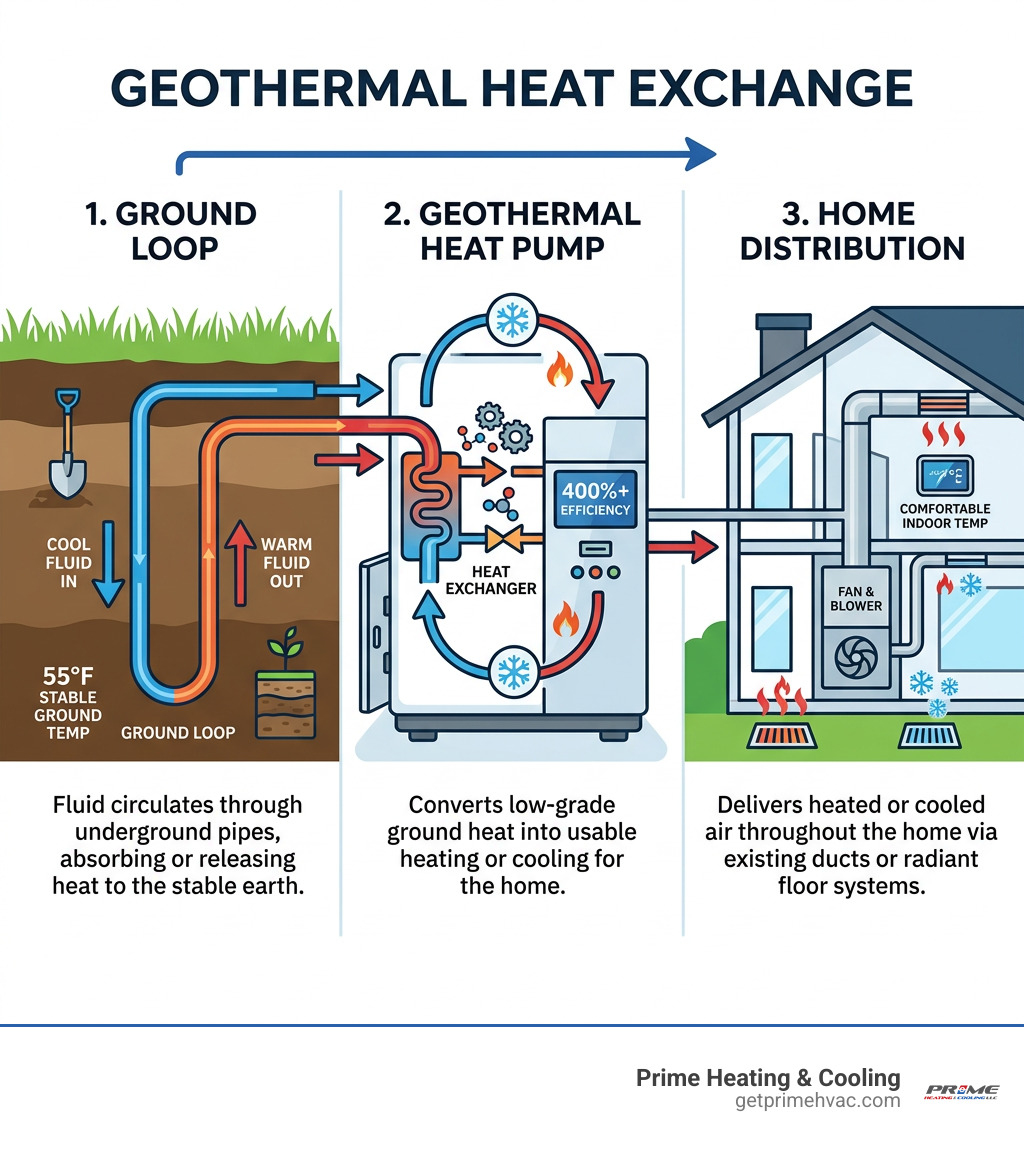
To understand Geothermal HVAC systems, it helps to stop thinking about “creating” heat and start thinking about “moving” it. Whether we are in the middle of a blizzard in North Scituate or a heatwave in Warwick, the Earth is a massive solar battery. It absorbs nearly 50% of all the solar energy that reaches our planet. While the air temperature fluctuates wildly, the temperature just a few feet below our feet stays between 45°F and 70°F.
These systems are often referred to as “Thermal Energy Networks.” They function using a relatively simple refrigeration cycle similar to your kitchen refrigerator, but on a much larger scale. In a refrigerator, heat is pulled from the inside of the box and pushed out into your kitchen. A geothermal system does the same, but it uses the entire Earth as either its source of heat or its dumping ground for heat.
During the winter, a fluid (usually a mixture of water and eco-friendly antifreeze) circulates through a series of underground pipes called a “ground loop.” This fluid absorbs the natural heat from the earth and carries it to the indoor heat pump unit. The heat pump then concentrates that heat and distributes it through your home via standard ductwork or radiant flooring. In the summer, the process reverses. The system pulls heat out of your home and pushes it back into the cool earth.
Because these are highly energy-efficient heating and cooling systems, they don’t need to burn fossil fuels like oil or natural gas. They simply use a small amount of electricity to power the pump and the compressor.

Closed-Loop vs. Open-Loop Geothermal HVAC Systems
When we design a system for a home in Rhode Island, the first thing we look at is the “loop” configuration. The loop is the most critical part of the installation because it determines how effectively we can exchange heat with the soil. There are four primary types of configurations, and the right one for you depends on your lot size and geology.
- Vertical Loops: This is the most common choice for homes in more suburban or urban areas like Providence or East Greenwich. We use a drilling rig to create several holes (usually 200 to 500 feet deep) and insert U-shaped pipes. This requires the least amount of surface yard space.
- Horizontal Loops: If you have a larger property — say, a half-acre or more in Scituate or Coventry — we can dig trenches about four to six feet deep. We lay the pipes in these trenches. It’s generally more cost-effective than vertical drilling if you have the space.
- Pond/Lake Loops: If your property has a sufficiently deep and large body of water, we can actually submerge the coils at the bottom. The water acts as an incredible heat conductor, making this a very efficient option.
- Open-Loop Systems: These systems use actual groundwater from a well. The system draws water in, extracts the heat (or dumps it), and then discharges the water back into the ground or a drainage area. While highly efficient, these require a steady supply of high-quality water and must meet local environmental regulations.
Loop Comparison Table
| Loop Type | Space Required | Efficiency | Best For |
|---|---|---|---|
| Vertical | Minimal | Very High | Suburban/Small lots (Providence, Warwick) |
| Horizontal | Significant | High | Rural/Large lots (Scituate, Foster) |
| Pond/Lake | Water source needed | Excellent | Properties with deep ponds or lakes |
| Open-Loop | Minimal | Highest | Areas with abundant, clean well water |
Most modern systems use high-density polyethylene (HDPE) pipes, which are incredibly durable. In some specialized “Direct Exchange” (DX) systems, copper tubing is used to circulate refrigerant directly through the ground, which can offer even smaller footprints.
The Efficiency and Performance of Geothermal HVAC Systems
Efficiency is where Geothermal HVAC systems truly shine. In the HVAC world, we measure efficiency using COP (Coefficient of Performance) for heating and EER (Energy Efficiency Ratio) for cooling.
A traditional high-efficiency gas furnace might have an AFUE of 95%, meaning 95 cents of every dollar spent on fuel goes into heating your home. A geothermal system, however, often has a COP of 4.0 or higher. This means for every unit of electricity you put in, you get four units of heat out. That is 400% efficiency. Some advanced open-loop systems can even hit a COP of 5.2.
One “secret weapon” of these systems is the desuperheater. This is a small, auxiliary heat exchanger that uses excess heat from the geothermal unit to provide hot water for your home. During the summer, when the system is busy cooling your house, it’s essentially getting “free” hot water as a byproduct. This can reduce your annual water heating costs by up to 40%.
Because these systems are so efficient, they almost always carry the Energy Star certification. They provide consistent, “ridiculously quiet” comfort without the loud outdoor fan noise associated with traditional air conditioners.
The Financial and Environmental Benefits of Switching to Geothermal
Switching to geothermal isn’t just a “green” move; it’s a smart financial play. When you look at the long-term numbers, the savings are staggering. According to industry data, geothermal systems can cut utility bills by 30 to 70 percent.
Let’s look at some real-world examples of annual heating and cooling costs:
- A two-story home with a finished basement (approx. 4,583 sq. ft.) can cost as little as $459.14 per year to heat and cool.
- A one-story home with a finished basement (approx. 3,122 sq. ft.) can cost as little as $265.46 per year.
Compare that to the thousands of dollars many Rhode Island residents spend on heating oil or propane every winter. Beyond the monthly savings, you are also investing in the longevity of your home. While a traditional furnace or AC unit might need a full replacement every 12 to 15 years, the indoor portion of a geothermal system lasts about 25 years, and the underground loops are rated for 50 years or more.
From an environmental standpoint, the impact is massive. Using a single geothermal system is equivalent to planting 750 trees or removing two cars from the road. Because the system doesn’t burn fuel on-site, there are zero direct greenhouse gas emissions. If you pair your system with solar panels, you can potentially reach a “$0 electric bill” status, making your home completely energy-independent. You can explore geothermal potential maps to see how the geology in our region supports this technology.
Investing in these systems also involves professional HVAC installation and maintenance, which ensures the system operates at peak performance for its entire 50-year lifespan.
Installation Costs and Long-Term Return on Investment
We won’t sugarcoat it: the upfront cost of a geothermal system is higher than a conventional setup. A typical installation can range significantly depending on the drilling requirements and the size of the home, often falling between $15,000 and $30,000+. In comparison, a traditional central air and furnace system might cost between $5,000 and $12,000.
However, the “sticker price” doesn’t tell the whole story. You have to factor in:
- Federal Tax Credits: Currently, there is a significant federal tax credit for residential geothermal installations. This can cover up to 30% of the total system cost (including labor and drilling), which drastically lowers the initial investment.
- State Incentives: Depending on where you live in Rhode Island — whether it’s Lincoln, Smithfield, or Johnston — there may be additional local rebates or financing options through programs like Rhode Island Infrastructure Bank’s C-PACE or local utility energy-efficiency programs.
- Payback Period: Most homeowners see a return on their investment (ROI) in about seven to eight years. After that point, the system is essentially putting money back in your pocket every month through reduced utility bills.
- Home Value: Energy-efficient homes are in high demand. A geothermal system is a premium feature that increases the resale value of your property.
Geothermal vs. Traditional Air-Source Heat Pumps
We often get asked: “Why not just install a standard air-source heat pump?” It’s a great question. Air-source heat pumps have come a long way, but they have one major weakness: they rely on the outside air.
In a cold Rhode Island winter, an air-source heat pump has to work harder and harder as the temperature drops because there is less heat to “pull” from the freezing air. Once it gets below zero, many air-source units have to switch to expensive “backup” electric resistance heat.
Geothermal HVAC systems don’t have this problem. Because the ground 10 feet down is always around 55°F, the system doesn’t care if it’s -10°F or 100°F outside. It always has a steady, moderate temperature to work with. This leads to:
- Consistent Comfort: No “cold blows” or lukewarm air during extreme weather.
- Better Humidity Control: Geothermal systems are excellent at dehumidifying during our muggy New England summers.
- Longevity: Because the equipment is housed indoors (away from rain, snow, and salt air), it doesn’t corrode or wear down like an outdoor AC condenser.
Is Your Property Right for a Geothermal Installation?
While geothermal is a fantastic solution, it isn’t “one size fits all.” There are a few things we look at during a site assessment in areas like North Providence or Coventry:
- Soil Conditions: Is your ground rocky, sandy, or clay-heavy? This affects how we drill or trench.
- Lot Size: Do we have room for a horizontal loop, or do we need to go vertical?
- Drilling Access: Can we get a drilling rig into your backyard?
- Existing Infrastructure: If you are retrofitting an older home, we check if your current ductwork can handle the airflow of a heat pump. If you have a boiler and radiators, we might look at a “water-to-water” geothermal system for radiant heating.
Geothermal is perfect for new construction because we can integrate the loop installation into the initial excavation phase. However, many of our projects are retrofits where homeowners are tired of rising oil prices and want a permanent solution.
Choosing a Qualified Partner for Your Home Comfort
Installing a geothermal system is a major project that requires specialized knowledge. It’s not just about the equipment; it’s about the “loop field” design and the precision of the installation.
At Prime Heating & Cooling, we bring 20 years of experience to every job. We understand the specific challenges of the Rhode Island climate and geology. Our skilled technicians are trained in the latest energy-efficient technologies, and we take a customer-first approach to ensure your system is sized perfectly for your home’s needs.
Whether you are in East Greenwich, Warwick, or the East Side of Providence, we provide reliable, 24/7 service to keep your home comfortable year-round. If you’re ready to stop worrying about fluctuating fuel costs and start enjoying the most comfortable, efficient heating and cooling available today, we’re here to help.
Explore more info about our HVAC services and see how we can transform your home’s comfort with a system built for the future.
Ready to see if geothermal is right for your home? Contact us today for a consultation, and let’s start saving you money while protecting our New England environment.