
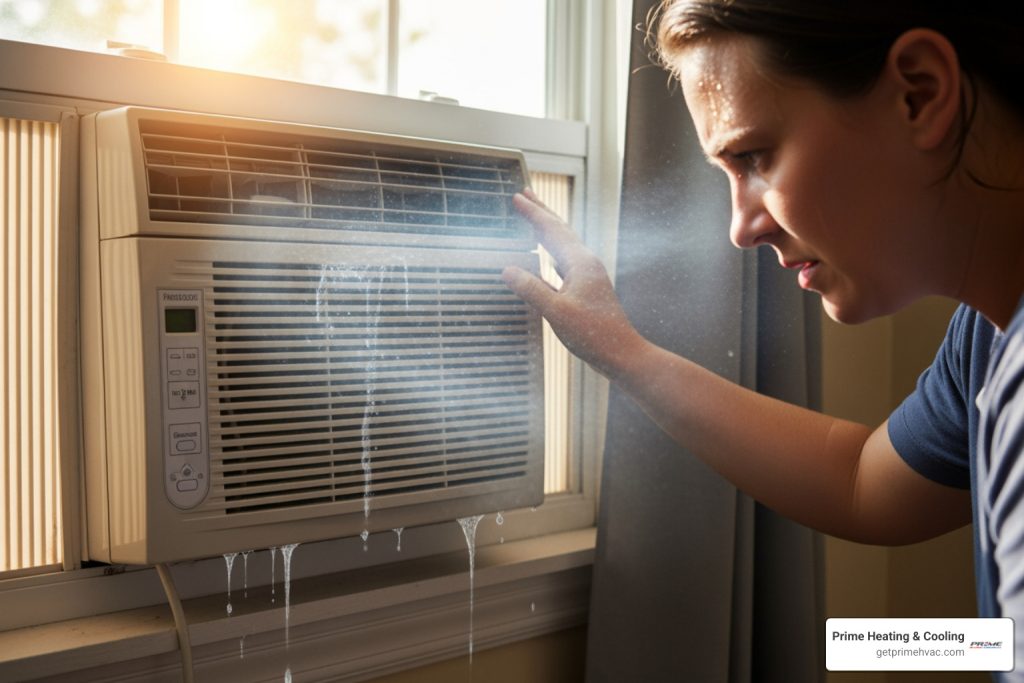
When Your AC is Not Cooling Enough: Understanding the Problem
An AC not cooling enough is a frustrating problem, especially during a hot summer. The good news is that many common causes have simple fixes you can try yourself.
Quick Answer: Why Your AC Isn’t Cooling Enough
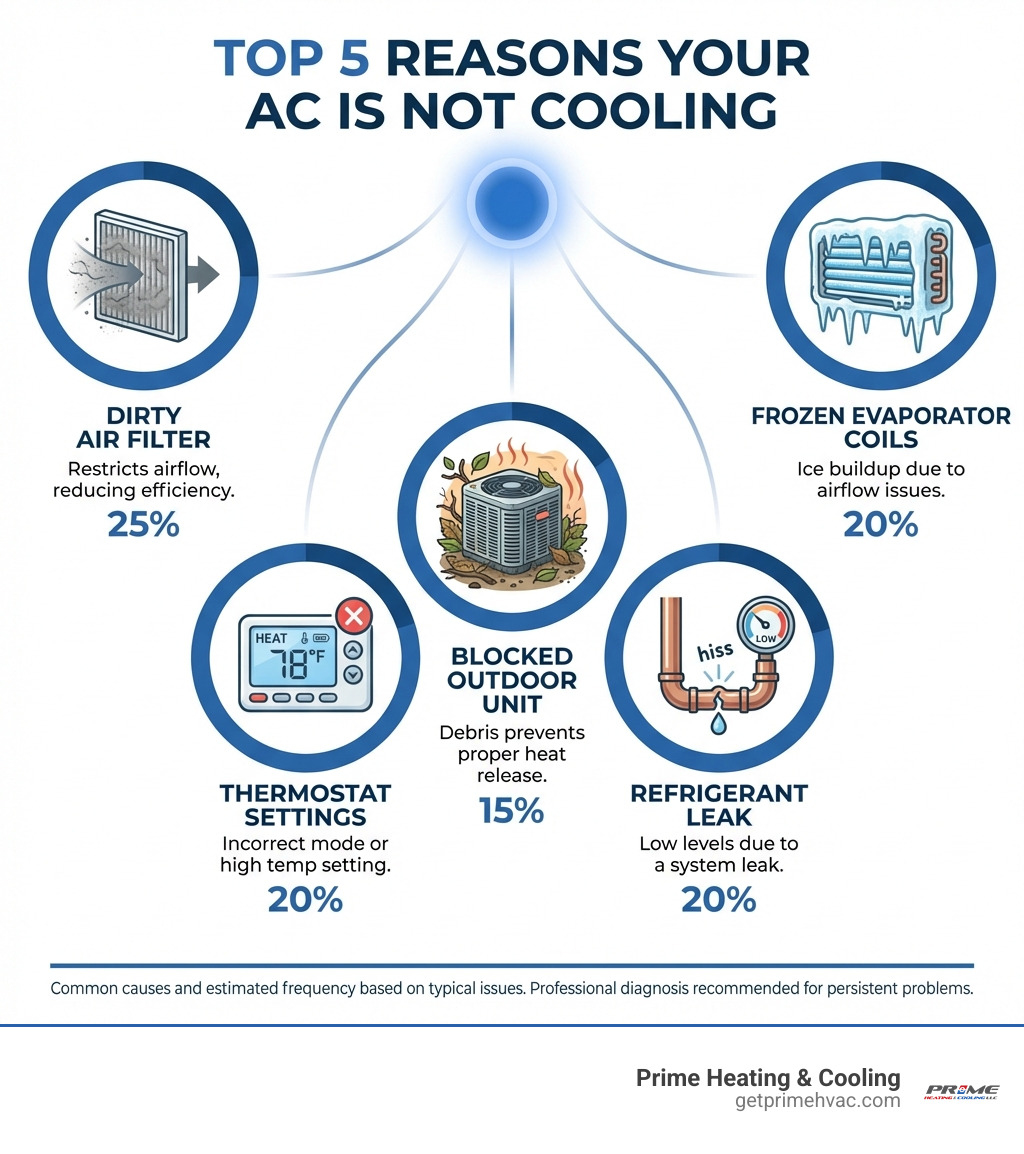
If your air conditioner is running but not cooling your home properly, the most common culprits are:
- Incorrect thermostat settings – Check it’s set to ‘cool’ and ‘auto’
- Dirty air filter – Restricts airflow
- Blocked outdoor condenser unit – Debris prevents heat release
- Low refrigerant levels – Usually indicates a leak
- Frozen evaporator coils – Often caused by restricted airflow
- Undersized AC system – Can’t keep up with cooling demand
- Leaky ductwork – Cooled air can escape
Some of these you can fix in minutes, while others require professional help. This guide will show you which is which.
An air conditioner has many parts working together. When one component fails, the whole system suffers. A clogged filter can reduce your system’s efficiency by 5-15% according to the Department of Energy. Leaky ducts can waste up to 30% of your cooled air before it even reaches you, as noted by Energy Star.
I’m Tyler Steiner, founder of Prime Heating & Cooling, and I’ve helped thousands of New England homeowners solve AC not cooling enough issues over the past decade. I’ll walk you through what to check and when it’s time to call a professional.
Simple DIY Checks for a Quick Fix
Before calling for professional help, perform a few simple checks. Often, the reason your AC not cooling enough is something easily overlooked, and a quick DIY fix can restore comfort to your Smithfield, Smithfield, or Providence home. These steps address the most common issues first.

Start with your thermostat, the brain of your HVAC system. A malfunctioning or incorrectly set thermostat can trick you into thinking your AC is broken. Similarly, a neglected air filter can drastically reduce your system’s performance. We stress the importance of these basic steps in our AC Filter Replacement: The Key to Clean and Healthy Indoor Air guide.
Check Your Thermostat Settings First
When your AC seems to be on strike, check your thermostat. A simple setting change can often resolve an AC not cooling enough problem.
- Mode Check: Is your thermostat set to “Cool”? It can accidentally be switched to “Heat” or “Fan Only.” “Fan Only” mode just circulates existing air.
- Temperature Setting: Ensure the desired temperature is set lower than the current room temperature.
- Fan Mode: We advise setting your fan to “Auto” rather than “On.” When the fan is set to “On,” it runs continuously, even when the compressor isn’t cooling, which can make the air feel warmer and prevent proper dehumidification.
- Smart Thermostats: Check for error messages or programming glitches. A quick reset might clear minor issues. See our guide: Is Your Thermostat Playing Dead? Revive It with These Simple Checks.
- Location: Ensure your thermostat isn’t near heat sources like lamps or sunny windows, which can cause your AC to run more than necessary.
If your thermostat has dead batteries, a blank screen is a common sign. For more troubleshooting, explore our article on How a Faulty Thermostat Affects Your AC System: Repair and Solutions.
Inspect for a Dirty Air Filter
If your thermostat is set correctly, check the air filter next. This component plays a massive role in your system’s performance.
A clogged air filter is one of the most common reasons an AC not cooling enough. When filters get full of dust and debris, they block airflow, forcing your AC to work much harder. This leads to warmer indoor temperatures and higher energy bills.
To check your filter, locate it in your indoor unit, pull it out, and hold it up to a light. If you can’t see light through it, it’s time for a change.
How often should you change it? For most homes in Rhode Island, check your filter monthly and change it every 1 to 3 months. If you have pets or allergies, you might need to change it more frequently. Regular filter replacement is a simple task that can significantly improve your AC’s performance. Learn more in The Role of Air Filters in Your AC System: Maintenance and Replacement.
Investigating Airflow and Outdoor Unit Problems
If the simple fixes don’t work, investigate the external components that impact cooling. The outdoor condenser unit and your home’s ductwork are crucial. If either is compromised, your AC not cooling enough problem can persist.

The condenser unit releases heat from your home. If it’s blocked, heat gets trapped, making your system inefficient. Your ductwork is the highway for cooled air; leaks or blockages mean that air gets stuck before it reaches you. We explore these issues further in Understanding Airflow Issues: Fixing Uneven Cooling in Your Home.
Clear the Outdoor Condenser Unit
Your outdoor condenser unit releases the heat your AC pulls from your home. It can’t do this if it’s covered in debris.
Leaves, grass clippings, and dirt can block airflow around the condenser coils. When airflow is restricted, the unit can’t dissipate heat, causing the system to work harder and resulting in your AC not cooling enough.
Here’s how to clean it:
- Safety First: Turn off the power to your AC unit at the circuit breaker.
- Clear Debris: Remove leaves, grass, and dirt from on and around the unit.
- Hose Down: Gently hose down the condenser fins to remove grime. Do not use a high-pressure washer, as it can damage the fins.
- Maintain Clearance: Ensure at least a 2-foot clearance around all sides of the unit. Trim back any nearby bushes or vegetation.
This simple task can significantly improve your AC’s performance. For more serious issues, see our Condenser Coil Repair: Restoring Efficiency of Your Air Conditioner guide.
Look for Leaky Ducts or Blocked Vents
Leaky ducts or blocked vents can cause an AC not cooling enough issue by preventing cool air from reaching you.
- Duct Leaks: Your ductwork can develop cracks or loose connections over time, especially in attics and crawlspaces. These leaks allow cooled air to escape, leading to inconsistent temperatures and higher energy bills. While a visual inspection can reveal obvious damage, professional sealing is often required. Our article on Ductwork Repair and Replacement: Improving Airflow and Energy Efficiency provides more detail.
- Blocked Vents: Ensure all supply and return vents are open and unobstructed by furniture, rugs, or curtains. Walk through your home in Johnston, Lincoln, or Warwick and check that no vent is covered. Move furniture away from vents and vacuum the covers to remove dust. Closing vents in unused rooms can actually strain your system and cause uneven cooling.
Addressing these airflow issues ensures the cool air your AC produces actually makes it to you.
When Your AC is Not Cooling Enough: Deeper System Issues
If DIY fixes don’t solve your AC not cooling enough problem, the issue may be more complex. Problems like refrigerant leaks, compressor failures, or an improperly sized unit require a professional HVAC technician.
Refrigerant is the lifeblood of your AC. The compressor is its heart. If either fails, or if the unit is the wrong size for your home, your system won’t cool effectively. Knowing when to call a professional is key to avoiding further damage. Our guide on When to Call an AC Technician: Signs You Need Professional Repair can help.
Signs of a Refrigerant Leak
Refrigerant makes cooling possible. Low refrigerant is almost always due to a leak, not something that needs a simple “top-off.” If your AC not cooling enough, look for these signs:
- Hissing or Bubbling Sounds: These noises from your unit could indicate escaping refrigerant.
- Ice on Evaporator Coils: Low refrigerant can cause the indoor coil to get too cold, freezing moisture from the air onto its surface. This ice blocks airflow and hampers cooling.
- Ineffective Cooling: The AC runs constantly, but your home stays warm and humid.
- Higher Energy Bills: The system works harder to compensate for low refrigerant, increasing electricity costs.
Refrigerant leaks are not a DIY fix. Only certified technicians can handle refrigerants. If you notice these signs, call us. We are experts in Refrigerant Leak Repair: Why It’s Critical for Your AC System in Smithfield and Smithfield.
Potential Compressor Problems
The compressor, located in the outdoor unit, pressurizes and circulates refrigerant. A failing compressor is a serious problem that will cause your AC not cooling enough or at all.
Signs of a failing compressor include:
- Strange Noises: Grinding, rattling, or loud banging are red flags.
- AC Not Turning On: A faulty compressor might prevent the outdoor unit from starting.
- Constantly Tripped Breaker: A struggling compressor draws too much power, tripping the circuit breaker.
- Reduced Cooling: If the AC blows warm air and you’ve ruled out other issues, the compressor could be the culprit.
Compressor problems are complex and require professional repair. If you suspect an issue, shut off your AC and call a technician. Our team specializes in Understanding AC Compressor Repair: Causes, Costs, and Solutions.
Why an Improperly Sized AC is a Problem
An AC unit that is too small or too large for your home can cause an AC not cooling enough problem, even if it’s working perfectly. This often stems from improper installation.
- Undersized Unit: A small unit will run constantly but fail to cool your home, leading to high energy bills and increased wear and tear.
- Oversized Unit: A large unit cools the air too quickly and shuts off before it can properly dehumidify your home. This is called short-cycling and leads to a clammy, sticky feeling, inefficient operation, and stress on components.
Determining the correct AC size requires a professional load calculation that considers your home’s square footage, insulation, windows, and local climate. This ensures optimal comfort and efficiency. We can help you with Choosing the Right Air Conditioning Unit for Your Home: Factors to Consider.
Prevention, Maintenance, and When to Upgrade
Many AC not cooling enough issues can be prevented with regular maintenance. A well-maintained system runs more efficiently, saving you money on energy bills and repair costs. Knowing what to do yourself and when to call a professional is key.
Proactive Maintenance to Prevent an AC Not Cooling Enough
Preventing an AC not cooling enough problem starts with proactive maintenance. Some tasks are simple DIY jobs, while others require a professional.
Here’s what you can do:
- Regularly Change Air Filters: Check filters monthly and replace them every 1-3 months to ensure good airflow.
- Keep Outdoor Unit Clear: Remove leaves and debris from around your condenser unit, maintaining a 2-foot clearance.
- Clear the Condensate Drain Line: To prevent clogs and water backup, you can pour a cup of distilled vinegar mixed with water down the drain line (after turning off the power).
- Check Vents: Ensure all supply and return vents are open and unobstructed.
Beyond these DIY tasks, professional tune-ups are invaluable. We recommend an annual AC tune-up in the spring. A technician will perform a comprehensive check, including cleaning coils, checking refrigerant levels, and inspecting electrical components. This helps catch minor issues before they become major repairs. For more tips, see our guides on DIY AC Troubleshooting: How to Fix Common Cooling System Issues and What Happens During an AC Tune-Up: Importance and Checklist.
Knowing When It’s Time for an AC Replacement
Sometimes, your AC not cooling enough is a sign that your system is at the end of its life. For homeowners in Coventry, East Greenwich, or North Providence, knowing when to replace your AC can save money in the long run.
Key indicators for replacement include:
- Age of the Unit: Most AC units last 10-15 years. If yours is over 10, it’s likely less efficient and prone to breakdowns.
- Frequent and Costly Repairs: If repair costs are adding up, replacement is often more economical.
- Rising Energy Bills: An older, inefficient unit works harder and costs more to run.
- Poor Performance: If your home is never cool enough or has inconsistent temperatures, your system may no longer be capable of cooling your space.
Modern AC units have much higher Seasonal Energy Efficiency Ratio (SEER) ratings, which can significantly cut your cooling costs. While a new system is an upfront investment, the energy savings and improved reliability make it a wise choice. Our article Is It Time for AC Replacement? Signs to Watch For offers more guidance.
Frequently Asked Questions
Here are answers to common questions we hear from homeowners across Rhode Island.
Why is my upstairs so much hotter than my downstairs?
Heat naturally rises, making upper floors warmer. This is often worsened by:
- Poor Insulation: Inadequate attic insulation allows heat from the sun to penetrate.
- Ductwork Issues: Leaks or poor design can prevent cool air from reaching the upper floors.
- Undersized System: An AC unit that’s too small will struggle to cool the entire house.
- Sun Exposure: Upper floors often get more direct sun, increasing heat gain.
Solutions include improving insulation, sealing ducts, or using zoning systems and ceiling fans.
Will setting my thermostat to a very low temperature cool my house faster?
No, this is a common misconception. Your AC cools at a constant rate. Setting the thermostat to a very low temperature will not cool your house faster. It will only make the AC run longer, use more energy, and potentially overcool your home. Set it to your desired temperature and use the “Auto” fan setting for efficiency.
How often should I change my air filter?
As a general rule, change your air filter every 1 to 3 months, and check it monthly during peak season. You may need to change it more often if you have:
- Pets: Pet dander and hair clog filters faster.
- Allergies/Asthma: Frequent changes improve indoor air quality.
- High Occupancy or Poor Air Quality: More dust and pollutants require more frequent changes.
If you can’t see light through the filter, it’s time for a new one.
Stay Cool and Comfortable with Professional Help
Dealing with an AC not cooling enough is frustrating. While many issues can be resolved with the simple DIY checks we’ve covered, it’s important to know when to call in the experts.
Your safety is paramount. Complex problems like refrigerant leaks or compressor failures are beyond the scope of a DIY fix and require a professional HVAC technician. Attempting these repairs yourself can cause further damage and pose safety risks.
If you’ve tried our troubleshooting steps and your AC not cooling enough problem persists, don’t hesitate. At Prime Heating & Cooling, we offer expert heating and cooling installation, repair, and maintenance across Rhode Island, including Smithfield, Smithfield, Johnston, and Warwick. With over 20 years of experience, our skilled technicians are available 24/7 for emergency service to provide reliable, energy-efficient solutions.
Ready to get your AC back in top shape? Contact us for reliable HVAC services in RI today!