
Why Commercial Exhaust Fans Are Essential for Your Business
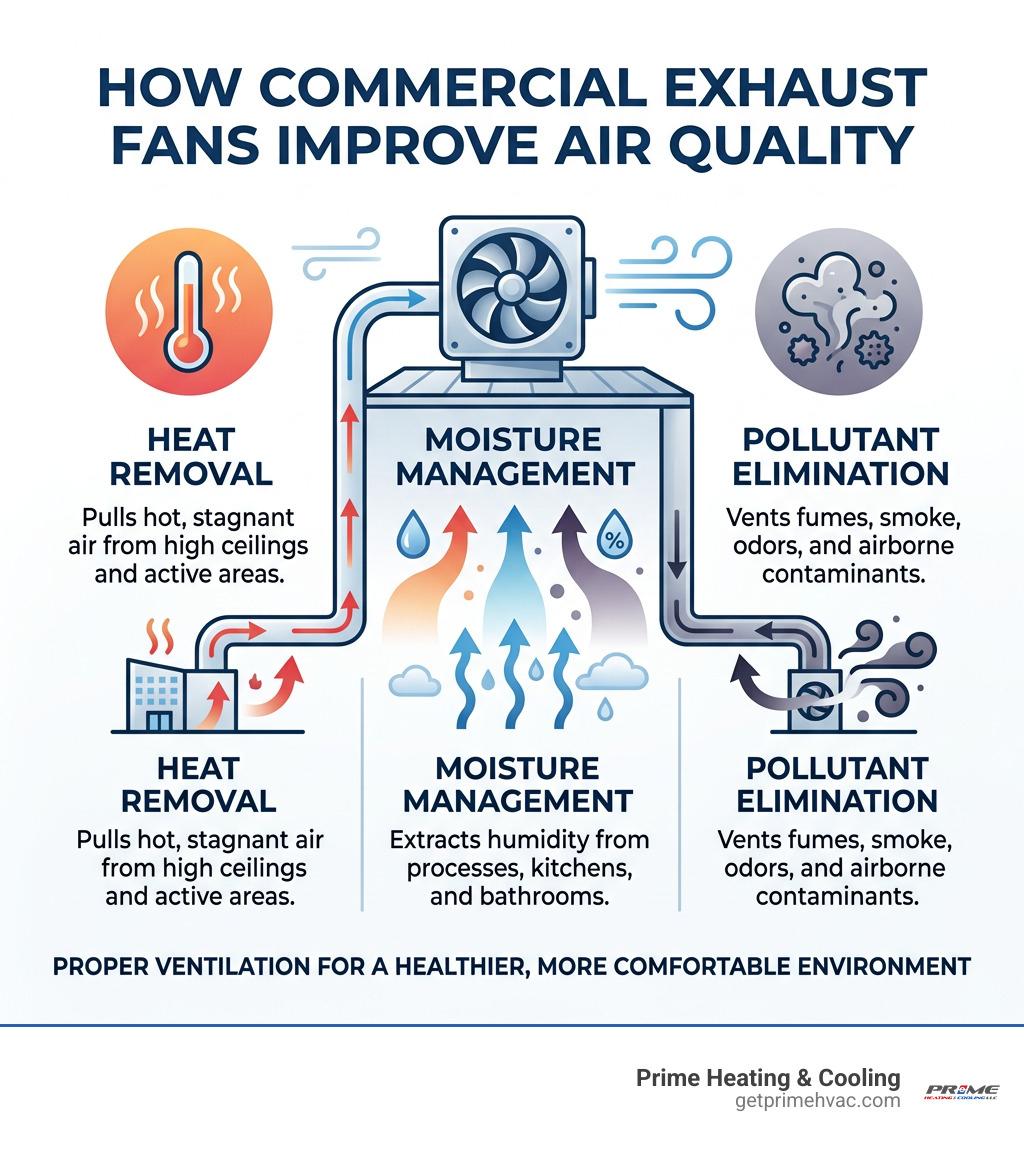
Commercial exhaust fans are powerful ventilation devices designed to remove heat, moisture, odors, and airborne contaminants from commercial and industrial spaces. Here’s a quick look at why they matter:
- Temperature control – Pulls hot air out of kitchens, warehouses, and factories
- Air quality – Removes fumes, grease, smoke, and pollutants
- Moisture management – Prevents mold and structural damage
- Workplace safety – Reduces buildup of harmful gases and contaminants
- Employee productivity – Comfortable, clean air keeps workers focused and healthy
Think about a busy commercial kitchen on a Friday night. Without a proper exhaust system, heat and grease-laden air build up fast — creating an uncomfortable, unsafe, and code-violating environment. The same goes for warehouses, manufacturing floors, and medical facilities. Poor ventilation isn’t just uncomfortable. It’s a liability.
Proper ventilation is one of the most overlooked factors in commercial building performance. Yet it directly impacts your energy bills, your team’s health, and your compliance with safety standards.
I’m Tyler Steiner, CEO and founder of Prime Heating & Cooling, and I’ve spent my career helping New England businesses design and maintain ventilation systems — including commercial exhaust fans — that perform reliably in demanding environments. In the sections below, I’ll walk you through everything you need to know to make the right call for your facility.
Understanding Commercial Exhaust Fans and Their Benefits
When we talk about Commercial exhaust fans, we aren’t talking about the little plastic fan in your home bathroom. These are industrial-grade machines designed to move massive volumes of air—sometimes up to 120,000 cubic feet per minute (CFM) in high-capacity vane axial models.
Residential vs. Commercial: The Power Gap
The primary difference lies in durability and performance. While a residential fan might run for twenty minutes after a shower, a commercial unit often runs 24/7. They are constructed from heavy-duty materials like spun aluminum or galvanized steel to resist weather and corrosion. Furthermore, they must adhere to strict Mechanical Ventilation Types standards to ensure they can handle the high static pressure found in ducted commercial systems.
Standards and Certifications
In our 20 years of experience serving Rhode Island businesses from Warwick to Smithfield, we always emphasize looking for two specific seals: AMCA (Air Movement and Control Association) and UL (Underwriters Laboratories). AMCA ratings guarantee that the fan will actually move the amount of air the manufacturer claims, while UL certification ensures the electrical components are safe for rigorous commercial use.

Types of Commercial Exhaust Fans for Every Application
Choosing the right “flavor” of fan depends entirely on where you are putting it and what you are trying to suck out of the building.
- Upblast Fans: These are the workhorses of the restaurant industry. They discharge air upward, away from the roof surface. This is critical for grease-laden air; you don’t want grease settling on your roof membrane and rotting it. Specific models like UBB and UBX Upblast Propeller Roof Exhaust Fans are designed specifically for these high-velocity needs.
- Downblast Fans: Typically used for general ventilation in schools, offices, or churches. They discharge air downward toward the roof. They are great for heat removal but should never be used for grease.
- Wall-Mounted Fans: Perfect for warehouses or mechanical rooms where roof access is limited. These often feature automatic shutters that open when the fan starts and close to prevent drafts when it’s off.
- Inline Fans: These live inside your ductwork. They are the “invisible” solution for office buildings where you need to move air through long stretches of pipe without having a massive fan visible on the exterior.
- Axial vs. Centrifugal: Axial fans (think of a plane propeller) move lots of air at low pressure. Centrifugal fans (the “squirrel cage” style) are better at pushing air through complex duct systems with high resistance.
Key Benefits of High-Capacity Ventilation
Why invest in a high-capacity system? It comes down to the science of “Building Pressure Balance.” If you suck air out without a plan, you create a vacuum. A well-designed system using Commercial exhaust fans ensures:
- Heat Removal: In a Rhode Island summer, a warehouse can become a literal oven. High-capacity fans can drop the perceived temperature significantly by constantly replacing stagnant hot air with fresher outdoor air.
- Moisture and Odor Control: From locker rooms to chemical processing plants, keeping humidity low prevents structural rot and keeps the environment smelling professional.
- Contaminant Filtration: In manufacturing, fans pull welding fumes or dust away from the “breathing zone” of your employees, keeping you in compliance with safety regulations.
Selecting the Right Size and CFM Rating
Sizing a fan isn’t a “bigger is better” situation. If a fan is too small, it won’t clear the air. If it’s too big, you’re literally throwing money out the window in the form of wasted electricity and conditioned air.
We calculate the required CFM (Cubic Feet per Minute) based on “Air Changes per Hour.” For example, a warehouse might need 6-10 air changes per hour, while a busy kitchen might need 30-50.
| Fan Size | Typical CFM Range | Common Applications |
|---|---|---|
| 14 – 18 Inch | 2,000 – 4,000 | Small shops, mechanical rooms |
| 24 – 30 Inch | 5,000 – 9,000 | Medium warehouses, large kitchens |
| 36 – 48 Inch | 10,000 – 20,000+ | Industrial plants, large factories |
| Vane Axial | Up to 120,000 | Mining, massive industrial complexes |
Installation, Maintenance, and Professional HVAC Integration
Installing Commercial exhaust fans is more than just cutting a hole in the roof. It requires a deep understanding of the building’s envelope. For instance, a roof-mounted fan requires a roof curb—a raised metal box that provides a level platform and ensures a watertight seal. Without a proper curb, you’re just inviting a roof leak during the next New England Nor’easter.
HVAC System Synergy
Your exhaust fan doesn’t live in a vacuum. It is part of a larger ecosystem. If your exhaust fan is pulling 5,000 CFM out, you need a Make-Up Air Unit (MAU) to put 5,000 CFM back in. If you don’t, you’ll experience “backdrafting,” where the building tries to pull air in through water heater vents or cracks in the doors, leading to dangerous carbon monoxide buildup or doors that are impossible to open.
For modern businesses looking to save on energy, we often integrate Energy Recovery Ventilators (ERV). These units “steal” the temperature from the outgoing air to pre-condition the incoming fresh air, significantly reducing the load on your commercial heating and cooling systems.
Essential Accessories for Commercial Exhaust Fans
To get the most out of your investment, consider these critical add-ons:
- Variable-Speed Motors: These allow you to ramp the fan up during busy hours and slow it down when the building is empty, saving a fortune in energy.
- Backdraft Dampers: These act like a one-way valve, preventing cold winter air from blowing back into your building when the fan is off.
- Disconnect Switches: A safety requirement that allows a technician to cut power locally while working on the unit.
- Bird/Outlet Guards: Essential for preventing critters from nesting in your equipment.
Maintenance for Long-Term Performance and Safety
We’ve seen many businesses in Providence and Smithfield neglect their fans until they seize up. A little proactive care goes a long way. At Prime Heating & Cooling, we recommend a regular maintenance agreement that covers:
- Belt Tension: Loose belts slip and reduce efficiency; tight belts break bearings.
- Bearing Lubrication: High-heat environments dry out grease quickly.
- Cleaning: In kitchens, grease buildup is a major fire hazard. In warehouses, dust buildup can unbalance the fan blades, leading to vibration and motor failure.
- Motor Inspection: Checking for amperage draws that indicate a motor is nearing its end of life.
Professional Solutions with Prime Heating & Cooling
At Prime Heating & Cooling, we’ve spent two decades serving the local business community across Rhode Island—from the East Side of Providence to the industrial hubs of North Smithfield. We know that when your ventilation goes down, your business can grind to a halt.
Whether you are dealing with an emergency HVAC crisis or looking to upgrade to more energy-efficient, variable-speed Commercial exhaust fans, we have the expertise to get it right the first time. We don’t just sell equipment; we design solutions that balance your air, protect your employees, and keep your operating costs low.
Don’t let poor air quality or excessive heat dampen your productivity. From Johnston to Coventry, we are your neighbors and your partners in commercial comfort.
Ready to clear the air? Schedule your commercial ventilation service today and let us help your business breathe easier.


