
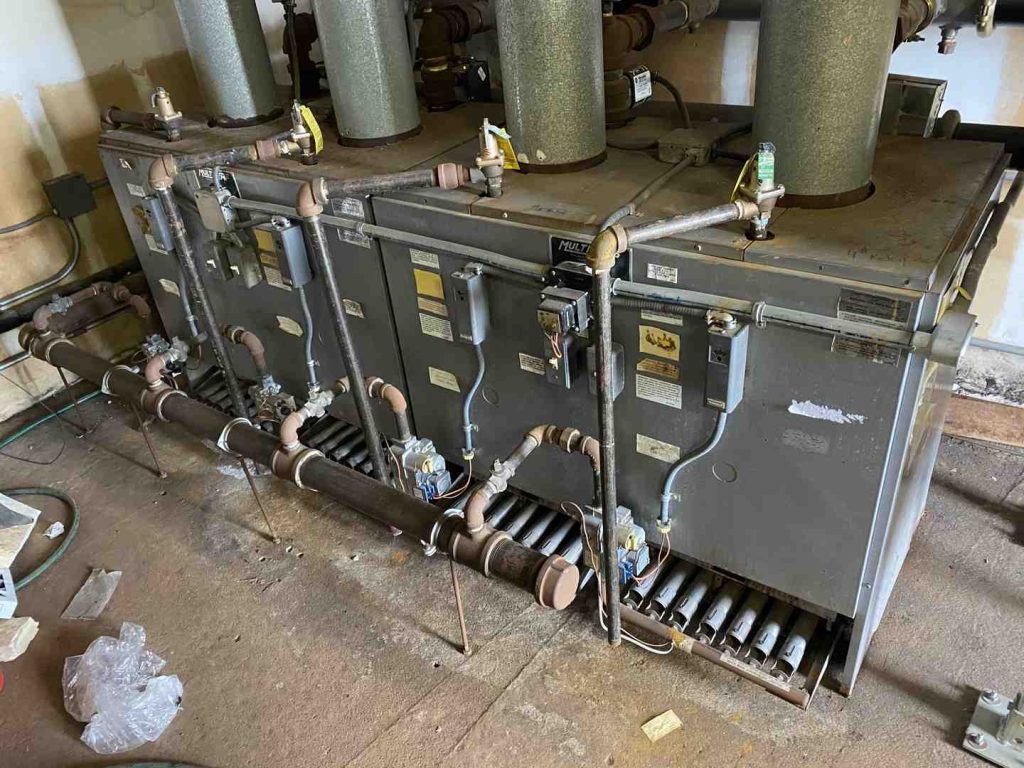
Why Commercial Hot Water Systems Matter for Your Business
Commercial hot water systems are the backbone of daily operations for countless businesses—from restaurants washing hundreds of dishes per shift to hotels serving guests around the clock, to gyms and spas where hot water is essential for comfort and hygiene. Unlike residential units, commercial systems must deliver large volumes of hot water reliably, often for 12+ hours a day, while managing energy costs that can significantly impact your bottom line.
Main types of commercial hot water systems:
- Tank (Storage) Water Heaters – Store and maintain hot water in large tanks (30-120+ gallons)
- Tankless (On-Demand) Water Heaters – Heat water instantly as it flows through the unit
- Heat Pump Water Heaters (HPWHs) – Transfer heat from air or ground to water (up to 52% more efficient)
- Hybrid Systems – Combine technologies for optimal performance
Key selection factors:
- Capacity and sizing – Match peak demand (measured in gallons per hour)
- Energy efficiency – ENERGY STAR certified models use 15% less energy
- Fuel type – Natural gas, propane, or electric based on availability and cost
- Space constraints – Footprint, venting, and structural requirements
A. O. Smith, the #1 most specified commercial water heater manufacturer, has been engineering these systems for over 145 years. Modern commercial hot water systems can save businesses nearly $890 million annually in energy costs while preventing over 17 billion pounds of greenhouse gas emissions—equivalent to removing 1.5 cars from the road per unit.
As Tyler Steiner, I’ve spent years helping New England businesses select and maintain commercial hot water systems that balance upfront costs with long-term efficiency. My work at Prime Heating & Cooling has shown me how the right system keeps operations running smoothly while cutting energy bills.
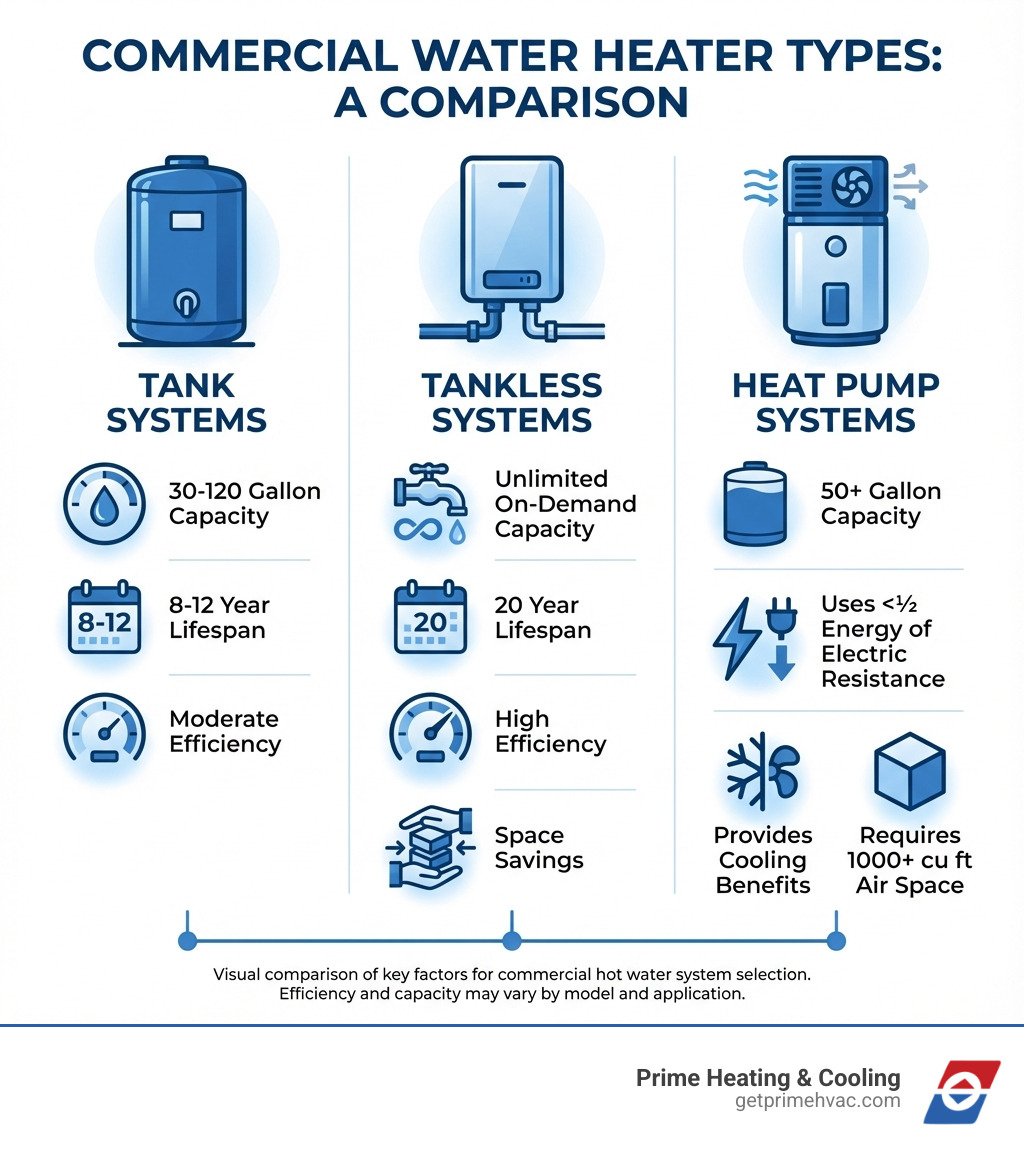
Decoding the Main Types of Commercial Water Heaters
When it comes to providing hot water for your business, understanding the fundamental differences between system types is crucial. From traditional storage tanks to modern on-demand solutions and innovative heat pumps, each category offers unique advantages depending on your specific needs. We’ll explore these system categories, focusing on how they provide on-demand heating or stored hot water, and even touch upon hybrid technology.
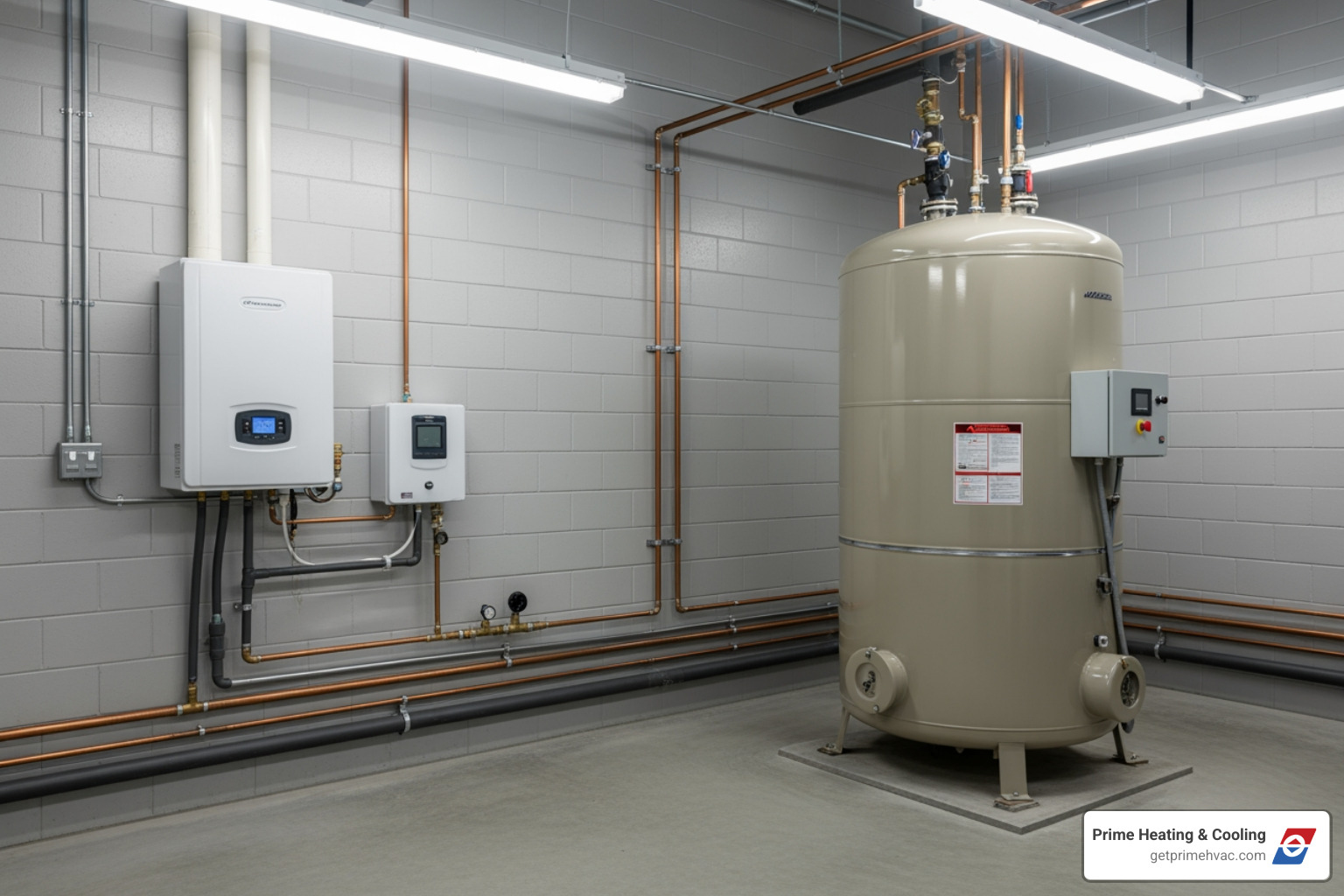
Tank vs. Tankless: The Great Debate for Businesses
The choice between storage tank and tankless commercial hot water systems is one of the most significant decisions for any business. Both have their merits, and the “best” option largely depends on factors like your hot water demand patterns, available space, and budget.
Storage Tank Water Heaters
These are the traditional workhorses, storing a large volume of hot water (typically 30 to over 120 gallons for commercial use) in an insulated tank. The water is heated and maintained at a set temperature, ready for immediate use. Once the stored hot water is depleted, the system needs time to recover and reheat a fresh batch. Commercial tank units often range in capacity, with common sizes like 40 gallons, and typically last between 8 to 12 years. They are often less expensive upfront.
Tankless (On-Demand) Water Heaters
Also known as instantaneous water heaters, these units heat water only when it’s needed. When a hot water tap is opened, cold water flows through a heat exchanger in the unit, where it’s rapidly heated to the desired temperature. This provides a continuous supply of hot water, which is a major advantage for businesses with high, sustained demand. For instance, a 10,000 sq ft restaurant might replace a 150-gallon storage tank with three tankless units to ensure faster kettle refills and save space. Tankless models can feature high BTU inputs, such as 199,000 BTU, and boast a longer lifespan, often up to 20 years.
Capacity vs. Flow Rate
For tank systems, “capacity” refers to the total volume of hot water available. For tankless systems, “flow rate” (measured in gallons per minute or GPM) and BTU input are more critical, indicating how much hot water can be delivered continuously. If your business has intermittent, high-volume needs, a tank might suffice. If you need a constant, uninterrupted supply, tankless systems are often superior.
Upfront Cost vs. Operational Cost
Tank systems generally have a lower upfront purchase and installation cost. However, tankless units, with their on-demand heating, can be more energy-efficient by avoiding standby heat loss (the energy wasted by keeping a tank of water hot 24/7). This translates to lower operational costs over the system’s lifespan. Some commercial tankless water heaters can offer a Uniform Energy Factor (UEF) of up to 0.95.
Space Savings
Tankless water heaters are significantly smaller than their tank counterparts and can often be wall-mounted, freeing up valuable floor space. For businesses with limited utility room space, this can be a major benefit. Multiple tankless units can even be linked together in rack systems for increased capacity, configured for back-to-back, wall-mount, or free-standing in-line installations.
Here’s a quick comparison:
| Feature | Traditional Tank Water Heater | Tankless Water Heater |
|---|---|---|
| Capacity | Stored volume (e.g., 30-120+ gallons) | Unlimited on-demand, based on flow rate (GPM) |
| Energy Use | Moderate efficiency, standby heat loss | High efficiency (up to 0.95 UEF), no standby loss |
| Lifespan | 8-12 years | Up to 20 years |
| Space | Large footprint, requires dedicated floor space | Compact, often wall-mounted, saves space |
| Cost | Lower upfront cost, potentially higher operating costs | Higher upfront cost, lower operating costs (energy savings) |
| Hot Water | Limited by tank size, can run out | Continuous supply |
For more detailed insights into this debate, you can check out our article on More info about tank vs tankless water heaters.
The Rise of Commercial Heat Pump Water Heaters (HPWHs)
Commercial hot water systems are constantly evolving, and heat pump water heaters (HPWHs) are leading the charge in energy efficiency. Unlike traditional electric resistance heaters that generate heat directly, HPWHs use heat transfer technology. They work by extracting heat from the surrounding air or ground and transferring it to the water, much like a refrigerator in reverse. This makes them incredibly efficient.
Energy Efficiency and Space Cooling Benefits
HPWHs use significantly less energy. An ENERGY STAR certified commercial electric heat pump water heater, for example, uses less than half the energy of an electric resistance unit. Studies have shown commercial HPWHs can provide 52% energy savings over baseline electric resistance water heaters, resulting in 10,000 kWh annual energy savings. This translates to substantial utility bill reductions and a smaller carbon footprint. An ENERGY STAR commercial HPWH can save at least 10 MWh annually, with emissions savings equivalent to removing 1.5 cars from the road per year.
A unique advantage of commercial HPWHs is their ability to provide space cooling. As they extract heat from the air, they effectively cool the surrounding environment. This can reduce overall HVAC costs, especially in spaces that already require cooling, creating a dual benefit for your business.
Ideal Operating Conditions
For optimal efficiency, HPWHs perform best in environments with specific temperature and air volume conditions. They generally operate most effectively in areas that remain within a 40º–90ºF range. Additionally, they require sufficient air space—typically at least 1,000 cubic feet—to draw heat from, making them suitable for larger utility rooms or mechanical spaces rather than confined areas. This ensures they have an adequate heat source to operate efficiently.
Our team at Prime Heating & Cooling keeps a close eye on advancements in this technology. We understand that HPWHs represent a smart investment for many businesses in Rhode Island and Massachusetts looking to cut energy costs and improve sustainability. Scientific research continues to affirm their performance, as detailed by the Electric Power Research Institute’s evaluation of field performance for commercial heat pump water heaters. You can learn more about this research here: Scientific research on commercial heat pump performance. For a broader understanding of how heat pumps work, you can visit More info about heat pumps.
Gas, Electric, and Other Fuel Sources
The fuel source for your commercial hot water systems is a foundational decision, impacting everything from operating costs to environmental considerations and infrastructure requirements.
Natural Gas: This is a very common and often cost-effective choice for commercial applications in Rhode Island and Massachusetts where gas lines are readily available. Modern natural gas water heaters are highly efficient, particularly condensing models. However, these condensing units require a drain line for the acidic condensate they produce, which may necessitate material upgrades (e.g., plastic piping) or a neutralizer in older facilities. ENERGY STAR certified gas water heaters are typically power-vented and not compatible with natural draft vent systems.
Propane: For businesses located in areas without access to natural gas lines, propane serves as a viable alternative. Propane systems function similarly to natural gas units but require on-site storage tanks and scheduled deliveries.
Electricity: Electric resistance water heaters are simple to install and operate, requiring only an electrical connection. They are often considered for smaller applications or when gas is not an option. However, their operating costs can be higher than gas or heat pump systems, especially if electricity rates are high. The exception here is the electric heat pump water heater, which, as discussed, is significantly more efficient than standard electric resistance units.
Environmental Impact and Emissions Regulations: With increasing focus on sustainability, the environmental impact of your fuel source is becoming more important. Natural gas and propane combustion produce greenhouse gases. However, many modern gas water heaters feature Ultra-Low NOx (nitrogen oxide) burners to reduce harmful emissions. Electric HPWHs are a “greener” choice, especially when powered by renewable electricity sources, as they simply move heat rather than generating it from combustion.
When we help businesses choose a fuel source, we consider local utility costs, availability of infrastructure, and any relevant emissions regulations that might impact your business in Rhode Island or Massachusetts.
Key Factors in Selecting Commercial Hot Water Systems
Choosing the right commercial hot water systems is a significant investment that impacts your operational efficiency and bottom line for years to come. It’s not just about picking a heater; it’s about making an informed decision based on your specific business needs. We consider sizing, budgeting for both upfront and long-term costs, and evaluating the overall value your system will provide.

Sizing and Capacity: Meeting Your Business’s Demand
One of the most critical steps in selecting a commercial hot water system is accurate sizing. Underestimate your needs, and you’ll face cold water complaints and operational disruptions. Overestimate, and you’ll pay more upfront and potentially incur higher energy costs.
Peak Demand Calculation: This is the cornerstone of proper sizing. We carefully calculate your business’s peak demand—the maximum amount of hot water needed during your busiest hour. This involves considering all hot water-consuming fixtures and processes.
Gallons per Hour (GPH) and Recovery Rate: For tank systems, we look at the GPH recovery rate, which indicates how quickly the heater can replenish its hot water supply. For tankless systems, we focus on the required GPM flow rate to ensure continuous hot water at all outlets simultaneously.
Fixture Count and Business Type: The number and type of fixtures (sinks, dishwashers, showers, laundry machines) are key. A restaurant, for instance, has intense, often concentrated demand for dishwashing and food preparation. A hotel needs consistent hot water for guest rooms, laundry, and potentially pools or spas. A gym requires high volumes for showers, especially during peak workout times. Offices, on the other hand, typically have much lower and more intermittent hot water needs.
To ensure your system meets your exact specifications, resources like A. O. Smith’s sizing tool can be invaluable. You can use their tool to size an A. O. Smith commercial water heater to meet your specs: Use our tool to size an A. O. Smith commercial water heater to meet your specs..
At Prime Heating & Cooling, we take the guesswork out of sizing, ensuring your business in Rhode Island or Massachusetts has a steady, reliable supply of hot water without unnecessary waste. For more information on how we can help with your overall commercial needs, visit More info about commercial services.
Energy Efficiency and Long-Term Savings
Beyond the initial purchase price, the energy efficiency of your commercial hot water system will be the biggest determinant of its long-term cost. Investing in an efficient system today means significant savings tomorrow.
Uniform Energy Factor (UEF) and Thermal Efficiency: These metrics are crucial for comparing the energy performance of different water heaters. UEF is a comprehensive measure of a water heater’s overall energy efficiency, while thermal efficiency specifically measures how effectively the system converts fuel into heat. Higher numbers generally mean better efficiency.
Standby Loss: This refers to the heat lost from a storage tank as it sits, keeping water hot even when no one is using it. Tankless systems inherently eliminate standby loss, contributing to their higher overall efficiency. For tank systems, good insulation and advanced controls can minimize this loss.
ENERGY STAR Certification: This is your go-to indicator for proven energy savings. ENERGY STAR certified commercial water heaters use approximately 15 percent less energy than conventional commercial units. For electric heat pump water heaters, the savings are even more dramatic, using less than half the energy of an electric resistance unit. If all commercial water heaters sold in the U.S. were ENERGY STAR certified, energy cost savings would grow to nearly $890 million annually.
Rebates and Incentives: Many utility companies and government programs in Rhode Island and Massachusetts offer rebates or incentives for installing ENERGY STAR certified or high-efficiency commercial hot water systems. We can help you steer these opportunities to maximize your return on investment. You can find more information about rebates and product information from ENERGY STAR here: Find rebates and product info from ENERGY STAR.
Space, Venting, and Structural Constraints
The physical environment of your business plays a major role in determining which commercial hot water systems are feasible.
Footprint: Traditional tank water heaters require significant floor space. If your utility room is cramped, a compact tankless system, or a tankless rack system that can be wall-mounted, might be a more practical solution.
Ventilation Requirements: Gas-fired systems, especially high-efficiency condensing models, have specific venting needs. ENERGY STAR certified gas water heaters are typically power-vented, meaning they use a fan to expel combustion gases, and are not compatible with natural draft vent systems. The exhaust vent for power-vented heaters must be properly installed, often above the snow line, and sloped back towards the water heater to prevent condensate freezing.
Condensate Drainage: Condensing gas water heaters produce acidic condensate that must be properly drained. This requires a corrosion-resistant drain line, often plastic. In facilities with older cast iron piping, drain lines may need to be replaced, or a neutralizer installed to prevent damage. In commercial food service, the condensate line can sometimes be drained downstream from the dishwasher to use cleaning agents for neutralization.
Structural Support: Large, heavy commercial water heaters, especially tanks filled with water, require adequate structural support. Wall-mounted tankless units also need sturdy wall structures.
Indoor vs. Outdoor Installation: Some tankless models are designed for outdoor installation, which can be a great option for businesses with limited indoor space, provided the local climate in Rhode Island or Massachusetts is suitable.
Considering these constraints upfront with an experienced professional like Prime Heating & Cooling will prevent costly surprises and ensure a safe, compliant installation.
High-Efficiency Features and Smart Technology
In today’s business world, commercial hot water systems are more than just heat sources; they’re sophisticated pieces of equipment designed for maximum efficiency and seamless operation. Advanced features and smart technology are changing how businesses manage their hot water needs.
What to Look for in High-Efficiency Models
When investing in new commercial hot water systems, focusing on high-efficiency models can lead to significant long-term savings and improved performance.
Condensing Heat Exchangers: This is a hallmark of high-efficiency gas water heaters. Condensing technology captures heat from the exhaust gases that would otherwise be wasted, using it to pre-heat incoming cold water. This significantly boosts efficiency, allowing some units to achieve efficiency ratings of up to 96%.
Advanced Burners: Look for systems with advanced burner technology, such as Ultra-Low NOx (nitrogen oxide) burners. These reduce harmful emissions, helping your business comply with environmental regulations while also contributing to cleaner air.
Improved Insulation: For tank-type water heaters, superior insulation around the tank minimizes standby heat loss, keeping the water hotter for longer and reducing the energy needed to re-heat it.
ENERGY STAR Benefits: As mentioned, ENERGY STAR certified commercial water heaters use about 15 percent less energy than conventional models. This certification indicates that the product meets strict energy efficiency guidelines set by the U.S. Environmental Protection Agency. These savings are not just theoretical; they translate directly into lower operating costs for your business.
Acidic Condensate Management: As discussed, condensing gas water heaters produce acidic condensate. High-efficiency models are designed with corrosion-resistant components and require proper drainage solutions. Ensuring this is handled correctly is vital for the longevity of the system and compliance with plumbing codes in Rhode Island and Massachusetts.
The Role of Smart Controls and Connectivity
Modern commercial hot water systems are increasingly integrated with smart technology, offering unprecedented control and insights.
Remote Diagnostics and Monitoring: Smart controls allow you to monitor your system’s performance remotely, often via a mobile app or web portal. This means we can often diagnose potential issues before they become major problems, minimizing downtime and ensuring consistent hot water. Some systems even offer intelligent leak detection and prevention.
Temperature Scheduling and Usage Tracking: You can program your water heater’s operation to match your business hours and peak demand times, ensuring hot water is available when needed and reducing energy consumption during off-peak periods. Usage tracking provides valuable data to optimize schedules and identify areas for further efficiency improvements.
Leak Detection with Auto-Shutoff: Advanced systems can detect leaks early and, in some cases, automatically shut off the water supply to prevent costly water damage, offering peace of mind and protecting your property.
Integration with Building Management Systems (BMS): For larger commercial facilities in Rhode Island and Massachusetts, smart water heaters can integrate seamlessly with existing BMS, providing a centralized platform for managing all aspects of your building’s energy consumption and operations. This level of connectivity empowers businesses to operate more efficiently and sustainably.
Installation, Maintenance, and Ensuring Longevity
Even the most advanced commercial hot water systems will underperform or fail prematurely without professional installation and consistent maintenance. This final stage is crucial for ensuring your investment pays off in reliable hot water and extended system life.
Installation Best Practices for commercial hot water systems
Professional installation is non-negotiable for commercial hot water systems. The complexity, size, and safety requirements of these units demand expertise.
Code Compliance: Our licensed technicians at Prime Heating & Cooling are well-versed in all local building and plumbing codes in Rhode Island and Massachusetts. Ensuring your installation is compliant from day one prevents fines, ensures safety, and guarantees proper operation.
Proper Venting: For gas systems, correct venting is critical for expelling combustion byproducts safely. This includes selecting the right vent type (e.g., power-vented for high-efficiency units), ensuring proper sizing, and maintaining correct slopes for condensate drainage.
Gas and Water Line Connections: Incorrect connections can lead to leaks, inefficient operation, or dangerous situations. Our experts ensure all gas and water lines are securely and correctly connected, adhering to all safety standards.
Electrical Requirements: Electric and heat pump water heaters have specific electrical needs. We ensure proper wiring, breaker sizing, and grounding to prevent electrical hazards and ensure efficient power delivery.
Commissioning and Testing: After installation, we rigorously commission and test the system to ensure every component functions as designed. This includes checking water temperature, pressure, flow rates, and safety mechanisms to guarantee your system is ready for reliable operation.
For expert commercial HVAC services, including proper installation of all components, you can always rely on our team. Learn more about our services at More info about commercial HVAC in Smithfield RI.
Creating a Maintenance Schedule
Regular maintenance is the secret to extending the life of your commercial hot water systems and avoiding unexpected breakdowns. Just like your business vehicles, these systems need routine care.
Annual Inspections: We recommend annual professional inspections. During these checks, our technicians will assess the overall condition of your unit, check for wear and tear, and identify any potential issues before they escalate.
Anode Rod Checks: For tank water heaters, the anode rod (or sacrificial rod) protects the tank from corrosion. Regular inspection and replacement of this rod are vital for preventing tank leaks and extending its lifespan.
Flushing the Tank: Sediment can accumulate at the bottom of storage tanks, reducing efficiency and potentially leading to premature failure. Regular flushing removes this sediment, maintaining optimal performance.
Descaling Tankless Units: Mineral buildup (scale) can significantly impede the efficiency of tankless water heaters. Periodic descaling, typically with a vinegar solution, is essential to keep the heat exchanger clear and functioning efficiently.
Checking Safety Valves: The temperature and pressure relief (T&P) valve is a critical safety component. We regularly test this valve to ensure it’s operating correctly, preventing dangerous pressure buildups.
With proper care and maintenance, a traditional tank water heater can last 8 to 12 years, while a tankless unit can serve your business for up to 20 years. Proactive maintenance is a smart investment that saves you money and headaches in the long run. To schedule regular hot water services in Smithfield, RI, or anywhere in our service area, visit More info about hot water services in Smithfield RI and More info about hot water services in RI.
Your Partner for Reliable Commercial Hot Water
Navigating the complexities of commercial hot water systems can seem daunting, but choosing the right system is a critical decision for your business’s efficiency, sustainability, and bottom line. We understand that every business in Rhode Island and Massachusetts has unique demands, from the busy kitchen of a restaurant to the consistent needs of a hotel or the variable usage of an office building.
At Prime Heating & Cooling, we pride ourselves on being your trusted partner. With over 20 years of experience, our skilled technicians are dedicated to providing reliable, energy-efficient solutions custom to your specific operational needs and budget. We’re not just about installing equipment; we’re about delivering operational reliability, helping you achieve your energy efficiency goals, and ensuring you have a steady, uninterrupted supply of hot water, 24/7.
From initial consultation and expert sizing to seamless installation and proactive maintenance, we’re with you every step of the way. We cover all your commercial plumbing and HVAC needs across Rhode Island and Massachusetts, including East Greenwich, Johnston, Scituate, Smithfield, Providence, Lincoln, Coventry, Warwick, North Smithfield, North Scituate, North Providence, and Franklin.
Let us put our expertise to work for your business. For expert plumbing installations and repairs, contact our team today! For expert plumbing installations and repairs, contact our team today!.