Is Your Rhode Island Water Safe to Drink?
How to Test Your Water Quality in RI is simpler than most homeowners think. Here’s a quick overview:
- Find a state-certified lab listed on the RIDOH website
- Call the lab to discuss which tests you need
- Pick up sterile sample bottles and instructions from the lab
- Collect your water sample — takes just 5–10 minutes
- Return the sample within 24 hours
- Receive your results in 10–15 business days
If you have a private well, you are personally responsible for testing your water. Public water customers can check their annual Consumer Confidence Report from their water supplier.
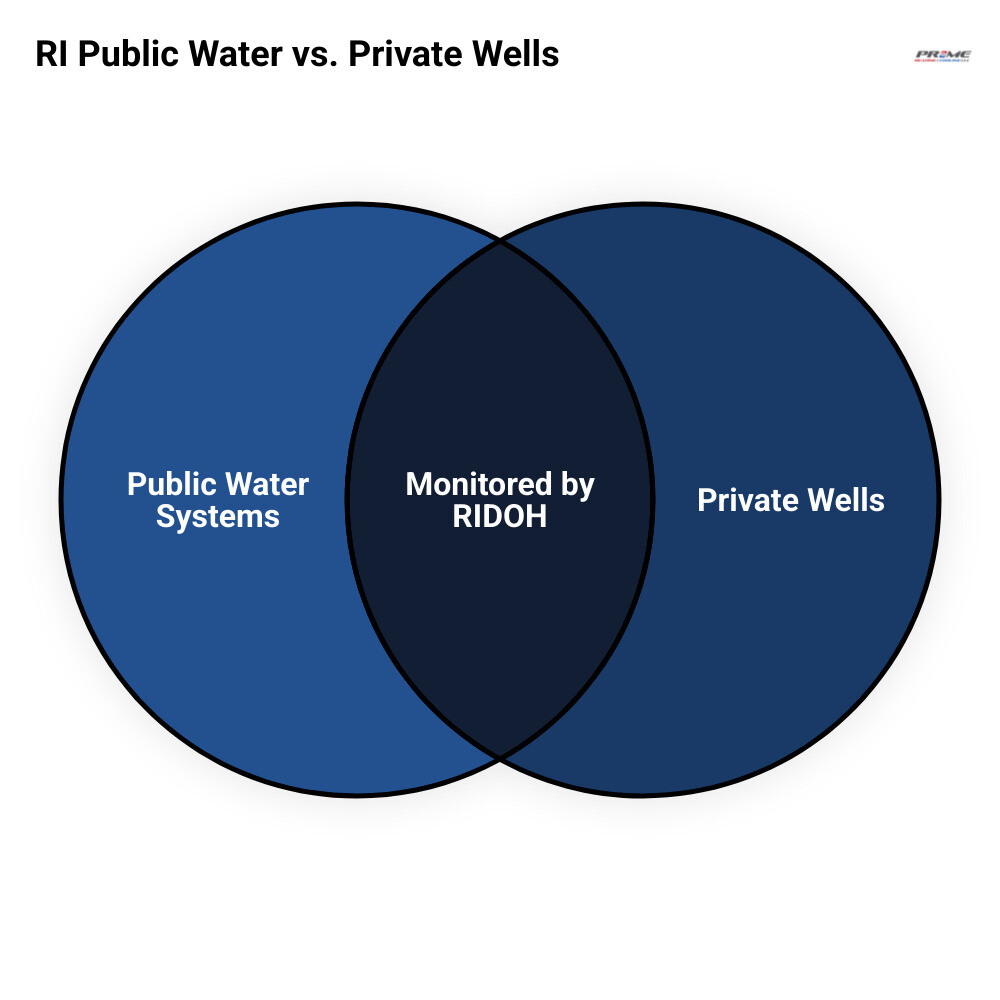
Water quality in Rhode Island varies significantly depending on whether your home uses a private well or a public water system. Many serious contaminants — including bacteria, arsenic, radon, and PFAS “forever chemicals” — have no taste, odor, or color. You simply cannot know they are there without a lab test.
In 2024 alone, the Rhode Island Department of Health (RIDOH) conducted 29,598 public water tests and 3,922 private well tests. Those numbers reflect how seriously the state takes water safety — and why you should too.
I’m Tyler Steiner, CEO and founder of Prime Heating & Cooling, and through years of serving Rhode Island homeowners with plumbing and water system solutions, I’ve seen how untested water can quietly damage both health and home infrastructure — which is exactly why understanding how to test your water quality in RI is something every local homeowner should know. In this guide, I’ll walk you through everything you need to do it right.
How to Test Your Water Quality in RI terminology:
Why Water Quality Testing is Essential for Rhode Island Homeowners
As we move through April 2026, the importance of knowing what’s in your tap has never been higher. Whether you live in the East Side of Providence or a more rural spot like North Scituate, your water quality impacts your family’s health, your property value, and even the lifespan of your home appliances.
In Rhode Island, the responsibility for safe water is split. If you are on a public system, the Drinking Water Quality Testing | Department of Health program ensures providers comply with the Safe Drinking Water Act. However, if you are one of the thousands of Rhode Islanders using a private well, you are the “utility manager.” There is no government agency coming to your door to test your water for you.
Health Risks and Hidden Dangers
Many contaminants found in RI—like arsenic from old orchards or radon from our rocky bedrock—are invisible. You can’t smell them, and you certainly can’t taste them. According to the Testing Your Well Water | Department of Health guidelines, regular testing is the only way to identify these risks. For instance, high nitrate levels can be particularly dangerous for infants, while long-term exposure to lead or arsenic is linked to serious chronic health issues.
Protecting Your Home Investment
Beyond health, water chemistry affects your plumbing. Corrosive water (low pH) can eat away at copper pipes, leading to pinhole leaks and lead leaching. Hard water, common in many parts of New England, causes mineral buildup in your water heater, reducing efficiency and leading to premature failure. Understanding Understanding Water Heaters In Your Home What Every Homeowner Should Know is a great start, but testing the water flowing into that heater is the best way to protect it.
Legal and Real Estate Requirements
If you are buying or selling a home in Rhode Island with a private well, testing isn’t just a good idea—it’s the law. State regulations require water testing before the sale or transfer of a property and whenever a new well is installed. This ensures that the new owners are aware of the water quality they are inheriting.
How to Test Your Water Quality in RI: A Step-by-Step Guide
If you’ve never done it before, the process might seem intimidating, but we promise it’s straightforward. Following the right protocol ensures your results are accurate and not “spoiled” by improper handling.
Finding a State-Certified Laboratory
The first rule of How to Test Your Water Quality in RI is to never rely on uncertified “DIY” kits from big-box stores for health-related results. You need a state-certified laboratory. The Rhode Island Department of Health (RIDOH) maintains a list of these facilities.
You can use the RIDOH State Health Laboratories located at 150 Richmond St. in Providence, or private certified labs like BAL Labs. The Where to Test – URI Home-A-Syst – The University of Rhode Island program is also an incredible resource for finding the right place to send your samples. Using a certified lab ensures that the equipment used is high-grade and the technicians follow strict EPA methodologies.
Collecting and Submitting Your Water Sample for How to Test Your Water Quality in RI
Once you’ve chosen a lab, you’ll need to pick up a testing kit. This isn’t just a random Tupperware container; labs provide sterile bottles specifically treated for certain contaminants.
- Pick up the bottles: Call the lab ahead of time. Some labs, like the state lab in Providence, have specific hours for bottle pickup (usually 8:30 a.m. to 4:30 p.m.).
- Follow the “First Draw” rule: For lead and copper testing, you often need a “first-draw” sample. This means the water must have sat in your pipes for at least six hours (usually overnight) before you collect it.
- The 5-10 minute collection: For most other tests, you’ll let the water run for a few minutes to get a sample of the water directly from the well or main line.
- Watch the clock: Most microbiological samples (like bacteria) must reach the lab within 24 hours of collection.
- Mind the calendar: The State Health Laboratory typically does not accept nitrate/nitrite samples on Fridays because the test takes time to process and the lab doesn’t run those specific tests over the weekend.
Ensuring a Steady Hot Water Supply In Smithfield Ri or any other RI town starts with making sure the water itself is clean and free of sediment that can clog your fixtures.
| Testing Factor | State Health Lab (RIDOH) | Private Certified Labs |
|---|---|---|
| Typical Cost | Standard state fees | Varies (may be higher) |
| Turnaround Time | 10–15 Business Days | 5–10 Business Days |
| Pickup/Drop-off | 150 Richmond St, Providence | Multiple locations or mail-in |
| ** PFAS Testing** | Available (Method 533) | Available at specialized labs |
Understanding RIDOH Testing Requirements and Frequencies
If you are on city water in Johnston or Warwick, your water is monitored thousands of times a year. You can request a “Consumer Confidence Report” from your supplier to see the latest data. However, for our friends in Lincoln, Coventry, or Smithfield who rely on private wells, the schedule is up to you.
The Hot Water Services In Smithfield Your Guide often mentions that water quality is the “blueprint” for your home’s health. RIDOH and URI recommend a specific “staggered” testing schedule to keep you safe without breaking the bank.
Recommended Frequencies for How to Test Your Water Quality in RI
We recommend setting a recurring reminder on your calendar for these intervals:
- Every Year: Test for Coliform Bacteria and Nitrate/Nitrite. These are the most common “moving targets” in water quality. Bacteria can enter a system after a heavy storm or flood, while nitrates often come from fertilizer runoff or failing septic systems. You should also check for color, chloride, sodium, and turbidity annually.
- Every 3–5 Years: Conduct a more comprehensive “Standard Analysis.” This includes testing for metals (like lead, iron, and manganese), corrosivity, and hardness. If you’ve noticed Regular Hot Water Services In Smithfield Ri are being hampered by white scale on your faucets, this is the test that will confirm high calcium/magnesium levels.
- Every 5–10 Years: Test for Volatile Organic Compounds (VOCs) and MTBE. These are man-made chemicals that can migrate through groundwater from industrial sites or old gas stations.
Identifying Rhode Island-Specific Contaminants: PFAS, Arsenic, and Radon
Rhode Island has a unique geological and industrial history that creates specific “hot spots” for certain contaminants. Understanding How to Test Your Water Quality in RI means knowing what is likely to be in our soil.
PFAS “Forever Chemicals”
PFAS (per- and polyfluoroalkyl substances) are man-made chemicals used in non-stick cookware and firefighting foam. They are called “forever chemicals” because they don’t break down in the environment. Between 2022 and 2023, RI conducted over 13,600 PFAS tests, detecting these chemicals in parts per trillion. If you live near a former industrial site or an airport, PFAS testing is highly recommended. Note: PFAS sampling is tricky! You have to avoid wearing certain clothes (like Gore-Tex) or using certain ice packs when collecting the sample, as you might accidentally contaminate it.
Arsenic and Beryllium
Arsenic was historically used as a pesticide in Rhode Island’s many apple orchards. If your home was built on former agricultural land, arsenic could be present in your well water. Beryllium, on the other hand, is often naturally occurring in our New England bedrock. Both require specific lab tests to detect.
Radon in Water
Most people know about radon in air, but in RI, radon can also dissolve into well water. When you shower or run the dishwasher, that radon is released into the air inside your home. RIDOH notes that most private wells in RI exceed suggested radon action levels.
Interpreting Results and Choosing Treatment Solutions
Once you get that lab report back (usually in about two weeks), it can look like a confusing jumble of numbers and chemical symbols. Don’t panic!
How to Read the Report
The lab report will list the “Result” alongside the “EPA Limit” or “Action Level.” If your result is higher than the limit, it’s time to act. RIDOH provides an “Understanding Your Lab Report” worksheet, and you can always call the lab to speak with a licensed interpreter.
Whether you have Tank Vs Tankless Water Heaters, the quality of the water entering the unit dictates how long it will last. If your results show issues, there are several professional Hot Water Services Ri and treatment options available:
- Reverse Osmosis (RO): Great for removing arsenic, fluoride, and nitrates. It uses a semi-permeable membrane to “strip” contaminants from the water.
- Activated Carbon Filters: These work like the charcoal in a barbecue, adsorbing chlorine, VOCs, and improving taste and odor.
- UV Purifiers: If bacteria is your problem, a UV light system can scramble the DNA of bacteria and viruses, making the water safe to drink without using chemicals.
- Water Softeners: These replace “hard” minerals like calcium with small amounts of sodium, preventing pipe clogs and dry skin.
- Acid Neutralizers: If your pH is low (acidic), these systems use calcite to balance the water and stop your copper pipes from corroding.
Professional Solutions for How to Test Your Water Quality in RI
At Prime Heating & Cooling, we’ve spent 20 years helping Rhode Islanders manage their home systems. While we focus on HVAC and plumbing, we know that water quality is the foundation of a healthy home.
If you’re concerned about lead, you should check with your local utility. For example, you can Request FREE Lead Test Kits – Providence Water if you are in their service area. Once you install a treatment system, always perform a “verification test” to ensure the system is actually doing what it’s supposed to do.
Frequently Asked Questions about RI Water Testing
Is water testing required to sell a home in Rhode Island?
Yes. Rhode Island law is very clear: any home with a private well must have its water tested before a sale or property transfer. This protects the buyer and ensures the water meets basic safety standards before the keys change hands.
Can I use an at-home DIY water test kit?
While those color-changing strips you find at the hardware store are fun for science experiments, they are not reliable for health safety. They can give you a rough idea of “hardness” or “pH,” but they cannot accurately detect lead, arsenic, or specific bacteria strains at the levels required by the RIDOH. Always use a state-certified lab for official results.
How much does professional water testing cost in RI?
While we don’t list specific prices as they can change, you should expect to pay for the lab’s time and materials. Standard annual tests are generally affordable, while specialized tests (like PFAS or VOCs) require more complex equipment and will cost more. Some labs offer discounts if you are testing multiple parameters at once.
Conclusion
Taking the time to learn how to test your water quality in RI is one of the best investments you can make in your home. From the Scituate Reservoir to the private wells of Coventry, our water is a precious resource, but it requires our attention to stay safe.
With 20 years of experience serving the Rhode Island community—from North Providence to East Greenwich—we at Prime Heating & Cooling are here to ensure your home runs efficiently and safely. Whether you’re dealing with the effects of hard water on your plumbing or need a full system inspection, our skilled technicians are available 24/7 with a customer-first approach.
Don’t leave your water quality to chance. Schedule your professional plumbing and water system consultation today and let us help you keep your home’s water—and your family—healthy and safe.