
Understanding Heating Repair for Your Home
When your home needs heating repair, it’s often more than just an inconvenience. It can mean a cold house, discomfort, and even safety concerns. Catching problems early can save you from bigger headaches and higher costs.
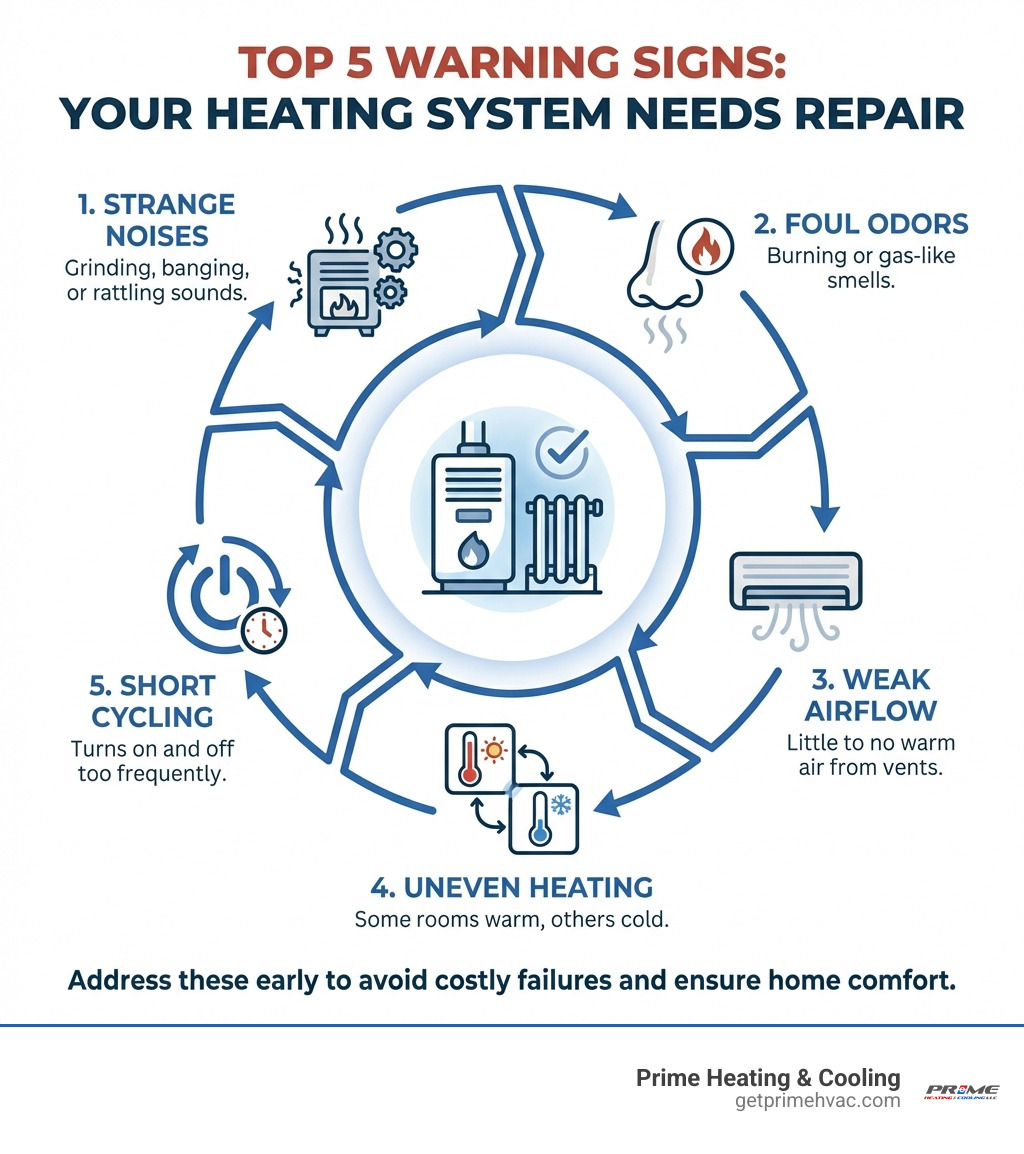
Here are the top signs your heating system might need attention:
- Strange Noises: Grinding, banging, or rattling sounds coming from your furnace.
- Foul Odors: A burning smell, or worse, the smell of gas, which needs immediate action.
- Weak Airflow: Little to no warm air coming from your vents.
- Uneven Heating: Some rooms are warm, while others stay cold.
- Short Cycling: Your heating system turns on and off too frequently.
- High Energy Bills: A sudden, unexplained jump in your heating costs.
- System Won’t Turn On: The most obvious sign, your heater simply fails to start.
Nearly half of the energy used in your home goes to heating and cooling. So, making smart decisions about your heating system impacts your comfort and your wallet. A properly running heater is essential, especially during the colder seasons when its failure can lead to real discomfort.
As Tyler Steiner, CEO & Founder of Prime Heating & Cooling, I’ve dedicated my career to ensuring homes and businesses in New England stay warm and safe. My expertise in heating repair is built on advanced HVAC training and a commitment to service excellence, making sure every system runs efficiently and reliably.
Telltale Signs: When to Call for Heating Repair
Sometimes, your heating system whispers its problems, and other times, it screams. Knowing the signs can help you address issues promptly, preventing minor annoyances from escalating into major, costly breakdowns. For homeowners across Rhode Island, from Providence to Warwick, recognizing these signals is key to maintaining a warm and comfortable home.

One of the most frustrating issues is uneven heating or the presence of cold spots in your home. You might find your living room is toasty while your bedroom feels like an icebox. This could signal problems with your ductwork, a clogged filter, or even a system that’s struggling to distribute heat effectively. Along with this, weak airflow from your vents is a clear indicator that something isn’t right. Airflow problems alone can reduce your system’s efficiency by up to 15 percent, meaning you’re paying more for less heat.
Then there are the sounds. Your heating system should operate relatively quietly. If you start hearing strange noises like grinding, banging, or rattling, it’s often a sign of mechanical trouble. A grinding noise might point to a failing motor bearing, while banging could indicate issues with your ductwork expanding and contracting or even a dirty burner. Rattling often suggests loose parts or debris inside the unit. These noises aren’t just annoying; they’re your system’s way of telling you it needs attention.
Foul odors are perhaps the most concerning sign. A faint burning smell when you first turn on your furnace after a long break is often just dust burning off, which usually dissipates quickly. However, a persistent burning smell could indicate an electrical issue, while a sulfur-like or rotten egg smell (especially with gas furnaces) is a serious warning sign of a gas leak and requires immediate evacuation and a call to your gas company and us. Improperly operating gas connections are a fire hazard and can contribute to health problems.
Another common issue we see in Rhode Island homes is short cycling. This is when your heating system turns on for a brief period, then shuts off, only to turn on again shortly after. This constant starting and stopping is inefficient, wastes energy, and puts undue wear and tear on your system’s components, potentially shortening its lifespan. If your furnace keeps turning on and off, it’s definitely time to investigate. You can find more information on this specific issue on our dedicated page: Furnace Keeps Turning On and Off.
A sudden, unexplained jump in your utility bills – what we call spiking energy bills – is often a direct symptom of an inefficient or malfunctioning heating system. If your energy bills are significantly higher than they usually are at this time of year, without a significant weather event, your HVAC system may require repair or maintenance. Your system has to work harder to achieve the desired temperature, consuming more energy in the process.
Finally, obvious thermostat issues or when your system won’t turn on at all are clear cries for help. An inconsistent thermostat reading could mean the thermostat itself is faulty, or it could be a symptom of a larger system problem. And if your heating system refuses to kick on, there’s no question: it’s time to call in the professionals.
DIY Troubleshooting Before You Call a Pro
Before you pick up the phone and call us for a heating repair service, there are a few simple checks you can perform yourself. Think of it as a quick diagnostic rundown that might save you a service call fee, or at least help us pinpoint the problem faster when you do call. We believe in empowering our Rhode Island homeowners with knowledge, so here are some basic troubleshooting steps:

- Check Thermostat Settings: This might seem obvious, but it’s often overlooked! Ensure your thermostat is set to “Heat” and that the desired temperature is higher than the current room temperature. Sometimes, a simple adjustment is all it takes.
- Replace Thermostat Batteries: If your digital thermostat isn’t lighting up or responding, dead batteries could be the culprit. A quick battery swap can often resolve this.
- Check the Circuit Breaker: Head to your electrical panel and look for a tripped breaker labeled “Furnace” or “HVAC.” If it’s tripped, flip it firmly to the “Off” position, then back to “On.” If it trips again immediately, there’s a deeper electrical issue that requires professional attention.
- Ensure the Furnace Power Switch is On: Furnaces typically have a light switch-like power switch on or near the unit. Make sure it’s in the “On” position. Sometimes, it gets accidentally flipped.
- Clean or Replace the Air Filter: A dirty filter is the most common problem we encounter. A dirty filter will slow down airflow and make the system work harder to keep you warm, wasting energy. A clean filter will also prevent dust and dirt from building up in the system, leading to expensive maintenance and/or early system failure. We recommend checking your filter monthly and changing it at least every 3 months. For more details on maintaining your system, refer to our comprehensive A guide to home heating and cooling.
- Make Sure All Vents Are Open and Unblocked: Blocked vents can restrict airflow, leading to uneven heating and making your system work harder. Walk around your Lincoln or North Providence home and ensure all supply and return vents are clear of furniture, curtains, or anything else that might impede airflow.
- Clear Debris from the Outdoor Unit (for Heat Pumps): If you have a heat pump, ensure the outdoor unit is free from leaves, snow, ice, or other debris that could block airflow. A blocked unit can significantly impact its heating efficiency. Our Winter HVAC Checklist in Rhode Island offers more seasonal tips for keeping your system in top shape.
If you’ve gone through this checklist and your heating system in Smithfield or Smithfield is still giving you trouble, it’s time to call in the experts. Our team at Prime Heating & Cooling is available 24/7 for emergency service and is always ready to help.
Repair vs. Replace: Making the Smart Financial Decision
Deciding whether to repair your existing heating system or invest in a new one is a common dilemma for homeowners in Rhode Island. It’s a choice that balances immediate costs with long-term savings, comfort, and energy efficiency. We understand this can be a tough call, so let’s break down the factors.
| Factor | Repair | Replacement |
|---|---|---|
| System Age | Typically under 10 years | Often over 15 years |
| Repair Cost | Minor repairs, less than 50% of replacement | Major repairs, over 50% of replacement |
| Frequency of Repairs | Infrequent (first or second in 3 years) | Frequent, recurring issues |
| Energy Efficiency | Maintained at current level | Significantly improved (new, high-efficiency) |
| Warranty | Active warranty often makes repair viable | New system comes with new warranty |
| Long-term Savings | Lower immediate cost | Reduced energy bills, fewer future repairs |
Generally, HVAC systems last about 15-20 years. However, this isn’t a hard and fast rule. The efficiency of your heating system is measured by ratings like AFUE (Annual Fuel Utilization Efficiency) for furnaces and SEER (Seasonal Energy Efficiency Ratio) for heat pumps. To earn the ENERGY STAR label, oil and gas furnaces must have an AFUE of 85% and 90%, respectively, or greater. Higher ratings mean better efficiency and lower energy bills. You can explore more about efficient heating and cooling on the Heat & Cool Efficiently website.
When to Choose Heating Repair
Choosing to repair your heating system often makes the most sense in several scenarios:
- System is under 10 years old: If your system is under 10 years old, a repair is usually the best option. Modern heating systems are built to last, and a repair can often get you many more years of reliable service.
- Active Warranty: If the warranty is active on your heating and air conditioning system, a repair makes sense. Warranties cover parts, significantly reducing your out-of-pocket expenses.
- Infrequent Breakdowns: If this is the system’s first or second repair in the past three years, it may still have a few years of life left in it. We’re not just fixing the symptom; we’re addressing the root cause to extend its reliable operation.
- Repair Cost is Less Than 50% of Replacement Cost: This is a good rule of thumb. If the cost of the repair is less than half the cost of replacing the entire unit, repairing is usually the more economical choice.
- The “5,000 Rule”: This is a widely accepted industry guideline that helps homeowners decide. Multiply the age of your heating system by the cost of the repair. If the amount is under 5,000, consider a repair; if over 5,000, replace. For example, if your system is 5 years old and the repair costs $500, then 5 * $500 = $2,500. Since $2,500 is less than $5,000, a repair is likely the more cost-effective decision.
When to Consider a Heating Replacement
Sometimes, repairing your heating system is akin to putting a band-aid on a much larger problem. This is when replacement becomes the wiser choice:
- System is over 15 years old: Generally, HVAC systems last about 15-20 years. If your HVAC system is more than 10 years old, you can save on electric bills and improve your home’s energy efficiency by investing in new equipment. As systems age, they become less efficient and more prone to breakdowns.
- Frequent and Costly Repairs: If your heating system requires constant attention and you’re shelling out for repairs every season, those costs quickly add up. At some point, the cumulative repair expenses will outweigh the cost of a new, more reliable system.
- Rising Energy Bills: An aging system loses efficiency, meaning it has to work harder and longer to heat your home, directly translating to higher energy bills. Replacing your old heating and cooling equipment with ENERGY STAR certified equipment can cut your annual energy bill by nearly $140.
- Major Component Failure: If a critical and expensive component like the heat exchanger (which can cost $1,500-$3,000 to replace) or the compressor (costing $1,200-$2,500+) fails, the repair cost can be so high that it makes more financial sense to put that money towards a new unit.
- Desire for Higher Efficiency: Newer heating systems are significantly more energy-efficient than models from even a decade ago. Upgrading can lead to substantial long-term savings on your utility bills and a smaller environmental footprint. For a deeper dive into choosing a new system, check out The Ultimate Guide to Choosing a Heating Replacement System.
Our team at Prime Heating & Cooling can help you weigh these factors and make the best decision for your home and budget in Coventry, North Scituate, or any of our service areas in Rhode Island.
The Professional Service Call: What to Expect
When you call Prime Heating & Cooling for heating repair in Rhode Island, you’re not just getting a technician; you’re getting a dedicated expert. We aim to make the entire process as smooth and stress-free as possible, from your initial call to the final check.
Here’s what you can expect during a professional heating repair service call with us:
- Scheduling: We offer 24/7 availability because we know heating emergencies don’t stick to business hours. You can book online or call us anytime. We’ll work with you to schedule a convenient appointment, often offering same-day service for urgent issues.
- Diagnosis Process: Our skilled technicians will arrive promptly, equipped with the latest diagnostic tools. They will carefully inspect your heating system, listening to your concerns and performing thorough tests to accurately pinpoint the problem. This includes checking electrical connections, testing components, and assessing overall system performance.
- Transparent Pricing: Once the issue is identified, our technician will clearly explain what’s wrong and present a detailed, transparent quote for the repair. We believe in open, straightforward conversations, so you’ll understand the costs involved before any work begins. There are no hidden fees with Prime Heating & Cooling.
- Repair Execution: With your approval, our technician will proceed with the repair. Our team is trained to service all makes and models of heating systems, using high-quality parts to ensure a lasting solution. We work efficiently, respectfully, and leave your home as clean as we found it.
- Safety Checks: After completing the repair, safety is paramount. Our technician will perform comprehensive safety checks, especially for gas or oil systems, to ensure everything is operating correctly and safely. This includes checking for gas leaks, proper combustion, and secure connections. Improperly operating gas (or oil) connections are a fire hazard and can contribute to health problems.
- Post-Repair Testing: Finally, we’ll test the system thoroughly to ensure it’s fully operational and heating your home effectively. We won’t consider the job done until we’re confident your heating system is running at its best, and you are completely satisfied with the results.
Understanding Common Heating Repair Costs
The cost of heating repair can vary significantly depending on the issue, the type of heating system, and the parts required. Here’s a general breakdown of what to expect:
- Diagnostic Fees: Most HVAC companies charge a diagnostic fee to send a technician to your home, assess the problem, and provide a quote. This fee typically ranges from $50 to $150.
- Labor Rates: Labor costs generally range from $75 to $150 per hour, depending on the complexity of the repair and the expertise required.
- Minor Repairs ($100-$200): Minor issues like replacing a thermostat or cleaning filters may cost around $100 to $200. A thermostat replacement, for example, might cost between $200-$300 including labor.
- Major Repairs ($500-$1,500+): More complex issues, such as a faulty heat exchanger or motor replacement, can range from $500 to $1,500 or more. For instance, a fan motor replacement can be $400-$700, while a control board might be $400-$900. If you’re dealing with boiler issues, understanding the cost of specific parts, like a gas valve, is crucial. For more on this, visit our page on The Price of Peace: Understanding Boiler Gas Valve Replacement Costs.
That these are averages, and actual costs can vary. We always provide a clear, written quote before any work begins, ensuring transparency for our valued customers in East Greenwich, Johnston, and throughout Rhode Island.
The Power of Prevention: How Maintenance Saves You Money
Imagine skipping oil changes for your car. Eventually, you’d face a costly breakdown. Your home’s heating system is no different. Regular, preventative maintenance is not just a good idea; it’s an investment that pays dividends in comfort, safety, and savings. For homes in Rhode Island, where winters can be quite cold, this is especially true.
A yearly tune-up of your heating and cooling system can improve efficiency and comfort. This is why we can’t stress enough the importance of regular HVAC maintenance. Following a regular maintenance schedule can reduce your heating and cooling costs by 5% to 10% and prolong the life of the equipment.
Here’s how maintenance saves you money and trouble:
- Improved Efficiency: A well-maintained system runs more efficiently. Dirty coils reduce the system’s ability to heat your home and cause the system to run longer, increasing energy costs and reducing the life of the equipment. A clean system doesn’t have to work as hard, meaning it uses less energy to heat your home.
- Lower Utility Bills: Directly linked to improved efficiency, a system that runs optimally consumes less fuel or electricity. You can save as much as 10% on heating and cooling costs by adjusting your thermostat when you are not at home and while sleeping. You can save 1% on heating bills for each 1°F you set it back during an eight-hour period. This translates to noticeable savings on your monthly energy bills, especially during peak heating season in Providence or Smithfield.
- Extended Equipment Lifespan: Regular maintenance keeps all the components in good working order, reducing wear and tear. This helps your heating system reach or even exceed its average lifespan of 15-20 years, delaying the need for an expensive replacement.
- Fewer Breakdowns: As the old saying goes, “an ounce of prevention is worth a pound of cure.” Regular tune-ups allow our technicians to catch minor issues before they escalate into major, costly breakdowns. This means fewer unexpected heating repair emergencies when you least expect them.
- Safety: For gas and oil furnaces, regular maintenance includes checking for potential safety hazards like carbon monoxide leaks or faulty connections. This ensures your system operates safely, protecting your family.
To truly understand the benefits for our local climate, read more about The Importance of HVAC Tune-Ups for Rhode Island Winters.
Here’s a list of what a typical heating system tune-up checklist includes:
- Thermostat Settings: Check and calibrate for proper operation.
- Electrical Connections: Inspect and tighten all electrical connections; faulty connections can lead to unsafe operation.
- Moving Parts Lubrication: Lubricate all moving parts to reduce friction and energy consumption.
- Condensate Drain: Inspect and clear the condensate drain to prevent water damage and humidity issues.
- System Controls: Check system controls for proper and safe operation.
- Air Filter: Inspect, clean, or replace the air filter. A clean filter is crucial for efficiency and air quality.
- Blower Components: Clean and adjust blower components for proper airflow. Airflow problems can reduce your system’s efficiency by up to 15 percent.
- Gas/Oil Connections: Check all gas (or oil) connections, gas pressure, and burner combustion for safety and efficiency.
- Heat Exchanger: Inspect the heat exchanger for cracks or damage, which can pose serious safety risks.
- Pilot Light/Ignition: Inspect and clean if necessary (for furnaces).
A comprehensive maintenance checklist can be found on the Maintenance Checklist page. With Prime Heating & Cooling, we make it easy to keep your heating system in top condition, ensuring comfort and peace of mind for your North Smithfield or East Side of Providence home.
Frequently Asked Questions about Heating Repair
We get a lot of questions about heating repair from our customers across Rhode Island. Here are some of the most common ones, along with our expert answers:
What is the most common furnace problem?
The most common problem we encounter in heating systems, particularly furnaces, is a clogged or dirty air filter. A dirty filter restricts airflow, forcing your system to work harder, which leads to higher energy costs, insufficient heating, and can even cause the heat exchanger to overheat and shut off prematurely. Beyond filters, ignition system failures (like a faulty pilot light or igniter) and thermostat malfunctions are also very common issues that often lead to a call for heating repair.
How long should a heating system last?
Generally, a well-maintained heating system, whether it’s a furnace, boiler, or heat pump, should last about 15-20 years. However, this can vary based on the type of system, the quality of its installation, how often it’s used, and crucially, the consistency of its maintenance. Regular maintenance, like the annual tune-ups we provide, can significantly extend the life of your equipment, ensuring you get the most out of your investment.
Is it worth repairing a 15-year-old furnace?
This is a classic “it depends” question! For a 15-year-old furnace, the decision to repair versus replace often hinges on the cost of the repair and the overall condition of the unit. If the repair is minor and relatively inexpensive (say, less than 25-30% of the cost of a new furnace), it might be worth it. However, if it’s a major component failure (like a heat exchanger) or if the repair cost approaches 50% of a new system, we generally recommend considering a replacement.
Also, consider the efficiency. An older furnace, even when repaired, will still be less energy-efficient than a new, ENERGY STAR certified model. Upgrading can lead to significant long-term savings on your energy bills. We recommend using the “5,000 Rule” (Age x Repair Cost) as a guideline, and our technicians are always happy to provide a thorough assessment and honest advice to help you make the best decision for your home in Rhode Island.
Conclusion
Navigating heating repair can seem daunting, but with the right information and a trusted partner, it doesn’t have to be. We’ve walked through the telltale signs of a struggling system, empowered you with basic DIY troubleshooting, and helped you weigh the critical decision between repair and replacement. We’ve also highlighted how essential preventative maintenance is for your system’s longevity and your wallet.
A reliable heating system isn’t just about comfort; it’s about the safety and well-being of your family, especially during the harsh Rhode Island winters. It’s about peace of mind, knowing your home will stay warm and cozy without unexpected breakdowns or skyrocketing energy bills.
For expert, reliable, and customer-focused heating repair service in Rhode Island, trust the experienced technicians at Prime Heating & Cooling. With 20 years of experience serving communities like Lincoln, Coventry, Warwick, and beyond, we’re committed to providing energy-efficient solutions and ensuring your home comfort.
Don’t let a faulty heating system leave you in the cold. Schedule Your Heating Repair RI Service Today and let us bring warmth and comfort back to your home.


