

The Most Common HVAC Troubleshooting Questions — Answered Before You Make a Costly Mistake
HVAC troubleshooting questions are something almost every homeowner faces at some point — and getting the answers wrong can mean bigger repair bills, system damage, or even safety risks.
Here are the most common HVAC issues and what to check first:
| Problem | First Thing to Check |
|---|---|
| System won’t turn on | Circuit breaker, thermostat settings, thermostat batteries |
| Weak or no airflow | Dirty or clogged air filter, closed vents |
| Not cooling or heating enough | Thermostat mode, refrigerant level, dirty coils |
| Strange noises | Loose components, worn motor, debris in unit |
| Water leaking around unit | Condensate drain line, drain pan |
| Short cycling (turns on/off repeatedly) | Oversized system, dirty filter, thermostat placement |
| High energy bills | Dirty filters, leaky ducts, aging system |
| Frozen coils | Low refrigerant, blocked airflow, dirty evaporator coil |
| Burning or musty odors | Dirty filter, mold in ducts, overheating parts |
| System works but one room stays hot/cold | Blocked vents, duct leaks, zoning imbalance |
Most HVAC problems start small. A dirty filter, a tripped breaker, a dead thermostat battery. The trouble is, many homeowners either overlook these basics entirely — or jump straight to the wrong conclusion.
That’s where costly mistakes happen.
I’m Tyler Steiner, CEO and founder of Prime Heating & Cooling. With hands-on experience diagnosing everything from short-cycling furnaces to refrigerant leaks across New England’s punishing winters and humid summers, I’ve seen the full range of HVAC troubleshooting questions homeowners get wrong — and the damage those missteps cause. Below, I’ll walk you through the 10 most common errors so you can avoid them.
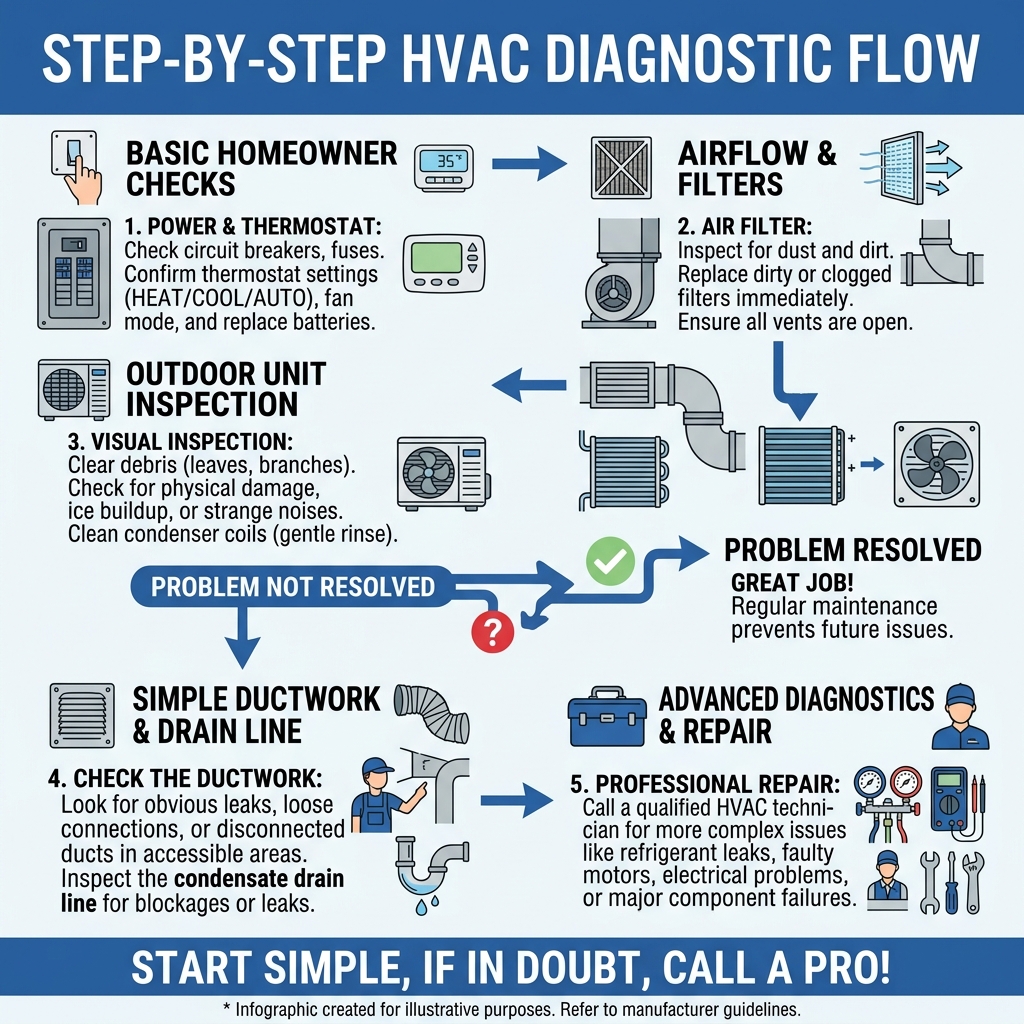
Avoiding Costly HVAC Troubleshooting Questions and Errors
When your home in Providence or Warwick suddenly feels like an icebox in January or a sauna in July, panic is a natural reaction. However, rushing into a DIY “fix” without a plan is how a $100 service call turns into a $3,000 equipment replacement. We always recommend starting with a calm, methodical approach.
The first step in any Diagnose HVAC System Issues: Step-by-Step Guide is a thorough visual and audible inspection. Before you touch a single tool, look for obvious signs of trouble: frayed wires, puddles of water, or ice buildup on the copper lines. Listen for sounds that weren’t there yesterday.
Safety should always be your North Star. If you are inspecting the indoor furnace or the outdoor condenser, ensure the power is off at the source if you plan to open any panels. Many modern systems have safety switches (like the “kill switch” on a furnace door) that prevent the unit from running while open, but you should never rely on these alone. If you’re comfortable using a multimeter, you can check for voltage and continuity, but for most homeowners, the best “tool” is simply a keen eye and a bit of patience.

Ignoring the Simple HVAC Troubleshooting Questions: Filters and Power
It sounds almost too simple to be true, but a staggering number of “broken” systems are just hungry for air or power. One of the biggest mistakes we see in Rhode Island is homeowners assuming their furnace has “died” when, in reality, the air filter is so clogged with dust and pet hair that the system has overheated and shut down as a safety precaution.
Air filters are the lungs of your HVAC system. When they are dirty, they restrict airflow, forcing the blower motor to work twice as hard. This leads to common AC problems like frozen coils or a furnace that “short cycles” (turns on and off rapidly). A good rule of thumb is to check your filter every 30 to 90 days. If you hold it up to a light and can’t see the glow through the fibers, it’s time for a change.
Next, check your power supply. HVAC systems draw a lot of “juice,” especially during a humid Smithfield afternoon. It’s common for a circuit breaker to trip during a power surge or a period of high demand. If your thermostat screen is blank, don’t call for a repair yet—check the batteries! Many thermostats rely on two AA batteries that, when dead, prevent the entire system from communicating. Finally, verify the “disconnect switch” near your outdoor unit hasn’t been accidentally flipped. Following a basic HVAC troubleshooting checklist can save you the embarrassment (and cost) of a technician simply flipping a switch.
For more detailed tips on managing these basics, check out our guide on DIY AC troubleshooting.
Misdiagnosing Noises and Frozen Evaporator Coils as Minor HVAC Troubleshooting Questions
Your HVAC system speaks to you, and usually, it’s telling you exactly what’s wrong. A common mistake is turning up the TV to drown out a new squeal or rattle, hoping it will go away. It won’t.
- Squealing or Screeching: This often points to a failing blower motor belt or bearings that have lost their lubrication.
- Grinding: This is the sound of metal-on-metal, usually indicating worn-out bearings in the fan motor.
- Thumping or Banging: Something is likely loose or out of balance, like a fan blade or a piece of debris trapped in the housing.
- Hissing: This is a red flag for a refrigerant leak—a problem that requires a pro immediately.
| Noise | Likely Culprit | Severity |
|---|---|---|
| Squealing | Blower belt or motor bearings | Medium – fix soon to avoid motor burnout |
| Grinding | Worn motor bearings | High – motor failure is imminent |
| Banging | Loose part or debris | Medium – can cause secondary damage |
| Hissing | Refrigerant leak | Critical – environmental and system risk |
Another common “mystery” is the frozen evaporator coil. Homeowners often see ice on the indoor unit and think, “Great, it’s extra cold!” In reality, ice is a sign of a major malfunction. It usually happens because of restricted airflow (that dirty filter again!) or low refrigerant levels. If you see ice, turn the system off immediately to let it thaw. Running a frozen system can lead to liquid refrigerant “slugging” back into the compressor, which is a death sentence for your AC.
Handling Refrigerant Leaks and Electrical Failures Improperly
This is where DIY troubleshooting becomes dangerous. We frequently encounter HVAC troubleshooting questions regarding “recharging” an AC unit. Here is the hard truth: Your AC does not “consume” refrigerant like a car consumes gas. It is a sealed system. If the refrigerant is low, you have a leak.
Adding more refrigerant without fixing the leak is like trying to fill a bucket with a hole in the bottom—it’s expensive, ineffective, and illegal under EPA regulations. Only technicians with EPA Section 608 certification are legally allowed to handle and buy refrigerant. Handling these chemicals yourself can lead to “refrigerant burns” or permanent damage to your lungs. If you suspect a leak—marked by hissing sounds or a system that runs but blows lukewarm air—you need to tackle the evaporator coil leak with professional help.
Electrical failures are equally tricky. A “dead” AC might just have a failed capacitor—a small cylindrical part that gives the motor the “kick” it needs to start. While capacitors are relatively inexpensive, they store a lethal electrical charge even when the power is off. Attempting to replace one without the proper safety tools and knowledge is a risk no homeowner should take.
When to Stop Asking HVAC Troubleshooting Questions and Call a Pro
Knowing when to put the screwdriver down is the hallmark of a smart homeowner. In our 20 years of serving Rhode Island communities from Johnston to East Greenwich, we’ve found that the “5,000 Rule” is a great guide for the “repair vs. replace” dilemma: Multiply the age of your unit by the cost of the repair. If the total is more than $5,000, it’s usually more cost-effective to invest in a new, energy-efficient system.
Beyond the math, safety is the ultimate deciding factor. If your gas furnace isn’t igniting, or if the pilot light is flickering yellow instead of burning a steady blue, you may have a combustion issue. This can lead to the production of carbon monoxide (CO), an odorless, colorless, and potentially lethal gas. If your CO detector goes off, or if you smell “rotten eggs” (the scent added to natural gas), leave the house immediately and call for emergency service.
Identifying Drainage Issues and Condensate Clogs
During a humid July in Lincoln or North Providence, your air conditioner doesn’t just cool the air; it removes gallons of moisture from it. That water has to go somewhere. Usually, it flows down a condensate drain line into a floor drain or out of the house.
A common mistake is ignoring a small puddle of water near the indoor unit. This usually indicates a clogged drain line—often caused by algae or “slime” buildup. If the line clogs, the water backs up into the drain pan. If your system is installed correctly, it should have a safety float switch that shuts the unit down before the pan overflows. To prevent this, you can perform a DIY “bleach flush” once a season: Pour a cup of distilled vinegar or a very dilute bleach solution down the condensate “T” pipe to kill any growing algae.
If you ignore these signs you need professional repair, you risk mold growth in your ductwork and water damage to your ceilings or floors.
Neglecting Seasonal Maintenance and Professional Inspections
The biggest mistake of all isn’t a wrong repair—it’s no maintenance at all. We often see energy bills spike 20% to 40% simply because a system is struggling against years of neglected dust and grime.
A professional bi-annual tune-up (heating in the fall, cooling in the spring) is like an oil change for your home. During these visits, we check the integrity of your ductwork—did you know that leaky ducts can account for up to 30% of your energy loss? We also clean the secondary heat exchanger and the outdoor coils, ensuring your system doesn’t have to work overtime to keep you comfortable.
Following a heating repair service checklist every year can extend the life of your equipment by 5 to 10 years. In a climate like ours, where the equipment works hard year-round, that’s a massive return on investment.
Conclusion: Securing Your Home Comfort with Prime Heating & Cooling
Navigating HVAC troubleshooting questions doesn’t have to be a solo mission. While checking your batteries and swapping your filters are great ways to stay proactive, complex mechanical and electrical issues require the steady hand of an expert.
At Prime Heating & Cooling, we’ve spent two decades ensuring our neighbors in Coventry, Scituate, and across Rhode Island stay comfortable no matter what the New England weather throws our way. We pride ourselves on transparent, energy-efficient solutions and a customer-first approach that prioritizes your safety and your wallet.
Whether you’re facing a midnight furnace failure or just want to ensure your AC is ready for the summer heat, our skilled technicians are available 24/7 to help. Don’t let a small troubleshooting error turn into a major headache.
Ready for a system that just works? Explore our professional HVAC services or give us a call today. Let us take the guesswork out of your home comfort!


