

Why a Leaking Boiler Air Vent Demands Your Attention
Boiler air vent replacement is a common repair for hydronic heating systems that can save you hundreds of dollars if you do it yourself. Here’s what you need to know:
Quick Answer:
- Turn off your boiler and let it cool
- Depressurize the system by tripping the relief valve
- Unscrew the old vent with a wrench
- Apply thread sealant to the new vent
- Install and tighten the new vent
- Refill the system and check for leaks
Cost: DIY = $10-$30 for parts | Professional = $100-$500+
That small, often-overlooked component on top of your boiler or air purger plays a critical role in your heating system’s performance. When air gets trapped in your hydronic heating system, it creates pressure imbalances that prevent hot water from circulating properly. The automatic air vent’s job is to release that trapped air—but when it starts leaking, hissing, or spitting water, it’s not just annoying. It can waste energy, cause corrosion, and lead to water damage in your home.
According to forum discussions from experienced HVAC professionals, a leaking boiler air vent is one of the most common calls they receive, yet it’s also one of the simplest repairs a homeowner can tackle. The process typically involves just a few basic tools, takes less than an hour, and costs under $30 in parts.
I’m Tyler Steiner, founder of Prime Heating & Cooling, and I’ve guided countless New England homeowners through boiler air vent replacement during my years of hands-on HVAC work. Whether you’re hearing strange noises from your heating system or noticing water dripping from that small valve, this guide will walk you through exactly how to fix it yourself—and when it makes sense to call in a professional.
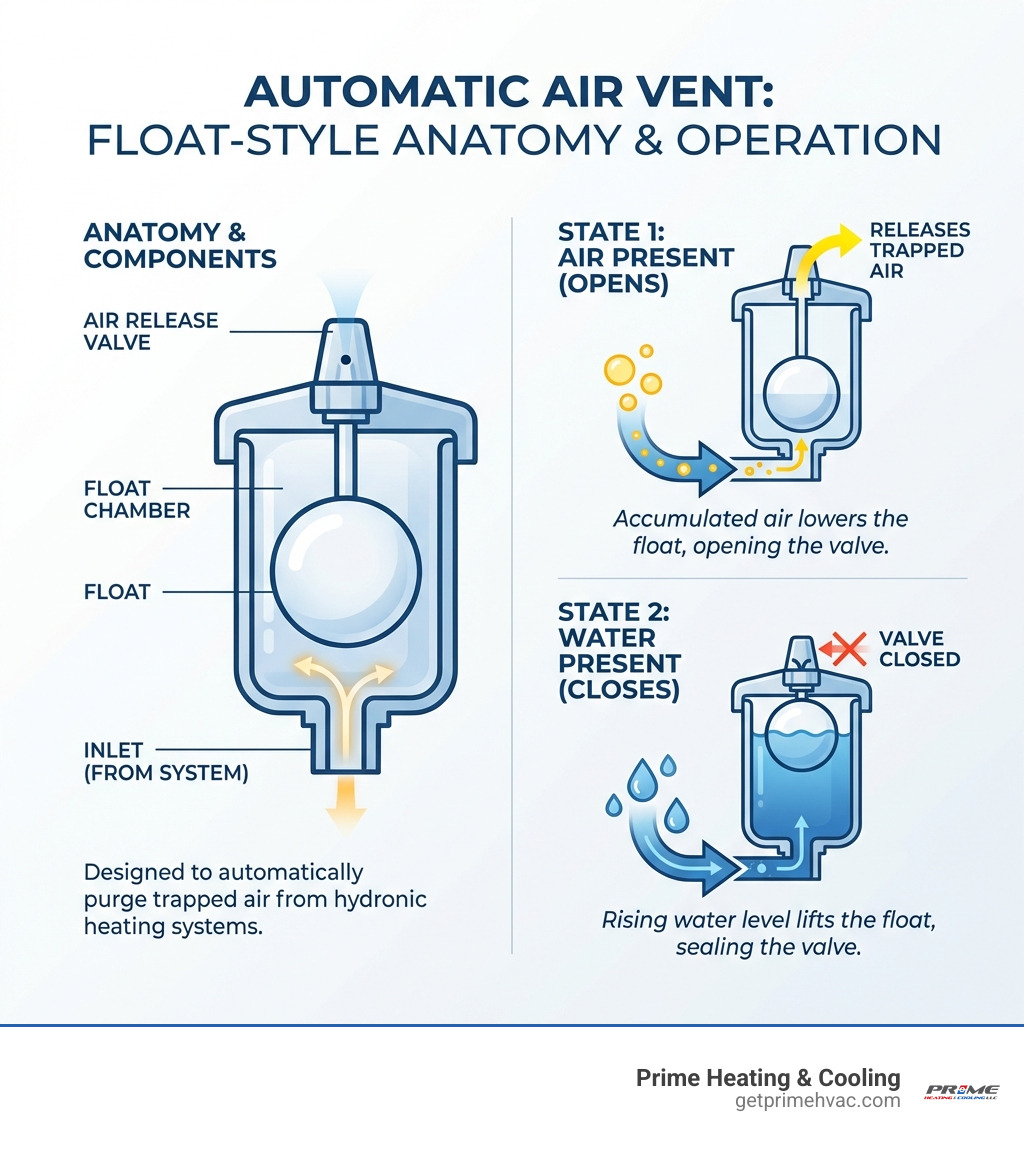
A boiler air vent, particularly an automatic float-style vent, is designed to purge unwanted air from your hydronic heating system. Think of your boiler and pipes as a giant closed loop filled with water. As water heats up, air dissolved in it separates and rises to the highest points in the system. If this air isn’t removed, it can create air pockets that block the flow of water, leading to cold spots in radiators, gurgling noises, and reduced heating efficiency.
Boiler air vent replacement becomes necessary when these vents fail to do their job. Over time, the internal mechanisms (like the float or hygroscopic discs) can get stuck, corrode, or become coated with sediment, preventing them from opening or closing properly. This can lead to:
- Trapped Air: Manifesting as cold radiators or gurgling sounds, indicating your system isn’t heating efficiently.
- Leaks: Water dripping from the vent, which can cause corrosion on the boiler or surrounding components, and potentially lead to costly water damage.
- Pressure Loss: Continuous air release or water leakage can cause your system’s pressure to drop, requiring frequent refilling and potentially stressing your boiler.
- Corrosion: The presence of oxygen in the system, due to a faulty vent, accelerates corrosion of internal boiler components and piping.
While the general principle of venting air is similar, it’s important to note that air vents for steam systems operate differently than those for hot water (hydronic) systems. Steam systems use vents that allow air to escape but close in the presence of steam, while hot water systems use vents that open to release air and close when water rises to fill the chamber. This guide will focus on boiler air vent replacement for hot water (hydronic) systems, which are most common in Rhode Island homes.
Preparing for the Job: Tools, Materials, and Safety
Before you begin any boiler air vent replacement, safety is paramount. We’re dealing with a heating system, and that means hot water, pressure, and electricity. A little preparation goes a long way in ensuring a smooth and safe repair.
Signs You Need a Boiler Air Vent Replacement
How do you know it’s time for a new air vent? Your boiler system often sends clear signals:
- Hissing Sounds: This can indicate air is escaping, but if it’s constant or accompanied by water, the vent might be stuck open.
- Spitting Water: A definite sign of a failing vent. It means the internal mechanism isn’t closing properly, allowing water to escape with the air.
- Visible Corrosion or Mineral Deposits: If you see green or white crusty buildup around the vent, it’s likely been leaking for a while.
- System Pressure Drops: If you find yourself frequently adding water to your boiler to maintain the recommended 12-15 PSI, a leaking air vent could be the culprit.
- Radiators Not Heating Evenly: Cold spots at the top of your radiators, especially after the boiler has been running, are a classic sign of trapped air that your vent isn’t releasing.
- Dripping Water: As noted in one forum discussion, a dripping air vent, even in an attic, is a clear sign it needs attention.
Ignoring these signs can lead to reduced heating efficiency, higher energy bills, and potential damage to your boiler or home. A small drip can become a big problem over time.
Tools and Materials You’ll Need
Gathering your tools and materials beforehand will make the boiler air vent replacement process much quicker and less stressful. You won’t need a massive toolbox for this job.
Tools:
- Adjustable pipe wrench or channel-lock pliers: For gripping and turning the old and new vents.
- Bucket: To catch any water that drains from the system.
- Rags: For cleanup and wiping threads.
- Small wire brush: Useful for cleaning old threads if they’re corroded.
Materials:
- New automatic air vent (1/8-inch typical): Most residential boiler air vents are 1/8-inch NPT (National Pipe Thread). Double-check your existing vent’s size or consult your boiler manual. Common brands like Taco (e.g., Taco Hy-Vent 400-4) are widely recognized as industry standards and readily available.
- PTFE thread sealant tape (Teflon tape) or pipe dope: To ensure a watertight seal on the new vent’s threads.
For comprehensive heating system care, regular maintenance, including checking components like air vents, is crucial. More info about heating system tune-ups can help you keep your entire system in top shape.
Your Step-by-Step Guide to Boiler Air Vent Replacement
This guide focuses on a common hot water (hydronic) boiler system. While the specific location of your air vent might vary (e.g., on top of the boiler, on an air purger, or at a high point in the piping), the general procedure for boiler air vent replacement remains consistent.
Step 1: Depressurize and Partially Drain the System
This is arguably the most critical step for safety and to minimize mess.
- Turn off boiler power: Locate the emergency shut-off switch for your boiler (it’s usually a red switch near the boiler or on a nearby wall) or turn off the circuit breaker that powers it. This prevents the boiler from firing up unexpectedly and protects you from electrical hazards.
- Allow the system to cool: Hot water can cause severe burns. Wait at least an hour, or until the boiler’s temperature gauge reads below 100°F (38°C). Patience is a virtue here!
- Shut off the water supply valve: Locate the automatic water feeder or the main water supply line to your boiler and close the valve. This stops new water from entering the system as you drain it.
- Locate the pressure relief valve: This valve is typically found on the boiler itself and has a small lever. Place your bucket directly underneath it.
- Trip the relief valve: Gently lift the lever on the pressure relief valve. You’ll hear water and air escaping into the bucket. Watch your boiler’s pressure gauge. Your goal is to bring the pressure down to 0 PSI.
- Drain minimal water: You don’t need to drain the entire system. Once the pressure gauge reads zero, you’ve typically only drained a couple of quarts of water. If water continues to flow significantly after the pressure drops, ensure your water supply valve is fully closed.
Step 2: Remove the Old, Leaking Air Vent
Now that the system is depressurized, it’s time to get rid of the old troublemaker.

- Position your wrench: Use your adjustable pipe wrench or channel-lock pliers to grip the base of the old air vent.
- Turn counter-clockwise: Carefully apply steady pressure and turn the vent counter-clockwise to loosen it. If it’s particularly stubborn, you might hear a slight creaking or cracking sound as the seal breaks.
- Dealing with rust and corrosion: Older vents, especially in humid basements, can be heavily corroded. If the vent is stuck, you can try applying a penetrating oil (like PB Blaster) and letting it soak for a while. In some rare, extremely corroded cases, you might need to gently tap the wrench with a hammer to shock the threads loose. Be cautious not to apply excessive force, as you could damage the pipe or fitting it’s screwed into.
- Remove the old vent: Once loose, carefully unscrew the vent by hand. A small amount of water might still trickle out – that’s normal.
- Clean pipe threads: Use your wire brush to clean any old thread sealant, rust, or debris from the boiler’s female threads where the old vent was installed. This ensures a good seal for the new vent. Wipe thoroughly with a rag.
Step 3: Install the New Air Vent
With the old vent gone and the threads clean, installing the new one is straightforward.
- Apply thread sealant: Wrap PTFE thread sealant tape (Teflon tape) around the male threads of your new air vent. Wrap it clockwise (the same direction you’ll be screwing in the vent) about 3-5 times. It’s crucial to keep the tape back from the very end of the threads to prevent small pieces from breaking off and entering your boiler system, which could cause blockages. If using pipe dope, apply a thin, even layer to the threads.
- Screw in by hand: Start threading the new air vent into the boiler’s fitting by hand. It should turn easily for several rotations.
- Tighten snugly with a wrench: Once you can no longer turn it by hand, use your pipe wrench or pliers to tighten it. You want it snug and leak-proof, but do not overtighten. Overtightening can strip the threads or crack the fitting, leading to a much bigger problem. A good rule of thumb is to tighten it about one to two full turns past hand-tight.
- Position correctly: Ensure the vent is upright and its cap (if it has one) is slightly loosened or open, as per manufacturer instructions, to allow air to escape.
Step 4: Refill and Restart Your Boiler System
The finish line is in sight! Now to get your heating system back up and running.
- Turn on the water supply: Slowly open the valve you closed in Step 1 to allow fresh water to enter the boiler.
- Watch the pressure gauge: The system pressure should rise. For most residential hydronic systems in Rhode Island, you’ll want the pressure to settle between 12 and 15 PSI when the system is cold.
- Check for leaks: Carefully inspect around your newly installed air vent for any signs of water drips. If you see any, you might need to tighten the vent slightly more (but again, avoid overtightening) or re-apply thread sealant. Don’t worry, a very slow drip can sometimes stop as the system warms up and the threads expand.
- Loosen the vent cap: If your new air vent has a cap, ensure it’s slightly loosened (usually one or two full turns) to allow the automatic venting mechanism to work. Some vents have a small manual bleed screw – ensure it’s open.
- Turn on boiler power: Return the emergency switch or circuit breaker to the “ON” position. Your boiler should begin its normal startup cycle. It might take a little while for all the air to purge from the system, and you might hear some gurgling initially.
If you encounter any issues during this process, or if your boiler system seems to be struggling even after the boiler air vent replacement, don’t hesitate to reach out. For any heating repair needs in Rhode Island, we’re here to help. More info about heating repair services.
Cost Analysis and When to Call a Professional
You’ve successfully tackled a boiler air vent replacement! But sometimes, knowing when to DIY and when to call in the pros is the smartest decision.
DIY vs. Professional Boiler Air Vent Replacement Costs
Let’s break down the potential costs:
- DIY Cost: The cost for the part itself is typically very affordable, ranging from $10 to $30. A new automatic air vent (like a Taco Hy-Vent) is a small investment for a significant improvement in your system.
- Professional Cost: If you call a professional HVAC technician for a straightforward boiler air vent replacement, you can expect to pay anywhere from $100 to $150 for labor and the part. This covers the technician’s time, expertise, and the cost of the vent.
- Complex Job Cost: However, the cost can escalate significantly if complications arise. For instance, if there are no isolation valves near the vent, or if existing valves are stuck, the technician might need to drain a larger portion of your heating system. A more complex scenario involving draining the entire system due to stuck valves or insufficient isolation valves could easily cost $500 or more.
Here’s a quick comparison:
| Feature | DIY Boiler Air Vent Replacement | Professional Boiler Air Vent Replacement |
|---|---|---|
| Cost | $10-$30 (parts only) | $100-$150 (simple) – $500+ (complex) |
| Time | 30-60 minutes | 1-2 hours (including travel & assessment) |
| Skill Level | Beginner to Intermediate | Expert |
| Risks | Water damage, system issues, burns | Minimal (for homeowner) |
When to Call for Expert Help
While many homeowners in Smithfield, Warwick, or Smithfield can confidently handle a simple boiler air vent replacement, there are definite situations where calling a professional is the best course of action:
- Stuck Valves or Extensive Corrosion: If your existing vent is so rusted it won’t budge, or if the isolation valves around your boiler are stuck, forcing them could lead to bigger problems. A professional has specialized tools and techniques (like applying heat or specific penetrating oils) to deal with these challenges.
- Unsure About the Process: If you’ve read this guide and still feel uncertain or uncomfortable with any step, it’s always better to err on the side of caution. A boiler is a complex piece of equipment, and improper repairs can be costly and dangerous.
- System Requires Full Drain-Down: If your system lacks isolation valves, or if other components need attention, a full system drain-down might be necessary. This is a more involved process that often requires specialized knowledge to ensure proper refilling and bleeding of the entire system.
- Steam Systems: This guide focuses on hot water systems. Steam boiler air vent replacement often involves different types of vents and a more nuanced understanding of steam dynamics. If you have a steam boiler, we highly recommend professional assistance.
Don’t just take our word for it. Read what other homeowners experienced when trying to diagnose and replace their boiler air vents. For any heating maintenance needs, especially if you’re not comfortable with a DIY approach, our expert technicians are always ready to provide reliable service in Lincoln, Coventry, and throughout Rhode Island. More info about professional heating maintenance.
Frequently Asked Questions about Boiler Air Vents
Why is my new air vent leaking or hissing?
Even after a successful boiler air vent replacement, you might notice some lingering issues. Here are a few reasons why your new vent might be leaking or hissing:
- Debris from Draining: Sometimes, the process of draining and refilling the system can stir up sediment or debris. A small piece of this can get lodged in the new vent’s delicate mechanism, preventing it from closing completely. This often resolves itself as the system runs and flushes out the debris.
- Over-tightened Threads: If you overtightened the vent during installation, you might have cracked the fitting or stripped the threads, creating a path for water to escape.
- Faulty New Part: While rare, a new part can occasionally be defective. If you’ve ruled out other issues, you might have received a faulty vent.
- Cap is Too Tight: Automatic air vents have a small cap that should be left slightly loose to allow air to escape. If it’s screwed on tightly, air can’t get out, and pressure might build, leading to leaks or other system noises.
Do I need to bleed my radiators after this job?
For a simple boiler air vent replacement that only required draining a small amount of water from the system, you usually do not need to bleed your radiators. The air vent’s job is to remove air from the highest points, and if you’ve only lost a couple of quarts of water, it’s unlikely a significant amount of air has entered your entire radiator system.
However, if you notice that some radiators are still cool at the top after the boiler has run for a while, it’s a good idea to bleed them. This indicates trapped air that wasn’t fully purged by the main air vent.
How often should a boiler air vent be replaced?
There’s no set schedule for boiler air vent replacement. These components are generally designed for long-term service, with some lasting for many years. We typically recommend replacement only when they show signs of failure, such as leaking, hissing, or failing to remove air effectively (indicated by cold radiators or gurgling noises).
Regular inspection during your annual boiler maintenance can help spot potential problems early. Our technicians in North Providence and East Side of Providence often check these components as part of a comprehensive heating system tune-up. Automatic air vents have been recognized as the industry standard for over 30 years, highlighting their reliability, but like all mechanical parts, they eventually wear out.
What are the different types of boiler air vents?
Boiler air vents come in a few main types, each designed to manage air in heating systems:
- Automatic Float-Style Vents: These are the most common for hydronic (hot water) systems. They contain a float that drops when air collects, opening a valve to release the air. As water rises, the float lifts and closes the valve. Brands like Taco (e.g., Taco Hy-Vent) and Bell & Gossett are prominent in this category.
- Manual Air Vents: Often found on individual radiators, these require you to manually open a small screw or valve to release trapped air. They’re simple but require user intervention.
- Hygroscopic Disc Vents: Used primarily on steam radiators, these vents contain cellulose discs that swell when wet (from steam) to close the vent, but shrink when dry (from air) to allow air to escape. Taco’s automatic coin vents use this technology.
- Air Eliminators (e.g., Spirovent): These are higher-capacity devices, often installed near the boiler or pump, designed to continuously separate and remove micro-bubbles of air from the system water, not just bulk air. They often feature an internal coalescing medium.
What are common brands of boiler air vents?
Several reputable brands manufacture high-quality boiler air vents. Some of the most common and well-regarded include:
- Taco: Their Hy-Vents are widely considered an industry standard for automatic air vents in hydronic systems.
- Bell & Gossett (B&G): Another leading manufacturer of hydronic heating components, including automatic air vents.
- Armstrong: Known for various steam and hydronic components, including different types of air vents.
- Hoffman: Offers a range of steam and hot water vents.
- Spirovent (Spirotherm): Specializes in high-efficiency air eliminators and dirt separators.
- Gorton & Barnes & Jones: These brands are particularly well-known for their quality steam radiator and main vents.
What are the differences between air vents for steam vs. hot water systems?
This is a crucial distinction! While both types of heating systems need to remove air, the vents operate differently due to the medium they handle:
- Hot Water (Hydronic) Systems: These systems are filled with water. Air vents for hot water systems (like automatic float vents) are designed to release air and then close when water reaches them. Their primary function is to prevent air pockets from blocking water circulation.
- Steam Systems: These systems use steam to heat radiators. Steam radiator vents must allow air to escape from the cold radiator but close tightly when hot steam reaches them, preventing steam from escaping into the room. Main vents on steam systems perform a similar function for the steam mains themselves. The mechanisms are often different, utilizing elements like hygroscopic discs or thermostatic bellows that react to temperature or moisture differences between air and steam. Using a hot water vent on a steam system (or vice-versa) would lead to improper operation and likely system failure.
Conclusion: Keep Your Boiler Running Efficiently
A properly functioning boiler air vent is a small but mighty component that ensures your hydronic heating system runs smoothly, quietly, and efficiently. By tackling boiler air vent replacement yourself, you can save money, prevent potential water damage, and enjoy a more comfortable home in places like North Scituate, Smithfield, and across Rhode Island. The benefits are clear: improved efficiency, preventing water damage, and quiet operation without those annoying gurgling noises.
However, we understand that not every homeowner is comfortable with DIY repairs, especially when it comes to their heating system. For complex issues, extensive pipe corrosion, or if you’re simply not comfortable with the repair, the expert technicians at Prime Heating & Cooling provide reliable boiler installation and repair services throughout Rhode Island. We’re here to ensure your home stays warm and cozy all winter long.