
Is Your Boiler Giving You Warning Signs? Here’s What to Look For
Signs of boiler failure? Here’s a quick answer:
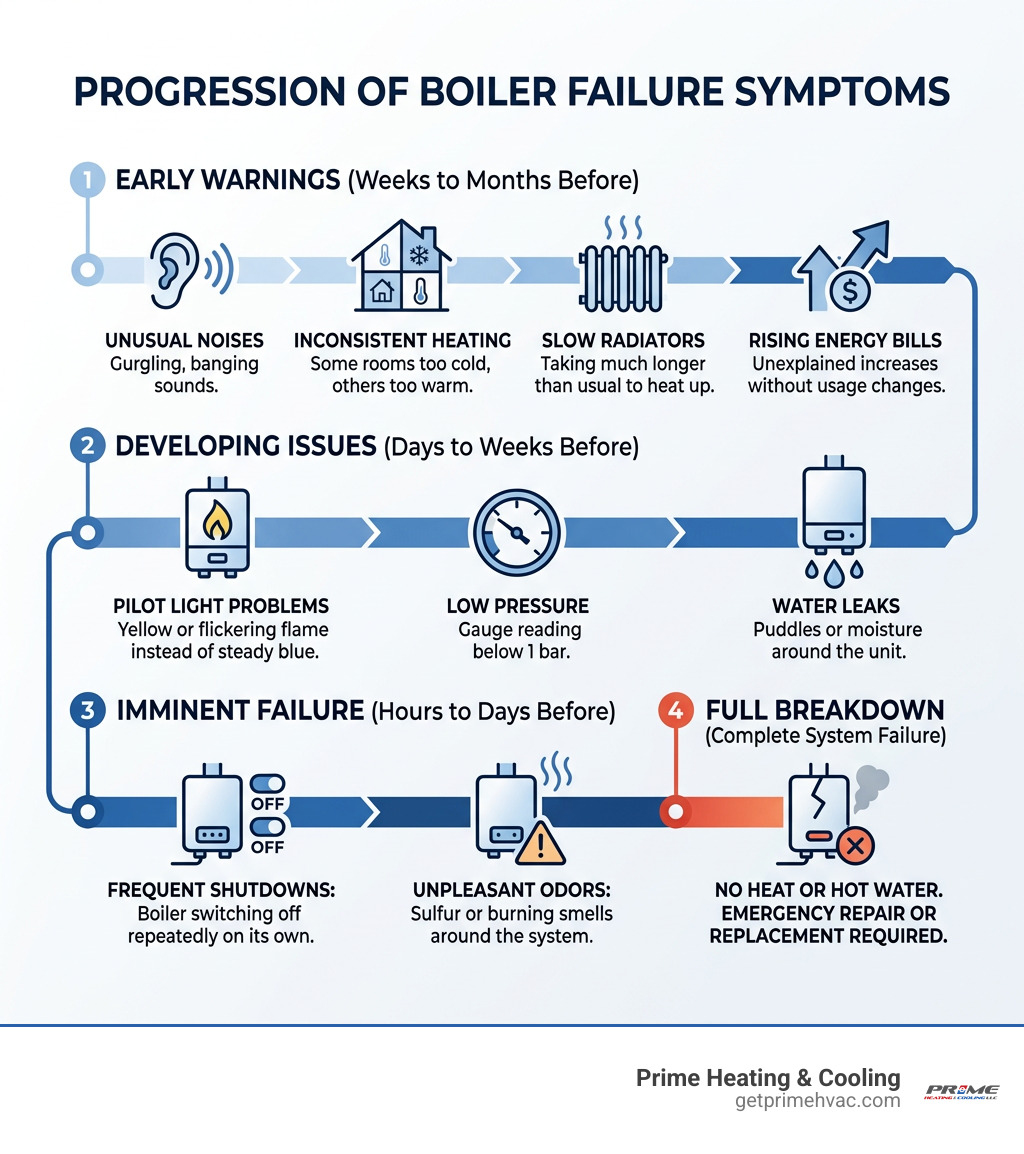
- Unusual noises – banging, gurgling, or whistling sounds
- Inconsistent heating – some rooms cold, others warm
- Water leaks – puddles or moisture around the unit
- Low pressure – gauge reading below 1 bar
- Rising energy bills – without changes in usage habits
- Pilot light problems – yellow or flickering flame instead of steady blue
- Frequent shutdowns – boiler switching off on its own
- Unpleasant odors – sulfur or burning smells
- Slow radiators – taking much longer than usual to heat up
- Old age – system is 15 years or older
Most boilers don’t fail overnight. They give you warning signs first — sometimes weeks or even months before a complete breakdown. The problem is that those signs are easy to miss or dismiss until you’re left with no heat on a cold New England night.
A boiler is one of the hardest-working appliances in your home. And like anything that works hard, it wears down over time. Catching the early warning signs can be the difference between a simple repair and an expensive emergency replacement.
This checklist is designed to help you spot trouble before it becomes a crisis.
I’m Tyler Steiner, CEO and founder of Prime Heating & Cooling, and after years of hands-on experience diagnosing and repairing boiler systems across Rhode Island and Massachusetts, I’ve seen how recognizing the early signs of boiler failure can save homeowners significant stress and money. Let’s walk through exactly what to watch for.
7 Critical Signs of Boiler Failure? to Watch For
When we talk about Signs of boiler failure?, we aren’t just looking for a system that won’t turn on. In fact, many boilers continue to “run” while they are actively failing, costing you a fortune in efficiency and risking your safety.
In our 20 years of experience serving Rhode Island communities from Providence to East Greenwich, we’ve found that homeowners who keep an eye on these seven indicators are much less likely to face a mid-winter emergency.
| Symptom | Minor Glitch | Major Failure Indicator |
|---|---|---|
| Noises | Occasional hum or click | Persistent banging, whistling (kettling), or screeching |
| Energy Bills | Small seasonal fluctuations | Sharp, unexplained spikes in fuel or electric costs |
| Heat Output | One radiator needs bleeding | Multiple cold spots or lukewarm water throughout the house |
| Cycling | Runs longer during a blizzard | Turning on and off every few minutes (short-cycling) |
| Visible Moisture | Tiny bit of condensation | Pooling water, active drips, or heavy rust/corrosion |
| Pressure | Needs topping up once a year | Constant pressure drops below 1 bar |
| System Age | 5–10 years old | 15–20+ years old |
1. Unusual Noises (Banging, Whistling, and Gurgling)
Your boiler should operate with a gentle hum. If it starts sounding like it’s trying to communicate via Morse code or like a jet engine is taking off in your basement, take note.
- Banging/Clunking: Often caused by “kettling.” This happens when limescale or sludge builds up on the heat exchanger, restricting water flow and causing water to boil and steam—much like a tea kettle.
- Gurgling: Usually indicates trapped air in the system or a frozen condensate pipe.
- Whistling: Often a sign of a failing pump or air in the system.
2. Rising Energy Bills
If you haven’t changed your thermostat habits but your gas or oil bill is climbing faster than a Rhode Island summer humidity level, your boiler is likely losing efficiency. Older systems lose combustion and thermal efficiency over time. Replacing an old G-rated unit with a modern A-rated model can save up to £420-£500 a year (depending on your region’s fuel costs and climate).
3. Inconsistent Heat or Hot Water
Are you getting a “refreshing” blast of cold water in the middle of your morning shower? Or maybe the living room is a sauna while the bedroom feels like a walk-in freezer? Inconsistent performance is one of the earliest signs of boiler failure. It often points to a failing pump, a faulty diverter valve, or a thermostat that has lost its mind.
4. Frequent Cycling (Short-Cycling)
If your boiler turns on, runs for a minute, and shuts off—only to repeat the process five minutes later—it’s “short-cycling.” This puts immense strain on the internal components and is a common sign that the system is either oversized, has a faulty thermostat, or is suffering from poor water circulation.
5. Water Pooling and Leaks

A boiler is a closed, pressurized system. It should never leak. If you see puddles around the base, it’s a red flag. Leaks often stem from a broken internal seal, a faulty pressure valve, or—more seriously—corrosion within the tank itself.
6. Constant Pressure Drops
Check your pressure gauge. For most residential systems in Johnston or Smithfield, it should sit between 1 and 1.5 bar. If you find yourself constantly repressurizing the system because it drops below 0.5 bar, you have a leak or a failing expansion vessel.
7. The “Birthday” Problem (System Age)
Most boilers have a practical service life of 12 to 20 years. If yours is celebrating its 15th birthday, it’s officially in the “failure zone.” While commercial systems can sometimes stretch to 25-30 years with intensive maintenance, residential units become significantly more prone to major part failures after the 15-year mark.
Identifying Physical Signs of Boiler Failure?
Sometimes, the signs of boiler failure are staring you right in the face. You just need to know what you’re looking at. Physical deterioration is often a slow burn that leads to a sudden flood.
- Water Leaks and Faulty Seals: Even a small drip can lead to massive electrical damage or structural rot. Signs your boiler needs repair often start with moisture around the fittings. If you spot a leak, don’t wait—contact our boiler repair services immediately to prevent further damage.
- Corrosion and Rust: If you see rust on the outer casing or white, chalky deposits (limescale) around the pipework, the metal is degrading. Corrosion is the “silent killer” of boilers; once it eats through the heat exchanger, the unit is usually toast.
- Limescale Buildup: In areas with hard water, minerals settle inside the boiler. This creates a crust that acts as an insulator, forcing the boiler to work twice as hard to heat the water. This eventually leads to overheating and component failure.
- Damaged Pipework: Look for “weeping” joints or pipes that look warped. If the pipes were installed too tightly, the natural expansion and contraction of the metal during heating cycles can cause them to crack or pull away from the boiler.
Performance-Based Signs of Boiler Failure?
Is your boiler “working” but not really working? Performance issues are often the most frustrating signs of boiler failure because they linger for months.
- Cold Radiators: If the bottom of your radiator is hot but the top is cold, you likely have trapped air. If the top is hot but the bottom is cold, you probably have a buildup of “sludge”—iron oxide that has settled at the bottom. Both are signs your system needs professional attention.
- Slow Heating: If it takes two hours for your home in Warwick or Coventry to reach a comfortable temperature, your boiler is struggling. This “sluggishness” is a hallmark of a failing pump or a system choked with debris.
- Efficiency Loss: Modern boilers must have a minimum ErP efficiency of 92%. If your older unit is hovering around 60% or 70%, you are essentially throwing 30 cents of every dollar out the window. If you’re tired of wasting money, check out our heating replacement guide to see the benefits of upgrading.
- Thermostat Unresponsiveness: Sometimes the boiler is fine, but the “brain” (the thermostat) is failing. However, if your boiler ignores the thermostat’s commands or takes forever to respond, it could be a failing PCB (Printed Circuit Board).
Safety Red Flags: Pilot Lights and Odors
This is the most important section of this checklist. Some signs of boiler failure are inconvenient; others are life-threatening.
The Pilot Light Color Test:
A healthy pilot light should always burn a crisp, steady blue. If the flame is yellow or orange, it means the gas isn’t burning correctly. This is a primary indicator of incomplete combustion, which produces carbon monoxide (CO).
- Carbon Monoxide Risks: CO is colorless and odorless, making it a silent killer. Beyond the yellow flame, look for soot stains around the boiler or excessive condensation on windows in the room where the boiler is located. Ensure you have a working CO detector on every floor of your home.
- Unpleasant Odors:
- Sulfur/Rotten Eggs: This is the scent added to natural gas. If you smell this, evacuate the house immediately and call the gas emergency line.
- Burning Smell: This could indicate electrical components overheating or dust/debris burning inside the unit.
- Gas Valve Issues: If your pilot light keeps going out, it could be a faulty thermocouple or gas valve. Understanding boiler gas valve replacement costs can help you decide if a repair is worth it on an older system.
- Electronic Ignition Faults: Most modern boilers don’t have a standing pilot light; they use electronic ignition. If you hear a repetitive clicking but the boiler won’t fire up, the igniter is likely failing.
Taking Action: Maintenance, Repair, or Replacement
If you’ve checked off several items on this list, don’t panic. Not every sign of trouble means you need a brand-new system. However, it does mean you need to take action.
Annual Servicing: The Best Defense
We cannot stress this enough: an annual service is the single best way to prevent boiler failure. During a service, we check for leaks, clean the heat exchanger, test the safety valves, and ensure the gas pressure is correct. It’s the difference between catching a $100 seal failure now or dealing with a $5,000 replacement later.
System Flushing
If your radiators are cold at the bottom or the boiler is “kettling,” a power flush can often save the system. We circulate high-pressure water and chemicals through the pipes to remove the sludge and limescale, restoring efficiency and quiet operation.
DIY Troubleshooting and When to Call a Pro
We love a handy homeowner, but boilers involve high-pressure water, electricity, and combustible gas. You have to know where to draw the line.
What You CAN Safely Do:
- Bleed Your Radiators: If you have cold spots at the top of your radiators, use a radiator key to let the air out. It’s a simple fix that can restore heat quickly.
- Check Your Thermostat: It sounds silly, but make sure the batteries aren’t dead and the “Heat” setting is actually on. If you need to replace a component like an air vent, follow our boiler air vent replacement guide.
- Thaw a Frozen Condensate Pipe: In Rhode Island winters, the external pipe that carries acidic water away can freeze, causing the boiler to shut down. You can safely thaw this by pouring warm (not boiling) water over the pipe or using a warm compress.
- Reset the Boiler: Sometimes a power surge causes a “lockout.” Pressing the reset button once is fine. If it locks out again, stop and call us.
When to Call a Professional: If the DIY steps don’t work, you need a technician. We’ve simplified the process with our guide on how to get boiler repair in 3 steps. You must call a professional if:
- You smell gas or burning.
- The pilot light is yellow.
- There is an active water leak.
- You need to open any of the internal gas or electrical compartments.
Deciding Between Repair and Replacement
This is the “million-dollar question” (though fortunately, the cost is much lower!). How do you know when to stop patching up the old unit and finally invest in a new one?
- The 50% Rule: If the cost of a repair is 50% or more of the value of a new boiler, it’s time to replace.
- Age Matters: If your boiler is over 15 years old, even a “successful” repair is often just a band-aid. Newer parts are harder to find for older models, and the lack of efficiency means you’re losing money every month.
- Frequency of Repairs: Did you have to call a technician twice last winter? If you’re on a first-name basis with your repairman, it’s a sign of systemic failure.
- Efficiency and “Boiler Plus”: Modern boilers are incredibly efficient. Under current standards, new installations must have a minimum 92% efficiency. Moving from an old 60% efficient boiler to a 92% model is like getting a massive raise on your paycheck every month.
At Prime Heating & Cooling, we specialize in helping homeowners in North Providence, Lincoln, and across Rhode Island find the perfect balance. We offer expert boiler installation and repair services with a focus on energy efficiency and long-term reliability.
Conclusion
Recognizing the Signs of boiler failure? early is about more than just staying warm; it’s about protecting your home and your wallet. Whether it’s a strange whistling sound, a spike in your energy bills, or a pilot light that just won’t stay blue, these warning signs are your boiler’s way of asking for help.
Don’t wait for the first blizzard of the year to find out your heating system is past its prime. By staying proactive with annual maintenance and knowing when to call in the experts, you can ensure your home stays cozy and safe all winter long.
If you’ve noticed any of the red flags we’ve discussed today, our team at Prime Heating & Cooling is here to help. With 20 years of experience and 24/7 availability, we’re ready to keep your Rhode Island home running at peak efficiency. Stay warm out there!