
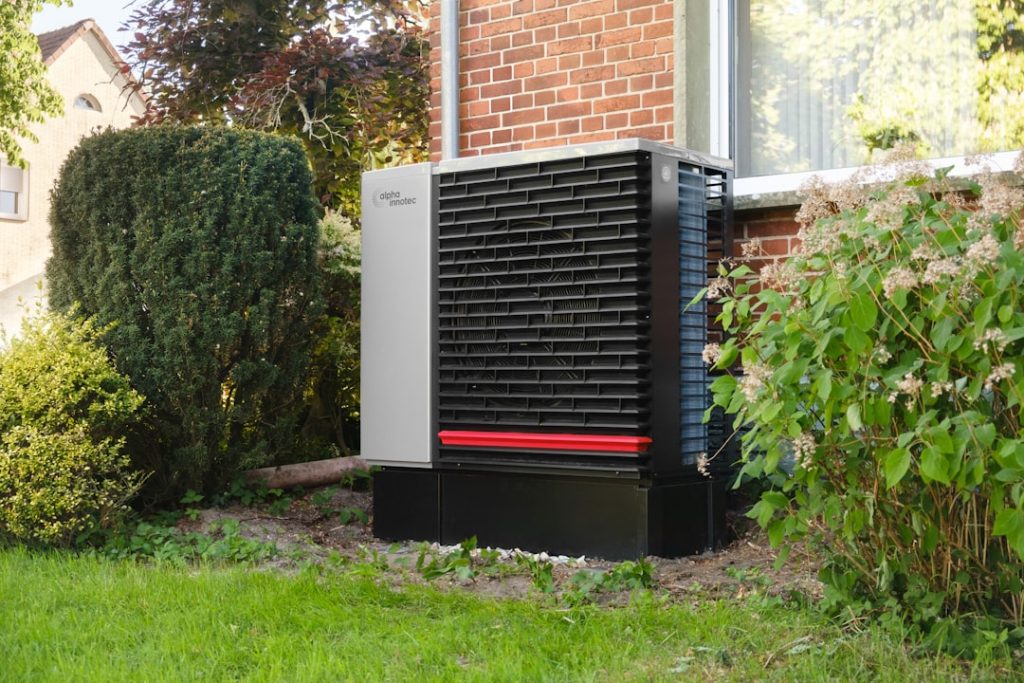
Is Your Heat Pump Not Heating? Start Here
Heat pump not heating your home is one of the most common cold-weather complaints we hear from New England homeowners — and the good news is that most causes are fixable, often without a service call.
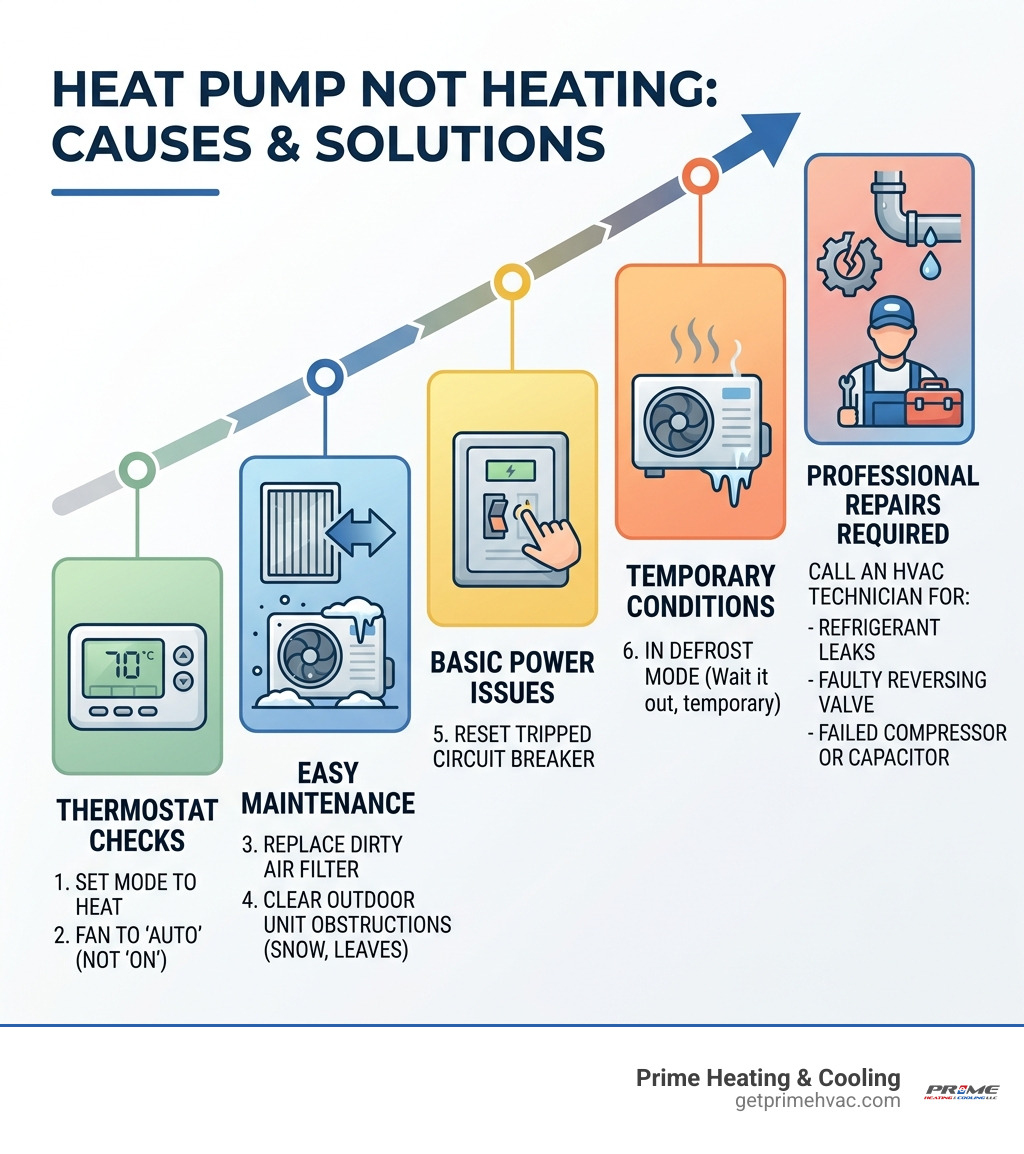
Here are the most common reasons your heat pump isn’t heating, ranked from easiest to hardest to fix:
| Cause | DIY Fix? |
|---|---|
| Thermostat set to COOL or fan set to ON | Yes |
| Tripped circuit breaker | Yes |
| Dirty air filter blocking airflow | Yes |
| Outdoor unit iced over or blocked by debris | Partial |
| Heat pump in defrost mode (temporary) | Wait it out |
| Low refrigerant from a leak | No — call a pro |
| Faulty reversing valve | No — call a pro |
| Failed compressor or capacitor | No — call a pro |
Before you panic, start at the top of that list. A surprising number of “broken” heat pumps are just thermostats accidentally bumped to the wrong mode.
Heat pumps work differently than gas furnaces. They move heat from outside air into your home rather than generating it through combustion. That means the air from your vents typically feels warm — around 85 to 93°F — not blazing hot. If your home is slowly reaching the temperature you set, your system may actually be working fine.
But if your heat pump is running constantly without warming your home, blowing cold air, or not turning on at all? That’s a real problem worth diagnosing.
I’m Tyler Steiner, CEO and founder of Prime Heating & Cooling, and I’ve spent years helping Rhode Island and Massachusetts homeowners troubleshoot heat pump not heating issues across every make, model, and New England winter condition imaginable. In this guide, I’ll walk you through exactly what to check — and when to call for backup.
Related content about Heat pump not heating:
Understanding Why Your Heat Pump Is Not Heating

It is May 2026, and while we are heading toward warmer months, the lessons from the past winter in Rhode Island remain fresh. Many homeowners in Johnston, Scituate, and Warwick found themselves staring at their vents, wondering why the air felt “lukewarm” at best.
The first thing to understand is that a heat pump is a “heat mover,” not a “heat maker.” Unlike a furnace that burns fuel to create a 120°F+ blast of air, a heat pump extracts heat from the outside air (even when it’s cold!) and brings it inside.
Because the air coming out of your vents is usually between 85 and 95°F, and your body temperature is 98.6°F, that air can actually feel cool to the touch. This leads many to believe they have a heat pump not heating correctly when, in reality, the system is just operating within its design. However, if your home isn’t reaching the set temperature, or the air is truly cold, it’s time to dig deeper. According to Common Reasons for Your Heat Pump Not Heating – Trane®, understanding this temperature difference is the first step in troubleshooting.
How Heat Pumps Work in Heating Mode
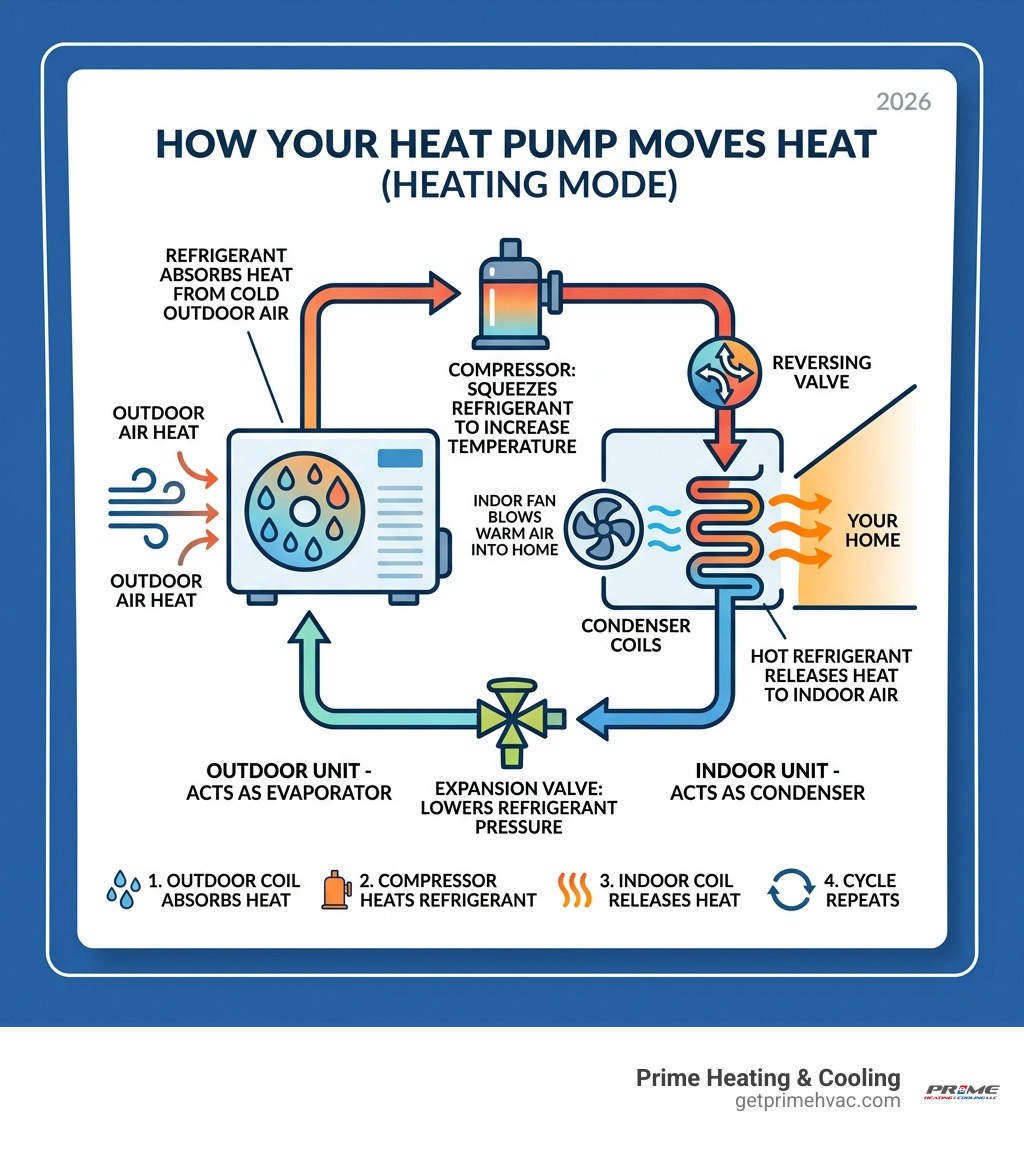
To fix the problem, you need to know how the “magic” happens. In heating mode, the system uses a reversing valve to switch the direction of the refrigerant.
- The outdoor unit acts as an evaporator, absorbing thermal energy from the outdoor air.
- The compressor squeezes that refrigerant, raising its temperature significantly.
- The hot refrigerant travels to the indoor condenser coil.
- The indoor fan blows air across these hot coils, carrying the heat into your living room.
If any part of this cycle—the extraction, the compression, or the distribution—is interrupted, you end up with a heat pump not heating.
Common Reasons for a Heat Pump Not Heating
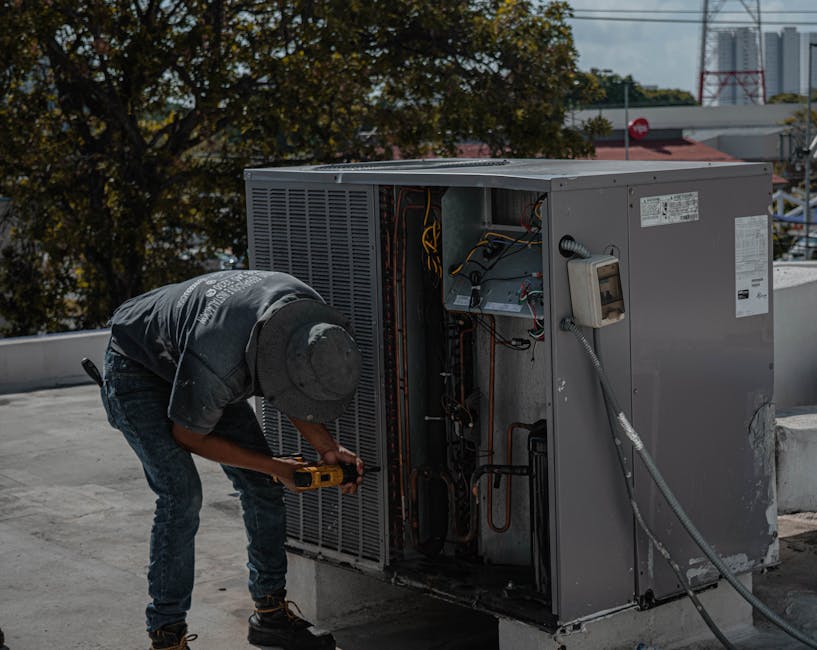
When we get a call in Smithfield or North Providence for a system failure, we always start with the basics. You’d be surprised how often a “major breakdown” is actually a minor oversight. If you are dealing with a ductless system, you might also want to consult The Ultimate Guide To Ductless Mini Split Heat Pump Installation to see if your unit’s specific setup is contributing to the issue.
Troubleshooting a Heat Pump Not Heating at Home
Before calling us at Prime Heating & Cooling, run through this quick DIY checklist:
- Check the Thermostat: Is it actually in “HEAT” mode? Sometimes during the fluctuating New England spring or fall, someone switches it to “COOL” or “OFF” and forgets.
- The “AUTO” Fan Setting: Ensure your fan is set to “AUTO” rather than “ON.” If it’s set to “ON,” the fan will blow air even when the heat pump isn’t actively heating, making the air feel cold.
- Power Supply: Check your electrical panel for a tripped circuit breaker. Heat pumps have two: one for the indoor unit and one for the outdoor unit. If the indoor unit power switch (often looking like a light switch near the air handler) is off, the whole system stops.
- Batteries: If your thermostat screen is blank or fading, replace the batteries. A weak signal can prevent the system from engaging.
For more detailed steps, you can refer to general HVAC Troubleshooting Steps – Fraser-Johnston.
The Role of Airflow and Dirty Filters
Airflow is the lifeblood of your HVAC system. A heat pump not heating is frequently the victim of a clogged air filter.
- The 30-60 Day Rule: In Rhode Island winters, we recommend checking your filter every month. A dirty filter suffocates the indoor coil, causing the system to work harder, lose efficiency, and eventually trigger an emergency shutoff to prevent the compressor from overheating.
- Static Pressure: When air can’t move freely, “static pressure” builds up. This can lead to the system short-cycling (turning on and off rapidly) without ever actually warming the house.
Outdoor Unit Issues: Ice, Debris, and Defrost Cycles
Living in the Northeast means dealing with snow, ice, and frozen rain. Your outdoor unit is tough, but it isn’t invincible. For a deeper dive into surviving our local winters, check out The Cold Climate Heat Pump Survival Guide.
Managing a Frozen Heat Pump Not Heating
It is perfectly normal to see a light coating of frost on your outdoor unit. When this happens, the system enters Defrost Mode.
- The Defrost Cycle: The unit temporarily reverses itself to send warm refrigerant to the outdoor coils to melt the ice. You might see steam rising or hear a “whooshing” sound. This usually lasts 10-15 minutes.
- When It’s a Problem: If the unit is encased in a block of ice and the defrost cycle isn’t clearing it, you have a problem. This is often caused by a faulty defrost control board, a bad sensor, or low refrigerant.
- Clearance: Ensure you have at least a 2-foot clearance around the unit. Clear away snow drifts, fallen leaves, or overgrown vegetation that might be “smothering” the unit.
If the icing persists, it’s a sign of a deeper mechanical issue, as noted in Heat Pump Not Heating: Causes, Troubleshooting, and Quick Fixes.
When to Use Emergency or Auxiliary Heat
Most heat pumps have auxiliary heat (usually electric resistance strips) that kicks in when the temperature drops below a certain point—typically around 25-30°F for older models.
- Emergency Heat Mode: You should only switch your thermostat to “EM Heat” manually if your heat pump has actually failed. It is much more expensive to run than the heat pump itself.
- Relay Failure: If your auxiliary heat isn’t coming on during a cold snap, you might have a failed sequencer or relay, leaving you with a heat pump not heating when you need it most.
Advanced Mechanical Failures and Professional Repairs
Sometimes, DIY fixes aren’t enough. If you’ve checked the filters and the breakers and you’re still shivering in Lincoln or Coventry, it’s likely a mechanical failure. If you are considering a new system altogether, our Ultimate Checklist For Heat Pump Installation can help you prepare.
Identifying Low Refrigerant and Valve Issues
Refrigerant is not “fuel”—it doesn’t get used up. If it’s low, you have a leak.
- The 95% Rule: Statistics show that 95% of low refrigerant cases in heat pumps stem from leaks rather than normal consumption. Signs include hissing sounds or liquid pooling near the unit.
- The Reversing Valve: This is the “brain” of the operation. If it gets stuck, your system might be stuck in “cooling mode” only. If your heat pump blows cold air even when the thermostat is set to heat, this valve is a prime suspect.
- EPA Certification: Handling refrigerant requires specialized tools and EPA certification. This is never a DIY job.
Repair vs. Replacement: The 50% Rule
How do you know when to stop repairing and start replacing? Most heat pumps live 12-15 years with proper care. We often suggest the “50% Rule”: if the cost of the repair is 50% or more of the value of a new system, it’s time to upgrade.
| Factor | Repair | Replace |
|---|---|---|
| Age | Under 10 years | Over 12-15 years |
| Repair Frequency | First time in years | Multiple times per season |
| Energy Bills | Stable | Skyrocketing |
| Efficiency | System is SEER 14+ | System is old and inefficient |
For a better understanding of what a new setup might look like, see The Price Of Comfort Unpacking Ducted Heat Pump Installation Costs.
Frequently Asked Questions About Heat Pump Failures
Why is my heat pump blowing cold air when set to heat?
There are four common culprits:
- Defrost Mode: The system is temporarily blowing cold air inside while it melts ice outside.
- Thermostat Setting: The fan is set to “ON” instead of “AUTO.”
- Reversing Valve: The valve is stuck in the cooling position.
- Low Refrigerant: There isn’t enough “juice” to carry heat indoors.
Is it normal for heat pump air to feel lukewarm?
Yes! As mentioned, heat pump air is typically 85-95°F. While this is much warmer than the room temperature (usually 68-70°F), it is cooler than your body temperature, making it feel “lukewarm” compared to the 130°F air from a gas furnace. As long as your home is reaching the set temperature, the system is doing its job.
What are the signs I need professional heat pump repair?
- Grinding or Screeching: This indicates a motor bearing failure or a damaged compressor.
- Persistent Icing: If the outdoor unit stays frozen even in milder temperatures.
- The “Emergency” Bill: If your electric bill suddenly doubles, your heat pump might be failing, forcing the expensive auxiliary heat to do all the work.
- Short-Cycling: If the system turns on and off every few minutes.
Conclusion
A heat pump not heating doesn’t always mean a total system replacement. Often, it’s a simple matter of a dirty filter, a tripped breaker, or just the system doing its normal defrosting thing. However, in the harsh climate of Rhode Island—from the East Side of Providence to North Scituate—your system takes a beating.
The best way to prevent these “no-heat” emergencies is through annual maintenance. At Prime Heating & Cooling, we bring 20 years of experience to every home in Rhode Island. Whether you need a quick repair in East Greenwich or a full system installation in Johnston, our skilled technicians are available 24/7 to ensure your home stays comfortable.
Don’t wait for the next cold snap to realize your system is struggling. More info about Rhode Island HVAC services is just a click away. Let us help you keep the “heat” in your heat pump!


