
When Your Boiler PRV Leaks: What You Actually Need to Know
Boiler pressure relief valve repair is one of those topics where the answer is almost always the same: don’t repair it — replace it.
Here’s a quick breakdown of what that means for you:
- A leaking PRV is a safety issue, not just a nuisance — it protects your boiler from dangerous over-pressurization
- Repair is rarely an option — PRVs are safety-critical components that should be replaced when faulty
- DIY replacement is possible for homeowners with basic plumbing experience, but requires careful preparation
- If your PRV is dripping, hissing, or corroded, it’s time to act — don’t ignore it or try to seal it
The bottom line: a faulty PRV should be replaced promptly. Attempting to patch or seal it can create a hazardous situation.
Your boiler’s PRV is its last line of defense against excess pressure. When water heats up, it expands — and that pressure has to go somewhere. The PRV releases it safely. When the valve fails, that protection disappears.
I’m Tyler Steiner, CEO and founder of Prime Heating & Cooling, and boiler pressure relief valve repair and replacement is something my team handles regularly across Rhode Island and Massachusetts. In this guide, I’ll walk you through exactly what to do — and what to avoid — when your PRV starts giving you trouble.
Key terms for boiler pressure relief valve repair:
Why Boiler Pressure Relief Valve Repair Usually Means Replacement
When we talk about boiler pressure relief valve repair, the term “repair” is a bit of a misnomer. In the HVAC world, safety-critical components like the PRV are designed to be swapped out, not patched up.
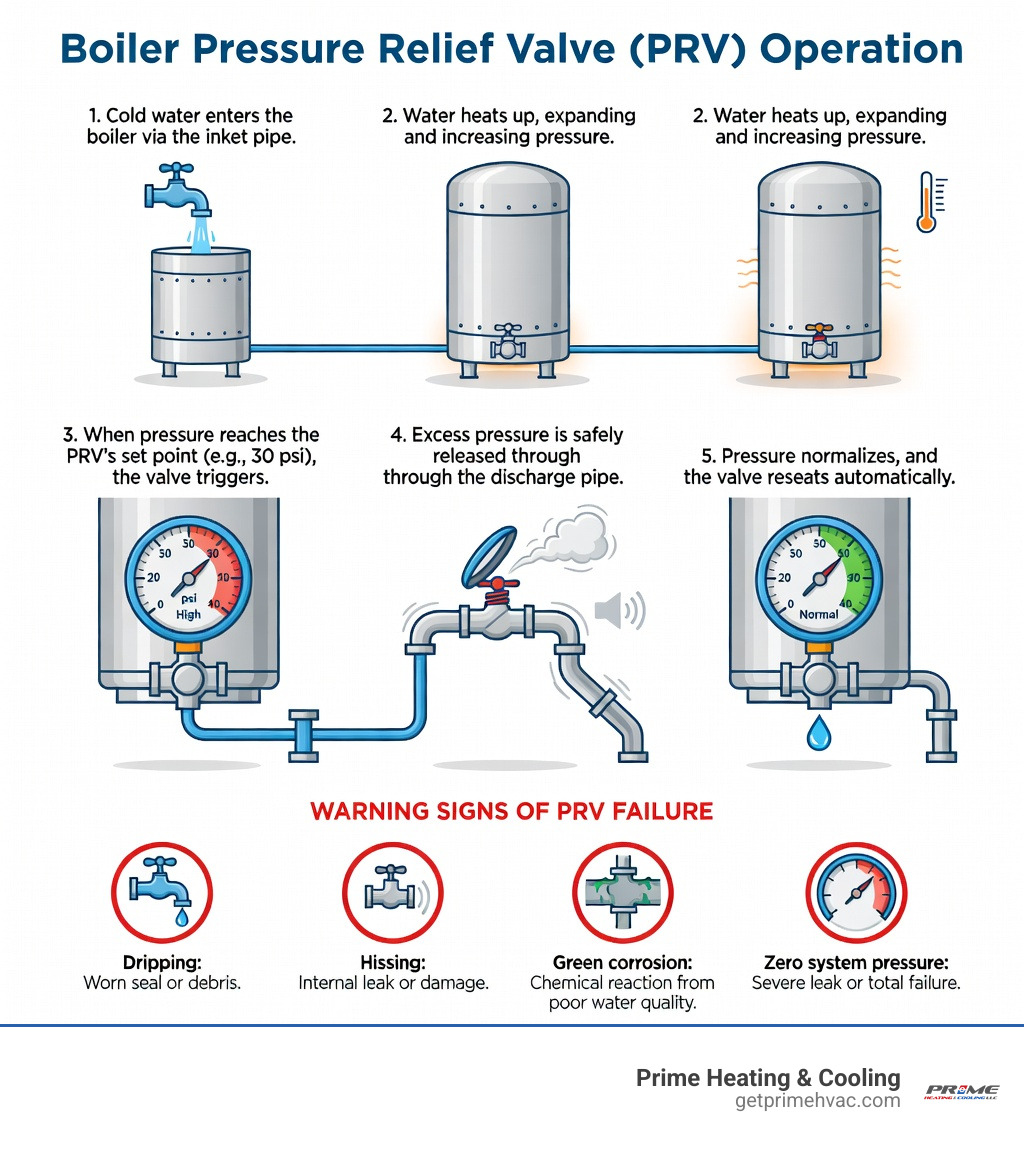
Think of the PRV as the emergency brake on your car. You wouldn’t want to “repair” a snapped cable with a piece of duct tape; you’d replace the cable to ensure it works when you truly need it. The same logic applies to your boiler. These valves are engineered to open at a specific pressure (usually 30 PSI for residential water boilers) to prevent the system from exploding.

The primary reasons a valve fails are internal. Over time, calcium buildup and mineral deposits from your home’s water supply accumulate on the valve’s seat. This prevents the internal diaphragm from closing tightly, leading to a persistent drip. Once those minerals have hardened, no amount of cleaning can reliably restore the factory-calibrated seal.
Furthermore, professional standards like those set by ASME (American Society of Mechanical Engineers) and the National Board of Boiler and Pressure Vessel Inspectors emphasize that safety valves should be maintained in peak condition. For industrial settings, a “VR Stamp” is required for repairs, which involves a rigorous recertification process. For residential homeowners in Rhode Island, it is significantly safer and more cost-effective to simply install a brand-new, factory-tested unit.
| Feature | Repairing an Old PRV | Replacing with a New PRV |
|---|---|---|
| Safety Level | Low (High risk of failure) | Maximum (Factory calibrated) |
| Reliability | Temporary fix at best | Long-term peace of mind |
| Cost | Labor intensive, parts unavailable | Affordable and efficient |
| Compliance | Likely violates local codes | Meets ASME/Manufacturer standards |
Identifying Signs You Need Boiler Pressure Relief Valve Repair
How do you know if your valve is actually failing or if something else is wrong with your boiler? In our 20 years of experience serving areas like Johnston, Warwick, and East Greenwich, we’ve found that the symptoms are usually quite visible if you know where to look.
- The Persistent Drip: If you see a bucket under your discharge pipe that needs emptying every day, the valve has lost its seal. Even a slow drip indicates that the internal spring or diaphragm is compromised.
- Hissing Sounds: A faint hissing sound near the valve suggests that steam or high-pressure water is escaping. This often happens when the valve is “simmering”—stuck somewhere between open and closed.
- Green Copper Oxide (Corrosion): If the exterior of the valve or the connecting nut looks like the Statue of Liberty (crusty and green), it means water has been leaking and evaporating for a long time. This corrosion can eventually seize the valve shut, which is the most dangerous failure mode.
- Zero System Pressure: If your boiler’s pressure gauge is reading zero but you still have heat, the valve might be leaking so much water that the system can’t maintain pressure.
- Water on the Floor: If the PRV fully “blows” due to an over-pressure event, it can dump 5 to 10 gallons of water in just 20 seconds. If you find a massive puddle, the valve did its job, but it may now be stuck open by sediment.
If you are noticing these issues, check out our boiler installation and repair services to see how we can help restore your system’s integrity.
The Risks of DIY Boiler Pressure Relief Valve Repair
We love a good DIY project as much as anyone, but boiler pressure relief valve repair carries unique risks. This isn’t like fixing a leaky kitchen faucet.
- Scalding Risk: Boilers operate at high temperatures. If you attempt to remove a valve while the system is hot or pressurized, you risk a “flash steam” explosion that can cause severe burns.
- Explosion Hazard: The most dangerous mistake a homeowner can make is plugging a leaking PRV with a cap or a bolt. If you seal the leak without replacing the valve, the pressure in the boiler will continue to rise with nowhere to go. This turns your boiler into a potential bomb.
- Backpressure Issues: If the discharge pipe is installed incorrectly or is too small, it can create backpressure that prevents the valve from opening when it needs to.
When researching DIY fixes, you might come across various forums or sites. It’s always a good idea to understand the terms of service and privacy policy of any platform where you solicit technical advice, as incorrect internet advice can lead to dangerous outcomes in the mechanical room.
Step-by-Step Guide to Replacing a Faulty PRV
If you have decided that you are comfortable with basic plumbing and want to tackle the replacement yourself, follow this guide carefully. We are replacing the valve, not attempting to take the old one apart.
Before you start, ensure you have an identical replacement part. Check the tag on your current valve for the PSI rating (usually 30 PSI) and the BTU/hr rating. These must match exactly. While you are working on your boiler, it’s also a great time to check other components; you can learn more about air vent replacement to keep your system running quietly.
Preparation and Safety Precautions
Safety is our number one priority at Prime Heating & Cooling. Before you touch a single pipe wrench, follow these steps:
- Kill the Power: Turn off the electrical switch at the boiler and flip the dedicated circuit breaker. You don’t want the boiler firing up while it’s empty.
- Isolate the Water: Close the cold water feed valve (the “fill valve”) that supplies water to the boiler.
- Let it Cool: This is the hardest part—waiting. The water inside can be 180°F or higher. Wait at least 2–4 hours until the pipes are cool to the touch.
- Check the Gauge: Ensure the pressure gauge on the boiler reads zero before you start loosening any fittings.
If this sounds overwhelming, don’t worry. We have a guide on how to get boiler repair in three easy steps to help you navigate the professional route.
Tools and Materials for the Job
Gather these items before you begin so you aren’t left with a disassembled boiler and a closed hardware store:
- Replacement PRV: Must match the original specifications.
- Two Large Pipe Wrenches: One to turn the valve, one to “back up” the pipe so you don’t snap a fitting off the boiler.
- PTFE Tape (Plumber’s Tape): For sealing the threads.
- Bucket and Towels: To catch the inevitable remaining water in the lines.
- Wire Brush: To clean the threads on the boiler fitting.
- Radiator Key: To bleed air out of the system later.
The Replacement Process
- Drain the System: Locate the drain valve at the bottom of the boiler. Attach a garden hose and drain the water until the pressure gauge hits zero. You don’t need to drain the whole house, just enough to get the water level below the PRV.
- Remove the Discharge Pipe: Most PRVs have a copper pipe that runs toward the floor. Disconnect this first.
- Remove the Old Valve: Use one wrench to hold the boiler pipe steady and the other to unscrew the valve counter-clockwise.
- Clean the Fittings: Use your wire brush to remove any old tape or crusty mineral deposits from the boiler’s female threads.
- Apply PTFE Tape: Wrap the tape clockwise around the threads of the new valve. 3 to 4 wraps is usually sufficient. Avoid taping the bottom two threads to prevent tape from breaking off and entering the system.
- Install the New Valve: Thread it in by hand first to avoid cross-threading. Once snug, use your wrenches to tighten it another 1 to 2 turns until the outlet is pointing in the correct direction (usually down).
- Reconnect the Discharge Pipe: Ensure this pipe is not restricted and ends 6 inches above the floor.
- Refill and Bleed: Open the water feed valve. As the system fills, go to your radiators and use the radiator key to bleed out trapped air.
- Restore Power: Once the system is back to its operating pressure (usually around 12–15 PSI cold), turn the power back on.
When to Call Prime Heating & Cooling for Professional Help
While a DIY replacement is possible, many homeowners in North Providence, Smithfield, and Lincoln prefer the peace of mind that comes with professional service.
Boiler pressure relief valve repair often uncovers other issues. For instance, if your PRV was leaking, it might be because your expansion tank has failed. When an expansion tank loses its air cushion, the pressure spikes every time the boiler turns on, forcing the PRV to open. If you replace the valve but the tank is bad, the new valve will start leaking within days.
At Prime Heating & Cooling, we bring 20 years of experience to every job. We don’t just swap parts; we diagnose the root cause to ensure your system is as energy-efficient as possible. We offer 24/7 availability for those middle-of-the-night plumbing emergencies and serve the entire Rhode Island area, from Coventry to the East Side of Providence.
If your boiler is acting up, don’t wait for a flood. Contact us for expert boiler installation and repair services today. We’ll make sure your home stays warm and your family stays safe.